Get Full Government Meeting Transcripts, Videos, & Alerts Forever!
Get email alerts on the Legislative Priorities topic
No spam. Unsubscribe anytime.
Maplewood reviews 2026 legislative priorities, pushes $5.3 million bonding ask for training facility
Summary
City Manager Mr. Sable presented Maplewood’s proposed 2026 legislative program, highlighting a TIF amendment that freed roughly $1 million for redevelopment, a $5.3 million bonding request for an East Metro Public Safety Training Facility, and renewed calls for ambulance‑reimbursement changes and housing protections.
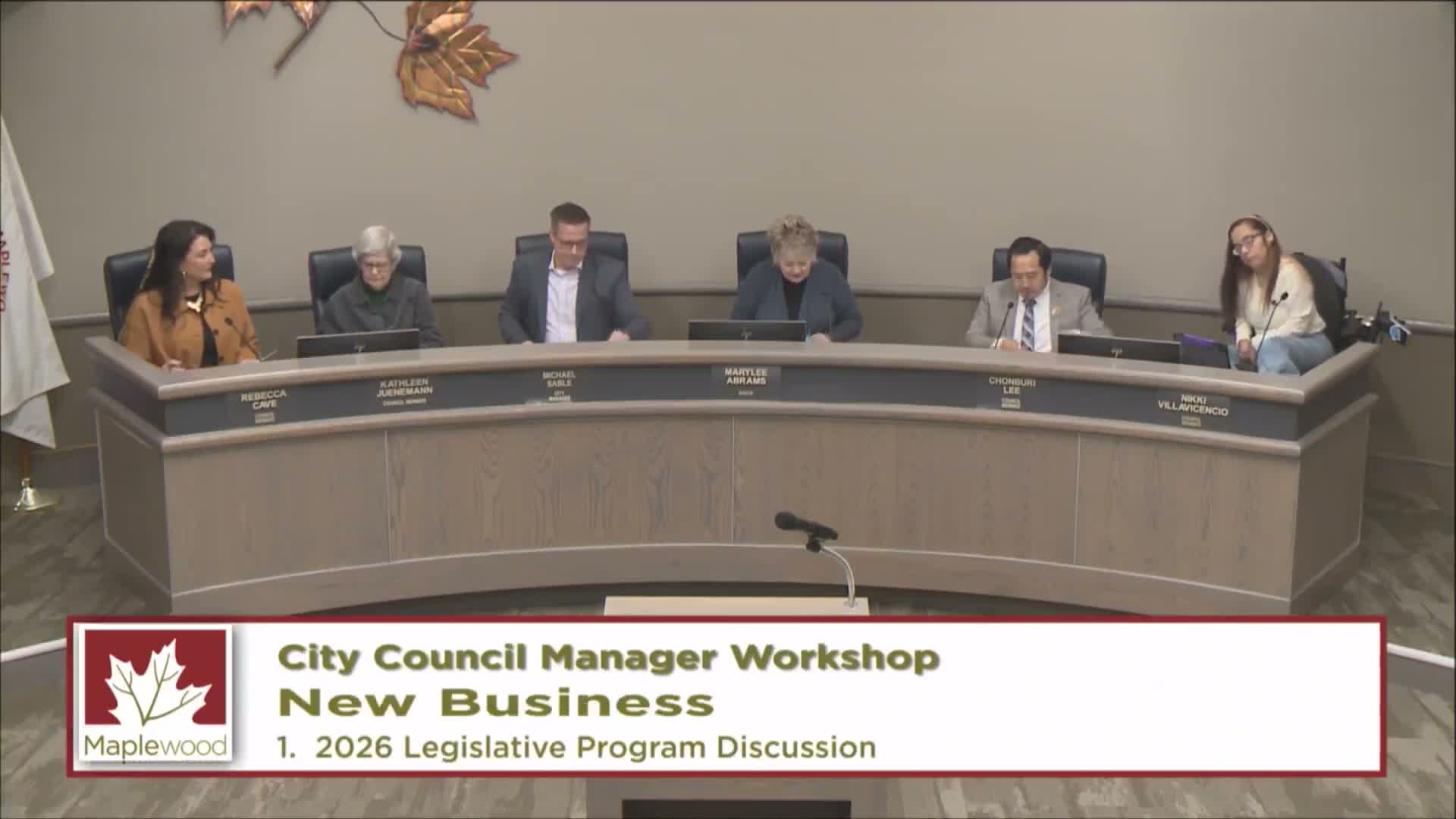
Maplewood staff asked the City Council on Jan. 26 to finalize a short 2026 legislative program that city officials plan to share with state legislators at a Wednesday delegation meeting. Mr. Sable, who led the presentation, said the program is intended to give the city’s delegation a concise picture of Maplewood priorities.
“[Last year] it freed up more than 1000000 dollars in redevelopment dollars that we could use to, enhance economic development opportunities,” Mr. Sable said, referencing a legislative amendment that allowed pooled tax‑increment financing to be applied to the North End. He also said the city has submitted a bonding request for the East Metro Public Safety Training Facility and asked the council to consider amending that request to $5,300,000 to cover design, parking, stormwater and utilities.
Council members raised several policy areas for the program. Councilmember Cave asked whether housing and economic development priorities from 2025 should simply roll forward; Mr. Sable described the conversation as open and adaptable and suggested staff could reword or add items to reflect current needs. On housing, staff emphasized protecting local zoning authority from proposed state preemption and securing resources for deeply affordable units.
Public safety funding was a focal point. Councilmembers pressed for progress on ambulance reimbursement and the city’s ambulance fund; Mr. Sable said reimbursement‑rate changes have not taken effect and that staff continue to advocate for dedicated funding streams. “The legislature set aside $6,000,000 for, to bolster ambulance services, but they only gave the money to Greater Minnesota,” he said, noting the city will ask for more targeted language to address ambulance reimbursement in the legislative program.
Staff also recommended including transportation and multimodal investments — such as funding for arterial bus rapid transit and last‑mile connections — and keeping transit funding priorities in front of regional partners and the Metropolitan Council. On economic development, community development staff said they are developing a business subsidy program for EDA consideration and will coordinate with county and regional grant programs to avoid overlap.
The council asked staff to add local‑option sales tax as a clear priority in the draft and signaled support for amendments to reflect council direction. The council did not take a final vote on the legislative program at the workshop; staff said the packet will be edited and the council will be asked to adopt the program at the formal council meeting.
Next steps: staff will finalize edits before the delegation meeting, incorporate council input (including potential language on ambulance reimbursement and local‑option sales tax), and return the program for formal adoption.