Get Full Government Meeting Transcripts, Videos, & Alerts Forever!
Get email alerts on the Local Option Sales Tax topic
No spam. Unsubscribe anytime.
Maplewood council weighs local-option sales tax to fund Community Center, public safety training facility
Summary
At a Jan. 12 manager workshop, Maplewood staff and a consultant outlined what seeking state permission for a local-option sales tax would involve, estimating a 1.5-cent tax could raise about $4.5 million annually and support up to roughly $83.6 million in borrowing; councilors prioritized a public safety training facility and a redesigned community center while staff prepares options ahead of a Jan. 31 legislative notice deadline.
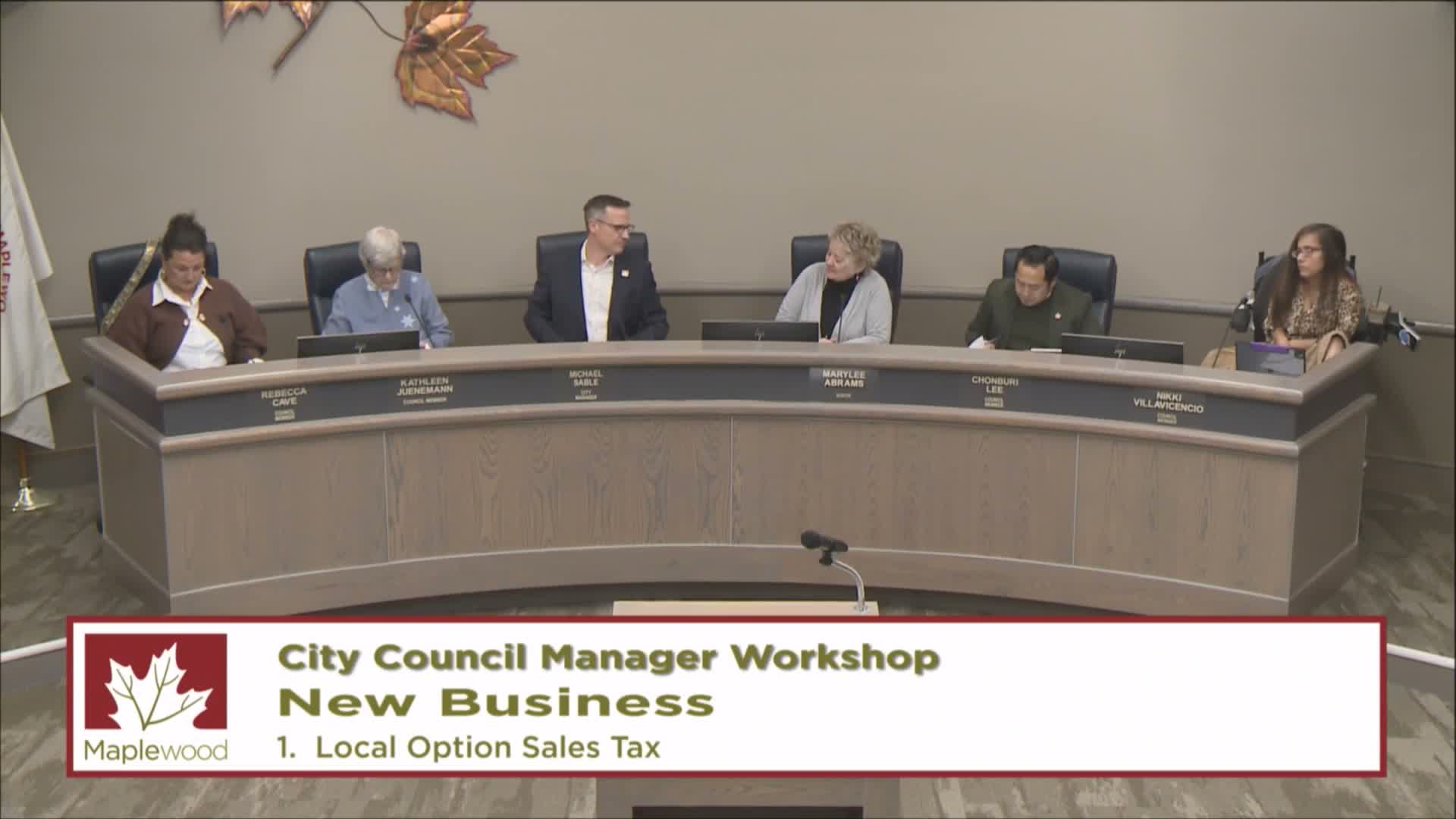
Maplewood leaders spent the Jan. 12 manager workshop discussing whether to seek state authorization for a local-option sales tax that could help pay for aging facilities and new projects.
City Manager Sable told the council the packet included a University of Minnesota analysis estimating a 1.5-cent sales tax would generate about $4.5 million a year within Maplewood and that roughly 60% of that revenue would come from nonresidents who shop in the city. An Ehlers and Associates borrowing analysis in the packet suggested the city could reasonably expect roughly $83,590,000 in bond proceeds depending on assumptions about interest rates and coverage factors.
"We have been talking about some of the infrastructure in the community that is aging and in need of repair," Sable said, summarizing an engineering and architectural study of the Maplewood Community Center that estimated about $20,000,000 to bring the building to a modern standard over a 10-year horizon. Sable added the city has to decide quickly: the chairs and ranking members of the state tax committees must be notified by Jan. 31 if Maplewood intends to pursue authorization.
Consultant Todd Stone of RAP Strategies, who has worked on roughly two dozen local sales-tax referenda, told the council that campaigns commonly fail for three reasons: residents do not understand the proposal, voters object to the price point or timing, and local leaders do not maintain sustained public engagement. "Invite the public to be a part of that visioning process," Stone said, urging clear communication about regional benefits and project specifics.
Mayor Abrams and several council members identified two near-term priorities: expanding the East Metro Public Safety Training Facility and rethinking the Maplewood Community Center. Abrams cited a previously discussed total cost of about $35,000,000 for the public safety facility and said a city match of roughly $17,000,000 would demonstrate local commitment and make legislative partners more likely to support the project.
"That certainly is a project that, if that's going to happen, then we are going to have to come up with $17,000,000," the mayor said, adding that the city already owns suitable property and that a regional training asset could be scheduled for partner agencies under a new operating agreement. Sable said the existing East Metro facility is run under a joint powers agreement with neighboring cities and that at least 27 agencies use the site; staff reported letters of support have been submitted to the legislature.
On the Community Center, councilors agreed the $20,000,000 maintenance-only estimate would leave the city with essentially the same building. Several members urged a broader redesign or repurposing so the center better serves residents. "We could come up with a completely redesigned community center that would live into the future," Mayor Abrams said.
Council members also discussed alternatives, including investing in new park buildings and better trail connectivity to serve South Maplewood residents. Sable noted back-of-envelope figures comparing the Wakefield park building (about 3,400 sq ft, built for roughly $2.9 million) and the existing Nature Center (about 3,000 sq ft) and estimated a Wakefield-like building today might cost about $4 million; two such park projects could be roughly $8 million.
On procurement and next steps, Sable said the council authorized staff in December to hire an architectural firm (identified in staff materials as LSE). The firm is scheduled to begin work the week after the meeting and will interview each council member, run trend analyses and deliver preliminary cost options by April. Sable said staff and the city's lobbyist are drafting bill language and that a written summary of options will be posted on the city's website and emailed to stakeholders. The council is scheduled to revisit the matter on Jan. 26; staff said it will meet the Jan. 31 legislative notification deadline if the council instructs it to proceed.
No formal authorization to submit a request to the legislature or to place a sales-tax question on the ballot was recorded at the workshop; the session concluded with staff tasked to provide a range of options and cost estimates for further council consideration.
The council adjourned the manager workshop and planned to reconvene for the regular council meeting five minutes later.