Get Full Government Meeting Transcripts, Videos, & Alerts Forever!
Get email alerts on the Climate Mitigation topic
No spam. Unsubscribe anytime.
Maplewood reviews draft climate mitigation plan with interim 2036 target and net‑zero 2050 goal
Summary
City staff and consultant presented a draft Climate Mitigation Plan that frames interim targets to cut greenhouse gas emissions about 46% below 2013 levels by 2036 and a long‑term net‑zero goal by 2050; staff will seek public comment through the review site and return a final draft this spring.
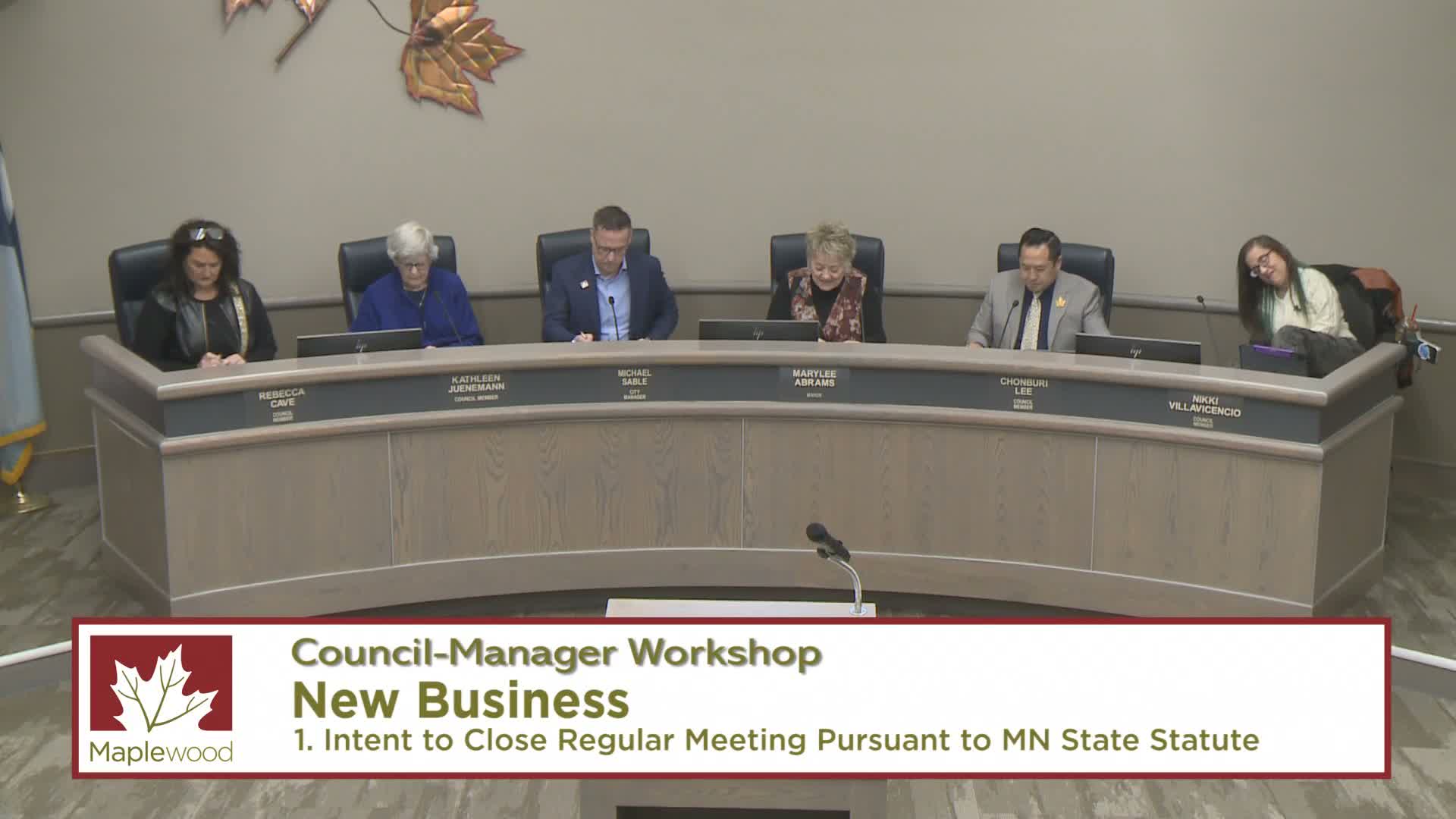
Maplewood officials reviewed a draft Climate Mitigation Plan at a council workshop after moving briefly into closed session to conduct the city manager’s annual evaluation.
Consultant Ted Redmond of Pale Blue Dot told the council the draft grew from two years of baseline research, a greenhouse‑gas inventory and more than 175 community engagement participants, and was refined by a volunteer collaborative planning team. "This plan will provide a roadmap for achieving meaningful emission reductions through 2036 in support of that long term vision," Redmond said.
The plan uses a 2013 inventory baseline, Redmond said, and proposes an interim target to reduce community greenhouse gas emissions roughly 46% below 2013 levels by 2036 and a long‑term goal of net‑zero emissions by 2050. Redmond said the 2013 baseline and the plan’s targets align with the state of Minnesota, the Metropolitan Council and Ramsey County.
Redmond described three sector strategies: transportation, buildings and energy, and waste management. He said transportation measures aim to cut about 46% of that sector’s emissions by reducing vehicle miles traveled, increasing transit use, expanding electric vehicle adoption and encouraging appropriate infill density. On buildings and energy, the plan emphasizes increasing both distributed (for example, rooftop solar) and purchased renewable energy, energy‑efficiency upgrades and fuel‑switching away from on‑site fossil fuels. For waste, the plan targets about a 13% reduction through waste prevention, increased organics diversion and higher recycling rates; Redmond pointed to Ramsey County’s green‑bag organics program as a leading example.
Redmond presented a high‑level estimate of cumulative costs and benefits for actions the plan can quantify and said the analysis includes avoided social‑cost‑of‑carbon values; the consultant cited a multi‑year cumulative savings figure in the plan’s illustrative analysis (transcript: "about a 180,000,000"). He cautioned the projections are approximations that assume achieving the stated goals over time.
On implementation, Redmond said staff would build annual implementation plans tied to the city’s Capital Improvement Program, identify staffing and funding needs and report progress each year. The draft plan is on a public review site with targeted comment forms; Redmond said the public review will remain open through April 1 and that staff expect to bring the draft to the Environmental, Natural Resources and Climate (ENRC) committee on May 13 and back to council in early June (date in transcript garbled).
Council members asked several practical questions. The mayor asked why the draft did not explicitly include a car‑sharing strategy at the Maplewood Transit Center; Redmond replied that car sharing had been discussed but was omitted because of uncertainty about implementing a Maplewood‑only program and suggested a regional or county partnership could enable it. "I think it could be in association with something like that, where we've got sort of a partnership that extends beyond Maplewood," he said.
Councilmember Villavicencio asked whether the plan includes policies to incentivize transit use—such as employer parking cash‑out or employer transit benefits—and Redmond said those specific employer incentives are not currently in the draft but could be explored and refined. Councilmember Keith asked how the plan would coordinate with regional transit projects such as the Bronze Line; Redmond said the plan is aligned with Met Council goals and recommended staff‑level coordination and periodic joint implementation meetings.
Councilmember Lee and staff emphasized that the plan is meant to be a living document; staff (S8) said annual refreshes tied to the CIP would allow the city to adapt to new technologies and opportunities and that communications and education actions are included to help residents find relevant steps they can take. City Manager Michael Sabol noted the city has a small, dedicated franchise‑fee funding stream that can support some projects and stressed that partnerships will be important to amplify local action.
The consultant and staff asked the council for feedback during the public review period and outlined next steps for collecting comments and returning a final draft. The council did not take a formal vote on adoption at the workshop stage.
Sources: presentation and Q&A with Ted Redmond (Pale Blue Dot), staff and city manager in Maplewood City Council workshop.
The council’s earlier procedural action to close the open meeting for the city manager’s annual evaluation was taken under Minnesota Statute 13D.05, subd. 3A; the council signaled assent and entered closed session before resuming the workshop.