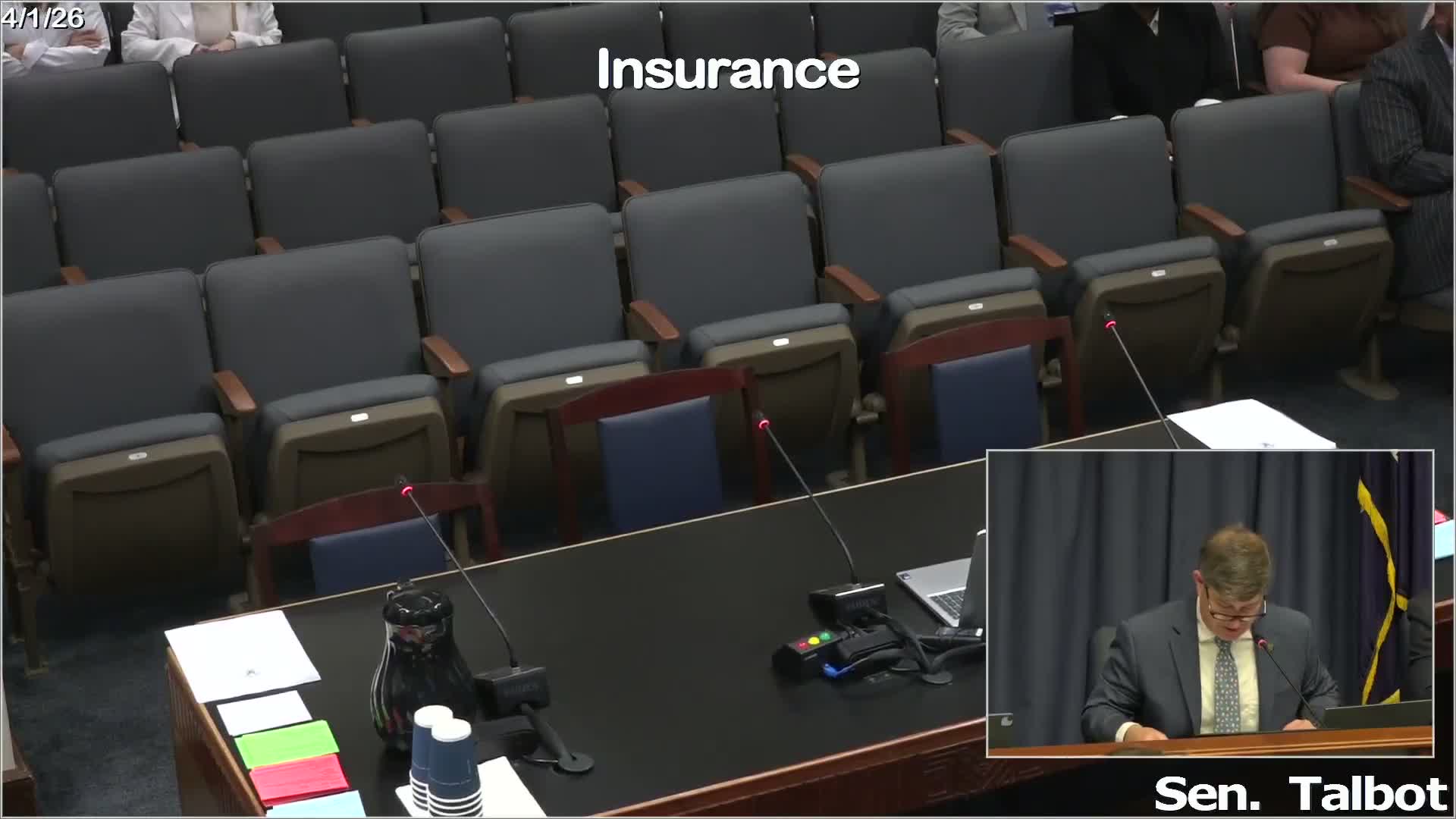
Senate Committee advances bill to create Prescription Drug Affordability Board after lengthy public debate
Loading...
Summary
The Senate Insurance Committee reported SB401 as amended on April 1, 2026. Sponsors said the board will gather manufacturer pricing data and recommend whether costs are justified; patient advocates warned the information could later be used to restrict access. A sunset and proprietary-data protections were added.
The Senate Insurance Committee advanced Senate Bill 401 as amended on April 1, a transparency measure to create a Prescription Drug Affordability Board that would gather manufacturer pricing and market information to help lawmakers evaluate whether prescription drugs available in Louisiana are priced appropriately.
Chairman Talbot, the bill’s sponsor, told the committee the board is an information‑gathering body that would not have authority to set price ceilings: “This bill does not set an upper price limit… We also do not give the board any authority to set prices for drugs,” he said, adding the panel will cover who sits on the board and how proprietary materials are handled.
The bill, as amended in committee, sets board membership to include the insurance commissioner or designee, the health department secretary or designee, the Board of Pharmacy president or designee, and public members appointed by the governor and legislative leaders. The board must meet at least four times a year and develop a list of critical drugs to analyze using factors that include Medicaid costs, current in‑state prices, availability of therapeutically equivalent alternatives and measures of clinical outcomes.
Patient advocates provided much of the morning’s testimony. Pharmacist and patient Steven Lee, who said, “My medicine’s roughly $130,000 a month,” urged caution: he said he supports transparency but worried about “what happens with this information” and the potential for future policies that could narrow patient access. Amanda Mitchell, a mother of two with complex conditions, said patients are not currently represented on the body and asked the committee to reserve a seat for a patient or patient‑advocacy group.
Industry witnesses were sharply divided. Jeff Draza of the Louisiana Association of Health Plans praised the bill’s transparency goals, while Charisse Rashard, senior director of state policy for PhRMA, testified in opposition and argued SB401 “will do nothing to lower costs for patients” if it focuses only on manufacturer disclosures while ignoring insurers and PBMs.
Committee members pressed staff and the insurance commissioner’s office about handling proprietary disclosures; Department of Insurance staff explained that marked proprietary submissions would generally be treated as such and that statutory standards can apply. The sponsor pledged to work with the attorney general’s office, the commissioner and stakeholders between committee and floor to refine confidentiality protections and enforcement language.
Senator Barrow successfully offered a sunset amendment limiting the board’s automatic termination to June 30, 2028, unless the legislature extends it — an amendment the sponsor accepted. Other amendments adopted in committee merged language from related bills, added reporting requirements for large brand‑name price increases relative to the Consumer Price Index, and linked certain SB401 provisions to passage of other bills under consideration.
Chairman Talbot moved to report SB401 as amended; with no objections the committee reported the bill out of committee. Next steps include any further floor amendments and, if enacted, rules the board will follow on review processes and the treatment of confidential manufacturer data.
The committee’s record shows the controversy centered on two questions: whether a state board should collect and publish manufacturer data, and whether such data — even if collected only for analysis — could be used later to narrow coverage decisions. Sponsors framed the bill as a measured, transparency‑first approach to inform future policy; patient advocates sought explicit patient representation and stronger assurances against uses that could reduce access.