DOTD outlines three Mississippi River Bridge South alternatives and financing options; board asks chair to consult with DOTD and advisers
Loading...
Summary
DOTD presented three build alternatives for the Mississippi River Bridge South with construction cost estimates of about $1.78B–$2.04B, described NEPA next steps, and heard an Ernst & Young overview of P3 delivery models and tolling; the board unanimously authorized the chair to meet with DOTD and consultants to scope procurement and consulting options.
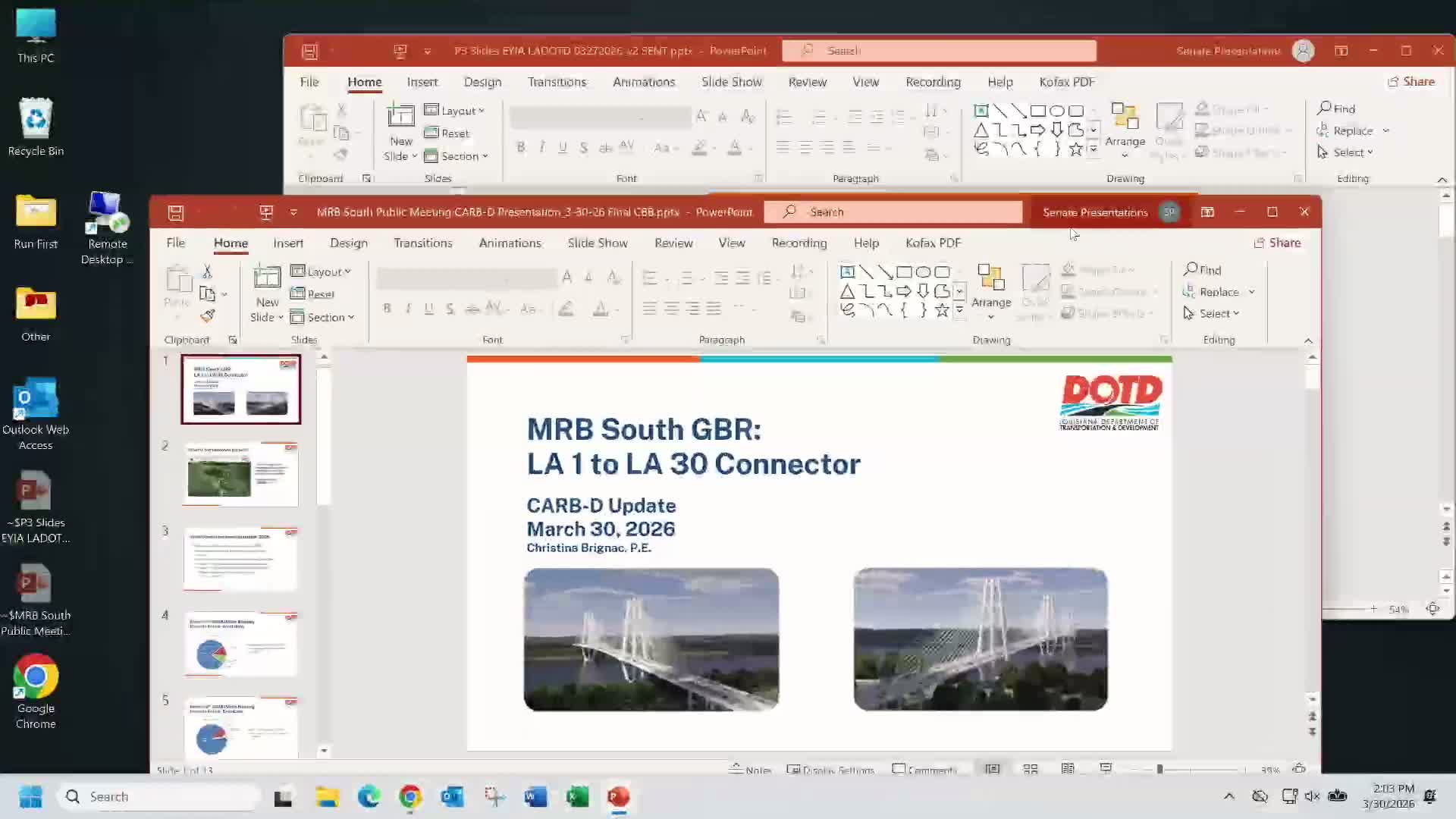
DOTD and outside advisers told the Capillary Road and Bridge District at its meeting that the Mississippi River Bridge South project now has three alternatives under study and that financing options, including public‑private partnerships, will be evaluated before a preferred alternative is selected.
At the meeting Christina Bridal of DOTD’s Critical Projects group summarized outreach and the environmental scoping: two March public meetings (one in Plaquemine and one in St. Gabriel) drew about 73 and 106 attendees, respectively, and the team collected roughly 174 public comments. Bridal said the screening process reduced more than 30 potential locations to three alignments and presented environmental maps, proposed cross sections and interchange concepts.
“The proposed project is to increase capacity in the area network … improve connectivity across the Mississippi River and provide an alternative route, especially during incident‑related closures on I‑10 or LA‑1,” Bridal said.
Bridal also presented high‑level construction cost estimates in current‑year dollars as shown in the environmental materials: alternative E11 about $1,780,000,000; S13 about $2,030,000,000; and F14 about $2,040,000,000. She said those estimates include bridge and roadway construction, elevated sections, right‑of‑way acquisitions and wetland mitigation but exclude final engineering, additional environmental mitigation and utility relocation.
Tom Resakos of Ernst & Young Infrastructure Advisors gave an overview of delivery options and the role P3s can play. “A P3 is a long‑term, performance‑based contract between a public agency and a private consortium to design, build, finance, operate and/or maintain an infrastructure asset,” he said, describing a spectrum from traditional design‑bid‑build through design‑build‑finance‑operate‑maintain (DBFOM) toll‑risk concessions and availability‑payment models. Resakos said P3s can transfer delivery and financing risk to private partners, potentially bring additional up‑front capital and change the public budget exposure over a multi‑decade concession.
Commissioners questioned how metropolitan scale and traffic patterns affect toll revenue potential and asked for examples and toll ranges. Resakos said suitability depends on demand characteristics and that cases range from rural availability‑payment models to larger toll transactions; DOTD agreed to present Calcasieu/I‑10 examples and proposed toll ranges at a future meeting.
On next steps Bridal described the NEPA schedule: identify a preferred alternative, undertake additional field and impact analyses, publish a draft environmental assessment for public review and hold hearings; the final document will yield either a Finding of No Significant Impact or a Notice of Intent to prepare an Environmental Impact Statement.
The board then voted on a motion — recorded in the meeting as moved by “President Daigle” and seconded — to give the chair authority to meet with DOTD and consulting firms between now and the June meeting to determine whether an RFP is needed and to examine options and requirements. The motion passed unanimously by voice vote.
What happens next: DOTD will continue NEPA work and field studies, prepare the draft EA and publicly post meeting and hearing schedules; the district will continue analyzing financing options including the P3 approaches described by the adviser.
Sources and attribution: direct quotes and attributions are taken from DOTD project manager Christina Bridal and Tom Resakos (Ernst & Young) during the Capillary Road and Bridge District meeting. The district’s vote to authorize the chair to meet with DOTD and consultants was recorded in the meeting minutes as unanimous.