APD reports falling violent crime but warns staffing and overtime pressures persist
Loading...
Summary
APD told the commission aggravated assaults and homicides are down while staffing shortages and overtime spending continue to create operational pressure; the department outlined recruiting efforts, academy graduations and event staffing challenges.
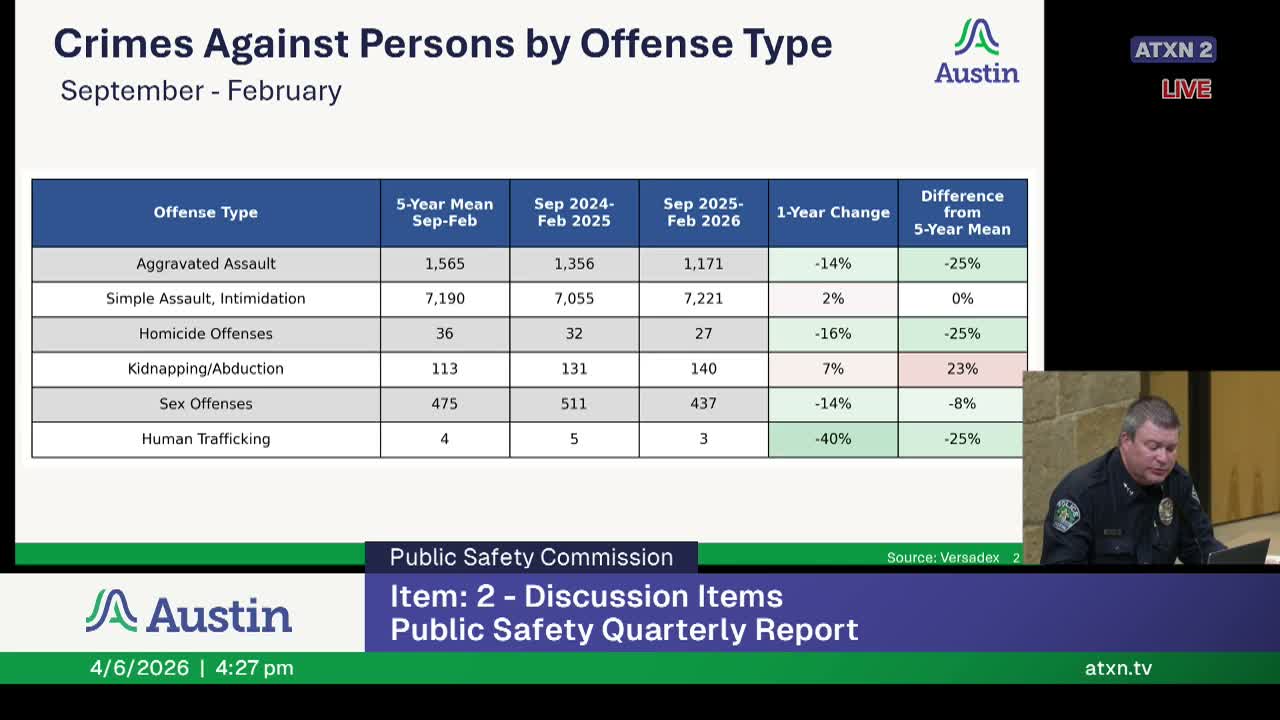
The Austin Police Department reported an overall decline in several violent crime categories during its quarterly briefing to the Public Safety Commission, while urging the panel to consider staffing and overtime constraints that the department says affect response times and operations.
An APD leader said "aggravated assault and homicide are down both compared to last year and the five‑year average," while also flagging an increase in unlawful restraint and kidnapping tied to family‑violence reporting changes. The department said property crimes — including motor vehicle theft and some fraud categories — are generally down.
APD linked part of its data shifts to targeted enforcement and outreach: data‑driven operations at identified high‑risk venues produced more arrests and contacts in concentrated enforcement efforts. The department reported roughly 81 arrests tied to South by Southwest operations, said it made roughly 400 contacts and seized 14 firearms during that period.
On staffing, APD said patrol vacancies are the chief driver of overtime demand. The department reported that about 62% of its overtime budget had already been spent for the year and warned that continued vacancies will require creative management of limited resources. APD described a recently launched internal leadership program and efforts to recruit using outside firms and targeted pipelines, and it outlined recent and projected academy graduations.
Commissioners pressed for more granular metrics and a standard definition of an evidence or processing backlog; APD agreed to return with more detailed process reporting and requested lead time to assemble data in the formats used across human resources and scheduling systems.
The department also highlighted the reserve officer program for event staffing and said it remains an important but limited supplement to regular staffing for the city’s growing event calendar.
Commissioners asked for a follow‑up presentation ahead of the city’s budget process so the commission and council can weigh staffing needs and overtime pressures during budget deliberations.