Get Full Government Meeting Transcripts, Videos, & Alerts Forever!
Get email alerts on the Land Use Development topic
No spam. Unsubscribe anytime.
Council certifies EIR and approves El Camino Real assisted-living project after debate over traffic and fire safety
Summary
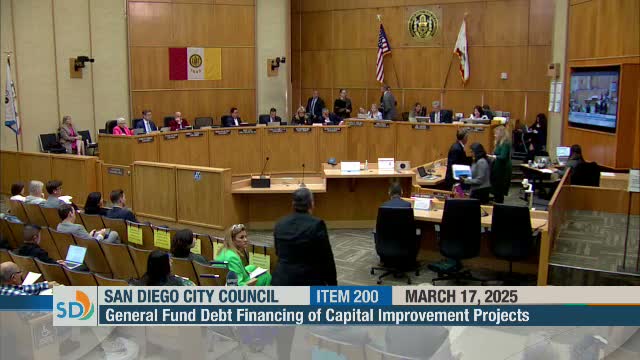
After extended public comment and conditions addressing access and traffic calming, the San Diego City Council certified the Subsequent Environmental Impact Report and approved permits for the El Camino Real assisted-living facility (PRJ067573) by an 8–0 vote with Council Member Von Wilpert absent.
The San Diego City Council on March 17 voted to certify Subsequent Environmental Impact Report No. 675732 (SCH 200001371043) and approve the conditional use permit, site development permit and neighborhood-use permit for the El Camino Real Assisted Living facility (PRJ067573). Council President Joe LaCava moved the action, Council Member Elo Rivera seconded it, and the motion passed unanimously 8–0 with Council Member Von Wilpert absent.
The project proposed on a 3.97-acre site at 13860 El Camino Real calls for a three-story, approximately 106,568-square-foot assisted-living facility with 124 beds (described in staff materials as a mix of assisted-living units and memory-care units). Staff told the council the project is located in the AR-11 zone within Proposition A lands in the North City Future Urbanizing Area and requires a Process 5 ordinance, a conditional use permit, a site development permit and a neighborhood-use permit; staff recommended approval if required findings can be made.
Applicant and design team representatives said the project responds to local demand for senior care and described adjustments made after community meetings. Anna McPherson (Atlantis Group) and Nolan Weinberg (PMB) highlighted design changes to reduce visibility and privacy impacts; architect Natalie Ruiz described stepped-back massing, muted exterior colors and obscure glass on third-floor windows to respond to neighborhood concerns.
Opponents and community groups urged delay and additional study. Johnny John, speaking for the San Diego River Community Alliance, said the SEIR and traffic analysis were inadequate and that safety and evacuation risks were not fully addressed: "We object to the approval of the project as it is currently proposed because of the project's significant traffic and fire impacts," he told the council. The opposition asked the council to recirculate the SEIR and to require a current comprehensive traffic study that analyzes cumulative impacts with adjacent planned projects.
The applicant's representative, Marcela Escobar, told the council the applicant agreed to conditions proposed by Council President LaCava, noted updated traffic counts and said fire experts and the project traffic engineer were available to answer questions. In announcing his proposed findings and conditions, Council President LaCava said he could make the necessary land-use findings provided certain additional assurances are added to the approval record, including that any amendments that increase beds, rooms, uses or amenities beyond the project before Council must return to Council at Process 5 and that an access easement protecting the singular driveway be imposed: "If the project were to increase the number of beds or rooms beyond the established 124 beds and 105 rooms, this might change the calculus for my decision," LaCava said.
LaCava also proposed traffic-calming measures to be worked out with the city engineer, to be implemented before certificate of occupancy, and the council required those measures in the conditions adopted with the ordinance. Fire-rescue staff told the council they were comfortable with the single driveway and with planned hydrants and fire connections and that shelter-in-place or evacuation approaches had been analyzed.
Planning commission and planning board history noted in staff materials: the Planning Commission voted unanimously to recommend approval; the Cornwall Valley community planning board had previously recommended approval with conditions (vote reported as 5–1–1). The council record also included public support from union representatives and local residents urging approval because of community need for memory care and skilled jobs.
The council approved the project based on the certified SEIR, the findings, mitigation monitoring and the additional conditions. The action will be subject to any further review required by other agencies, including a future California Coastal Commission review because the site is within a deferred certification coastal overlay area.