Get Full Government Meeting Transcripts, Videos, & Alerts Forever!
Get email alerts on the Municipal Finance topic
No spam. Unsubscribe anytime.
City Council receives training on general-fund debt financing and tracking; DOF flags $394 million gap
Summary
San Diego City Council received an informational training March 17 on the city’s general-fund bond financing program, which now decouples project appropriations from bond issuances; the Department of Finance said about $394 million in bonds may be needed to address existing appropriations and outlined plans for annual tracking and midyear reporting.
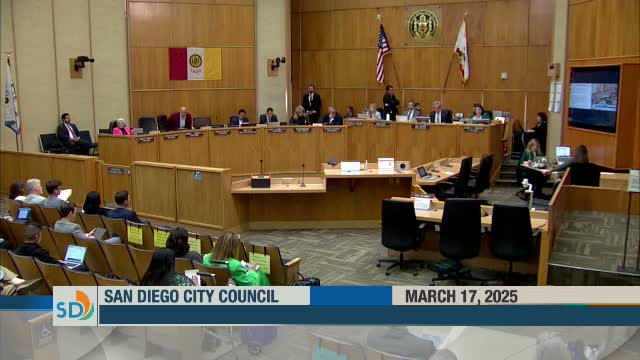
San Diego City Council on March 17 received a training from the Independent Budget Analyst and the Department of Finance on the city’s general-fund debt financing for capital improvement projects. The session explained why the city moved, beginning in August 2021, from project-specific bond appropriations to a program-wide approach that decouples appropriations from the timing of bond issuances.
"Appropriations happen in bigger chunks, and the bond issuances are really just matching the spend rate," Jyothi Pantulu, assistant director for the Department of Finance, told the council. She said staff now assess cash needs as the CIP program is implemented and issue debt when proceeds are needed to move projects forward.
Baku Patel of the IBA’s office summarized the training and said the shift aims to improve cash management and on-time delivery of projects. Pantulu told the council that, as of the end of the last fiscal year, the department identified roughly $394,000,000 in additional bond proceeds needed to cover existing appropriations.
DOF described a multi-part plan to increase transparency: an annual online list of appropriations and bond funding that will be updated at the end of each fiscal year, additional appendix reporting in the midyear CIP report showing expenditures by project, and inclusion of projected debt issuances in the five-year outlook. Pantulu emphasized post-issuance compliance work — paying debt service, tax analyses to ensure proceeds are used for eligible tax-exempt purposes, and timely spend-down of proceeds — as critical to preserving market access.
Council members asked whether contract structures such as phased funding or design-build agreements affect what can be appropriated. Pantulu answered that phase funding written into contracts can limit appropriations to the amount needed for the phase; otherwise, staff would typically need to appropriate the full contract amount for the fiscal year in which construction requires it, while bond size would be based on projected cash flow.
The IBA and DOF said they will continue to refine tracking and promised to include additional guardrails in the next debt policy update scheduled for July. As an informational item, the training required no council action.