Get Full Government Meeting Transcripts, Videos, & Alerts Forever!
Get email alerts on the Traffic Calming topic
No spam. Unsubscribe anytime.
NDOT proposes speed cushions on Barnes Cove Drive; residents raise safety and parking concerns
Summary
NDOT presented a speed-cushion–based traffic-calming plan for Barnes Cove Drive, citing measured speeds (85th percentile ~35 mph) and volume (~2,200 vehicles/day). Residents asked about a dangerous downhill curve, parking near Barnes Road and snow performance; NDOT described ballot, timeline and mitigation options.
NDOT consultant Jeff Hammond told neighbors that Barnes Cove Drive has been selected for this cycle of the department’s residential traffic calming program and that NDOT is proposing a speed-cushion–based plan supplemented in places by a feedback sign.
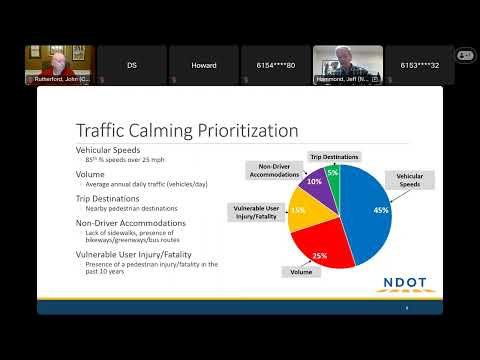
Hammond said NDOT measures and scores candidate streets using traffic volume and speeds (about 70% of the score) plus factors such as nearby destinations and documented pedestrian crashes. For Barnes Cove he cited an 85th‑percentile speed near 35 mph and traffic volumes of roughly 2,200 vehicles per day. "You are in the program now," Hammond told the meeting, noting Barnes Cove ranked high enough to be included in the cohort of about 24–25 projects NDOT advances each round.
Why it matters: NDOT emphasized the program’s safety focus — the agency said physical devices that slow vehicle speeds reduce risk to pedestrians more reliably than temporary enforcement. Hammond described speed cushions as NDOT’s standard device (manufactured recycled‑rubber modules with gaps to accommodate emergency vehicles), explained basic dimensions and spacing logic (roughly 400–600 feet between sets) and said cushions typically reduce speeds by "on the order of 9 to 11 miles an hour" in before/after comparisons, while cautioning results vary by street.
Residents raised specific concerns. One resident said, "I've witnessed 2 vehicle accidents already," pointing to the downhill approach toward Valencia Court and asking whether cushions or rumble strips would address the curve. Hammond said rumble strips are typically used to call attention to an already posted warning ("stop ahead" or similar) and suggested a warning sign plus a radar feedback sign near the hill as a supplemental measure; he also said NDOT will avoid placing cushions on slopes above NDOT’s preferred limit (about 5–8 percent) and will field‑check sight distances before final siting.
Neighbors and Councilman Rutherford also flagged parking near the Barnes Road end that can narrow the roadway; Hammond said NDOT could pursue clearer no‑parking signage or change striping (and could coordinate with the Traffic and Parking Commission to make parking restrictions enforceable) or, if desired by the neighborhood, incorporate a stripe change into the traffic calming design.
Cost and permanence: Hammond said there is no cost to the neighborhood for this data‑selected project (a separate neighborhood‑funded application path exists for different circumstances). He described the devices as intended to be permanent DOT assets — bolted in and maintained as needed — but removable for pavement or utility work if required.
Ballot and timeline: NDOT will produce detailed design plans and publish them online; property owners who abut the project limits (occupied parcels only) will receive a QR‑code ballot for six weeks. "If two thirds of the people have voted in favor of the project, we will move it forward," Hammond said. If the ballot fails to reach the two‑thirds threshold, NDOT said it will implement a plan B — typically feedback signage or pavement markings — rather than installing cushions.
Next steps: NDOT will finalize field measurements, publish design plans on trafficcalming.nashville.gov and EngageNashville, then open the six‑week ballot. Hammond invited residents to send questions to n.trafficcalming@nashville.gov or to his email (jeffhammond@birchtransportation.com) and said the meeting recording and plans will be posted on NDOT’s traffic calming web pages.
The meeting closed after roughly an hour with NDOT committing to post the design materials and to consider residents’ suggestions for signage and supplemental feedback devices as staff complete final site checks.