Get Full Government Meeting Transcripts, Videos, & Alerts Forever!
Get email alerts on the Housing topic
No spam. Unsubscribe anytime.
Planning commission backs Northpointe rezoning amendment that adds housing, trims commercial and proffers school site and transit work
Summary
The commission recommended approval of a Northpointe rezoning amendment that would add roughly 707 residential units, reduce commercial square footage and include proffers for a relocated school site, transit payments and road improvements; residents urged stronger traffic connections and safety measures.
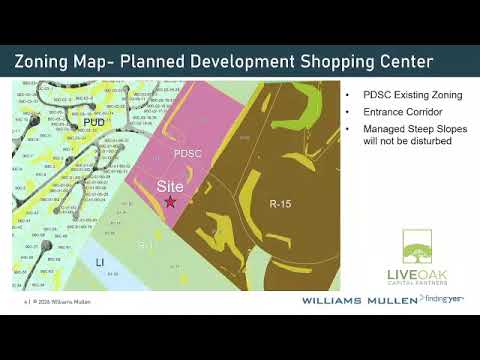
The Albemarle County Planning Commission on March 10 recommended approval of a major amendment to the Northpointe rezoning that would shift a large portion of the previously approved commercial area to residential development, add approximately 707 new residential units within the rezoned portion and reduce the proffered commercial square footage to about 250,000.
Staff planner Rebecca Ragsdale summarized the application submitted in 2023: it covers roughly 152 acres of the original Northpointe rezoning and proposes an updated application plan and proffers, relocation of the previously planned elementary school pad to a slightly larger, more usable site (about 13.5 acres) with a proffered dedication window tied to county request (270 days), updated affordable‑housing proffers, and proffered transportation commitments including a transit proffer and phased off‑site improvements linked to trip‑generation thresholds.
David Mitchell, representing master developer Great Eastern Management, said market and regulatory changes since the 2006 approval — notably changes in DEQ/core/permitting rules for streams and modern market demand for denser, attached housing — motivated the request. Mitchell said treating some previously planned commercial blocks as attached residential (townhomes, condos, apartments) reduces traffic generation compared with equivalent commercial square footage: the applicant cited roughly a 27–30% reduction in trip generation after substitution, given typical trip rates for townhomes and single‑family homes used in the study. He described existing Corps of Engineers permits for certain impacts and said the project’s stormwater facilities are designed to treat runoff on site where permitted.
The application includes proffers to support schools and transit: the applicant committed to deliver a graded, pad‑ready school site within 270 days of the county’s request, maintain a transit proffer that includes an initial $25,000 bus stop improvement and five additional payments of $25,000 toward transit improvements (applicant presentation), and to build road and multimodal connections as traffic thresholds are reached. Staff also flagged that the period of affordability on certain rental units in the proposal did not match some current county objectives and discussed how the proposed affordable housing will be reviewed under the applicable pre‑2024 policy; the applicant clarified an intended 10‑year period for affordability for future units (correcting an earlier 5‑year reference).
Several residents who spoke during public comment said they support more housing in principle but urged stronger traffic and safety commitments. Neighbors asked the commission to require re‑establishing the northern Lewis & Clark connection to Route 29 to disperse traffic, argued that Cliffstone Boulevard could become a bottleneck for pedestrians and school pick‑up/drop‑off, and urged restrictions on certain commercial uses near the school (for example, adult‑only bars, vape shops or 24‑hour uses). The applicant and staff responded that the traffic study considered the whole project and that VDOT’s direction and local topography/environmental constraints — including steep grades and perennial streams such as Flat Branch and Licking Hole — limit the feasibility of building the previously anticipated Lewis & Clark connection now. The developer agreed to provide a continuous multiuse path through the project and said emergency access points will be required.
Commissioners debated the depth and duration of affordability, the mix and location of commercial uses, and transportation proffers. Several commissioners said they would prefer deeper or more creative affordability tools but accepted the applicant’s commitments to bring remaining unbuilt units to 15% affordable (80% AMI) for a 10‑year term on new units and to proferred transportation improvements including a developer‑funded third northbound lane on Route 29 triggered by a 25,000 vehicle‑per‑day threshold. Commissioners also discussed allowing neighborhood‑scale commercial in two interior blocks to provide walkable services.
The commission voted to recommend approval of the rezoning amendment and separately recommended approval of the residential special‑use permit (SP202300009). Both recommendations were recorded on roll‑call votes. The recommendations will be forwarded to the Board of Supervisors for final action; site‑plan approvals and specific engineering and permitting steps remain to determine final designs and schedules.