Bill would direct $25 million toward Minnesota Hockey Hall of Fame in Inver Grove Heights
Loading...
Summary
House File 4238 would provide $5 million in general obligation funding for local roads and infrastructure and a $20 million cash appropriation to support a proposed Minnesota Hockey Hall of Fame and related facility in Inver Grove Heights; city officials told a House committee they expect $14–$17 million in local investment and said a future I‑494 interchange is planned at the site.
A House committee heard testimony on House File 4238, which would provide $5,000,000 in general obligation funding to the city of Inver Grove Heights for roads and infrastructure related to a proposed Minnesota Hockey Hall of Fame and a separate $20,000,000 cash appropriation to support the facility's construction and operations.
The lawmaker who introduced the measure told the committee, “We're introducing house file 42 38 today, which is a very exciting bill,” and said the proposal would benefit the state as well as the region. The presenter described the $5,000,000 as targeted to public infrastructure and the $20,000,000 as a cash appropriation to fund the hall of fame facility itself.
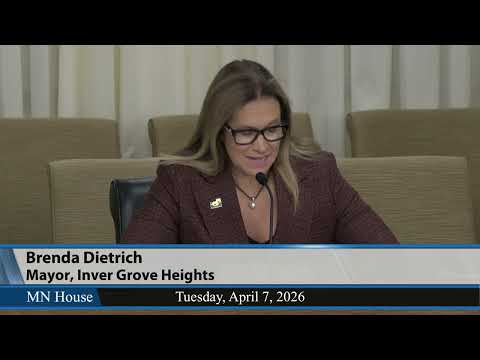
Brenda Dietrich, mayor of Inver Grove Heights, said the project would be “transformational” for the city and noted the site's regional access, including proximity to Interstate 494, Minneapolis–Saint Paul International Airport and the Mall of America. She told the committee the city council expects local investment of about $14 million to $17 million and that the city is seeking $5,000,000 in state assistance for improvements.
Jason Zemer, community development director for Inver Grove Heights, outlined how the $5,000,000 would be used. “The $5,000,000 that we're asking from the state will help fund construction of the roads, public water, and sanitary sewer extensions to service the area and the site and address stormwater issues and grading,” Zemer said, and added the city plans a mix of cash for land acquisition and debt for the planned improvements.
Rep. Sexton asked who would own and maintain the facility decades from now, citing concerns about long‑term upkeep such as roof repairs. Zemer replied that a private development partner would own roughly half of the facility (a taxable portion) and the Minnesota Hockey Hall of Fame nonprofit would own the ice arena portion, saying the complex would be privately owned.
Rep. Scrabba asked whether the state needed two hockey halls of fame and whether the proposed center would compete with the U.S. Hockey Hall of Fame. Mayor Dietrich said the Minnesota hall is intended to be state‑specific and to collaborate with the national institution in Eveleth, including sharing exhibits, so she did not characterize it as competition.
Committee members did not take a vote during the hearing. The lawmaker who introduced the measure closed by saying the community is excited and that the project would bring economic stability to the area. The committee then thanked the witnesses and moved on to other business.