City staff outline Washington’s Centennial Accord model and city tribal‑relations milestones
Loading...
Summary
City Office of Intergovernmental Relations staff briefed the committee on Washington state's Centennial Accord, the new millennium agreement and how Seattle has built MOUs and a tribal‑relations program to institutionalize government‑to‑government consultation and training.
City staff from the Office of Intergovernmental Relations briefed the Finance, Native Communities and Tribal Governments Committee on April 7 about the state and city frameworks for tribal relations, explaining how Washington’s Centennial Accord and subsequent agreements provide a model for government‑to‑government engagement and training.
Mina Hashemi, director of OIR, described the office’s portfolio and the importance of respectful, sustained engagement with sovereign tribal nations. Francesca Murnane, the city’s tribal relations director, framed the state’s approach as a set of interlocking tools — the Centennial Accord, the New Millennium Agreement and codified consultation policies — that together established liaison roles, staff training requirements, and annual forums to maintain accountability.
Murnane traced the region’s history from the fish‑rights conflicts of the 1960s and ’70s through the US v. Washington litigation to the 1989 Centennial Accord (signed at the Burke Museum) and subsequent state codification, which she said created durable institutional practices such as tribal liaisons and consultation policies. She described the Centennial Accord’s annual meeting and the city’s Tribal Nation Summit as mechanisms to maintain ongoing dialogue rather than one‑off ceremonies.
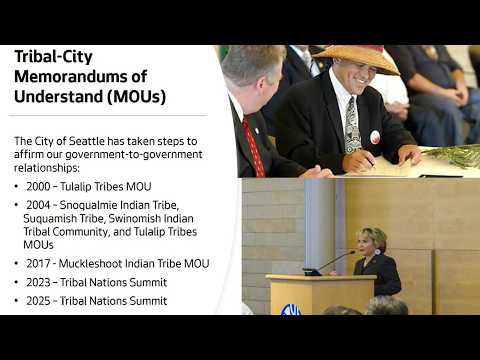
At the city level, Murnane highlighted milestones including a 2000 MOU with the Tulalip tribe, later MOUs with the Swinomish and Muckleshoot tribes, and the Indigenous Advisory Council and tribal summit work in 2023 and 2025. She emphasized that MOUs are tailored to each nation, create dispute‑resolution pathways and are most effective when they function as "living" documents that prompt implementation and reporting.
Council members asked how the Centennial Accord and the city summit function in practice; staff said the state model has evolved to include training provided by the Governor’s Office of Indian Affairs and that the committee will receive a follow‑up training from Gordon James (Governor’s Office) at a future meeting. Staff framed the work as iterative and requiring sustained commitment by elected officials and departments to translate agreements into daily practice.
Quote
"Tribal and state relations are not one document or one activity — it's the culmination of many tools that collectively create a framework for practicing more effective government relations," Francesca Murnane said.
What happens next
The committee expects Gordon James from the Governor’s Office of Indian Affairs to provide state‑level training on the Centennial Accord at a future meeting; staff will continue to coordinate annual summit work and intergovernmental engagement.