Get Full Government Meeting Transcripts, Videos, & Alerts Forever!
Get email alerts on the Port Msa topic
No spam. Unsubscribe anytime.
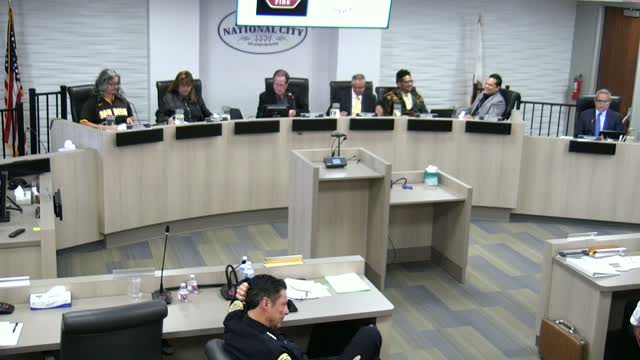
National City council votes to distribute MSA white paper, seeks fuller port reimbursements for police, fire and city services
Summary
The council unanimously approved distribution of a municipal‑services white paper aimed at renegotiating the city’s Mutual Services Agreement with the Port of San Diego, urging the port to fully reimburse National City for public-safety, public‑works and homelessness costs tied to port operations and new electrification infrastructure.
National City’s City Council voted unanimously to distribute a municipal‑services white paper to the Port of San Diego and other stakeholders and to direct the city manager to seek full reimbursement for municipal services the city provides at Port Tidelands.
The white paper, presented by the city’s special counsel for port matters, Ralph Hicks, says the existing MSA formula —which reimburses National City on a per-incident basis and counts only certain on‑port incidents—underestimates the city’s enterprise costs for police, fire, public works and homelessness response. Hicks told the council, “It’s about fairness,” and urged a methodology that accounts for standby readiness, training, specialized equipment and ongoing maintenance required by port activity.
Fire Chief Sergio Mora detailed operational consequences the city faces at the port and in the surrounding industrial area. “The EV issue . . . fires and highly toxic plumes from those fires . . . is real,” Mora said, describing lithium‑battery thermal‑runaway incidents that can burn for days and require specialized response, prolonged evacuations and equipment not covered by current per‑call reimbursement rules.
Police Chief Alex Hernandez described multi‑shift investigative and follow‑through costs after serious crimes on port property. “Cases need to be submitted. That’s a lot of man hours,” he said, stressing that patrol, investigative and evidence costs operate 24/7 and are not captured adequately under the current MSA accounting.
Port CEO Randa Coniglio told the council the port staff had only briefly reviewed the white paper but signaled willingness to engage. “We look forward to those conversations and to finding some common ground,” Coniglio said, adding the port will examine the city’s analysis and the legal constraints that apply to a statewide port district.
The white paper’s initial enterprise snapshot estimated the city’s annual cost for police and fire services tied to port operations at about $8.8 million, a figure city staff and counsel said is preliminary and intended to start negotiations. Councilmembers and union leaders asked for more granular supporting data and proposed an ad hoc council committee to oversee the negotiation. The council approved distribution and formation of an ad hoc committee; members indicated they expect follow‑up work to refine the methodology, collect comparable MSA data from other port cities, and begin multi‑level discussions with port leadership and, if needed, state authorities.
What happens next: the council directed the city manager to transmit the white paper to port leadership, pursue additional data needed to justify a revised reimbursement formula, and convene an ad hoc committee to participate in negotiations. The city flagged specific near‑term issues —including fire‑response capacity for battery‑energy incidents, shared‑training and equipment needs, and recurring public‑works maintenance along port access roads— that it says must be included in any new agreement.
Quotes in context: The article uses exact quotes only from speakers recorded in the transcript and attributes them to the speakers listed below. The council’s vote to distribute the white paper was unanimous; the council also requested the port review the white paper and return with its own data so negotiations can proceed.
Ending: Councilmembers emphasized this is an opening position, not a final settlement, and said they expect iterative staff‑level and executive‑level discussions with port officials over the coming months.