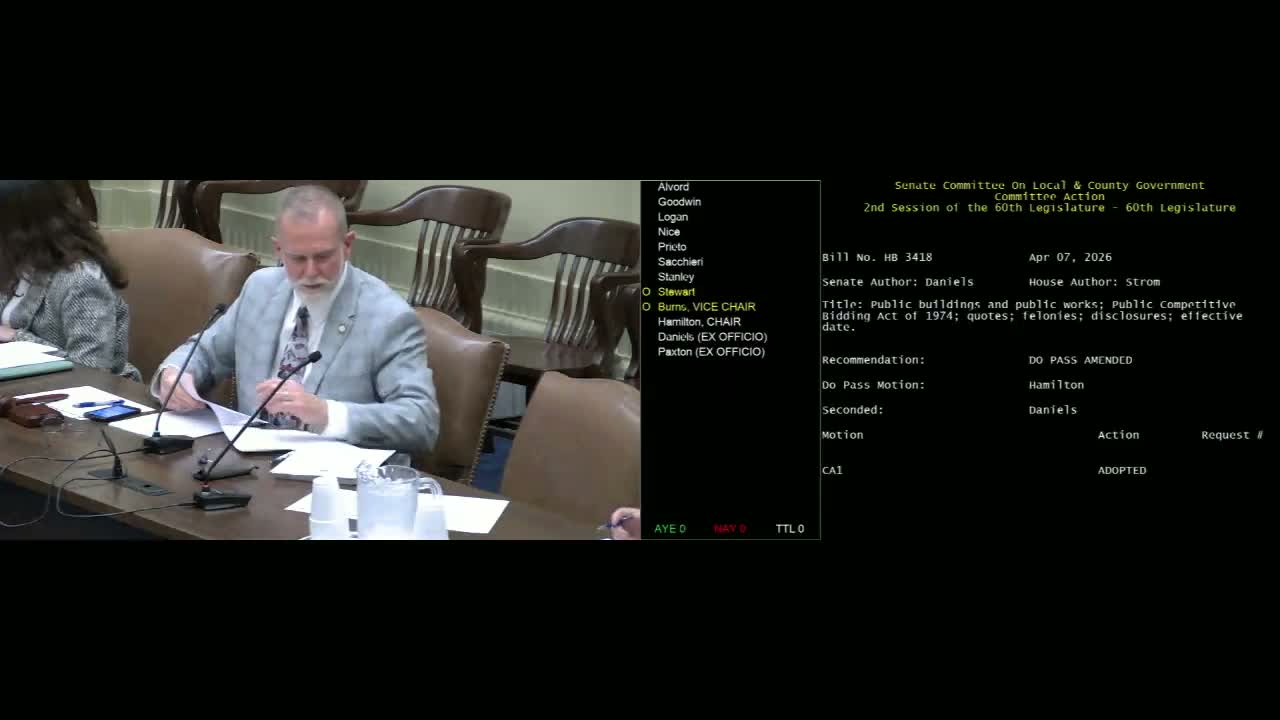
Senate committee approves 'Safe Neighborhoods Act,' allowing narrow compensation claims by property owners
Loading...
Summary
The Senate Local and County Government Committee approved House Bill 3985, the 'Safe Neighborhoods Act,' which lets property owners in larger municipalities seek compensation if a city is found to have a pattern of not enforcing certain public-safety ordinances; the measure passed after debate over a 130,000-population threshold.
Madam Floor Leader Daniels told the Senate Local and County Government Committee that House Bill 3985, the “Safe Neighborhoods Act,” creates a narrow procedure for property owners to seek compensation if a municipality with a population of 130,000 or more has a “policy, pattern or practice” of declining to enforce specified public‑safety ordinances. “The most important language is there at the top of page 3,” Daniels said, adding the measure applies only when a city’s inaction causes property devaluation or forces a property owner to spend money to restore their property.
Daniels told senators the bill targets repeated failures to enforce laws on illegal public camping, obstructing public thoroughfares, loitering, panhandling, public urination or defecation, public consumption of alcoholic beverages, possession or use of illegal substances and shoplifting. “This is just when the government is ignoring its responsibility so completely that the property owner suffers a devaluation in its property or has to mitigate by expending dollars to restore their property,” she said.
Senator Niesz pressed for detail about felony and misdemeanor language in the bill and asked the author to clarify several cross‑references. Daniels said the measure includes a felony provision intended to prevent fraud — for example, a government official disclosing bid terms to advantage a bidder — and that other actions could amount to misdemeanors; she agreed to provide follow‑up detail.
Several senators expressed reservations about the bill’s scope and its population cutoff. Senator Goodwin questioned why the threshold was set at 130,000 and whether smaller towns could experience the listed offenses. “Would you believe that all of that can happen in a small town, say, maybe 1,000 folks or 800 folks?” Goodwin asked. Daniels replied the bill is written narrowly and requires a pattern or practice; if a city is responding to complaints and prosecuting offenses, property owners would not qualify for relief.
Senator Nyece said she would not support the bill in committee, voicing concern that it could criminalize more Oklahomans and place burdens on municipalities that lack resources for enforcement. “I have concern with that, and I will not be supporting this today because I know there are better things that we can do,” Nyece said.
Daniels framed the bill as a limited deterrent and cited Arizona’s experience, saying the law produced only a few compensation filings in two years. After debate and closing remarks, the committee voted to pass House Bill 3985. The committee roll call in the transcript recorded ayes and nays that the chair summarized as the measure having passed (committee announced 7 ayes and 2 nays in the record).
The committee’s action advances the bill to the next stage; Daniels said she would provide requested clarifications on the population cutoff and the statutory language before floor consideration.