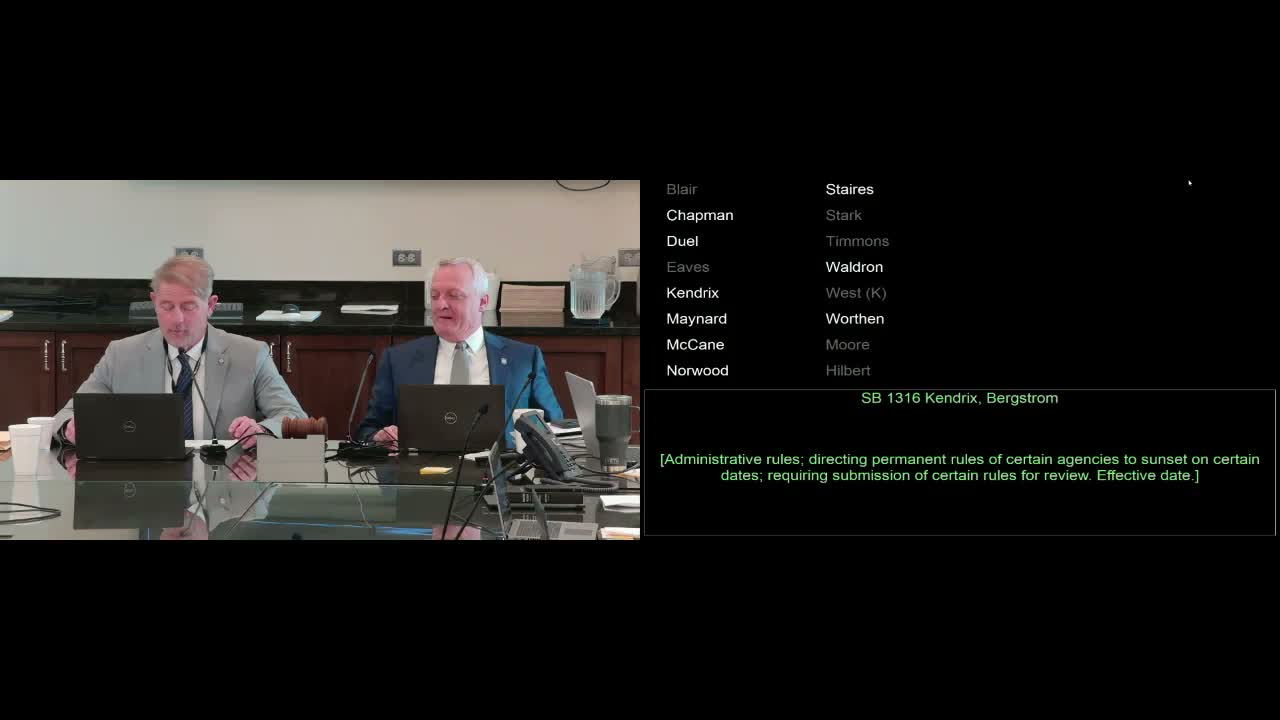
Committee advances eight‑year administrative‑rules review after questions on AI role and industry capture
Loading...
Summary
The Administrative Rules Committee passed Senate Bill 13‑16 to set an eight‑year rotating review of all agency administrative rules; members pressed the sponsor about who would conduct reviews, how an AI tool would be used, and safeguards against industry influence.
Representative Kendricks, chair of the Administrative Rules Committee, presented Senate Bill 13‑16, a measure modeled on Idaho law that would establish a rotating, full‑code review of state administrative rules on an eight‑year cycle and push the bill’s effective date to either 2030 or 2031.
The sponsor said the proposal is intended to verify that existing rules have proper statutory authority and to remove obsolete or duplicative provisions. “What we are doing, we're working on actually... to do a review for statutory authority out of the administrative code as it currently stands,” Kendricks said, adding the goal is to avoid a “rubber stamp” oversight process and to focus on statutory authority first and foremost.
Members pressed for details on implementation. Representative Walter asked whether the legislature already has review responsibility and what additional efficacy the eight‑year cycle would add; Kendricks answered that the committee and the legislature would both review rules and that the bill is meant to enable a comprehensive review of rules adopted in prior years rather than only reacting to proposed rule changes.
Several lawmakers questioned who would perform the reviews and whether the workload would be manageable given agencies with large rule bodies. Kendricks said staff and the Office of Management and Enterprise Services (OMES) would be involved and that large agencies could be split across multiple years to balance workload.
A central point of contention was the use of an AI‑assisted process to help identify questionable code sections. Kendricks described ongoing work with the state AI officer and OMES to build a restricted tool that uses only Oklahoma’s constitution, statutes and administrative code as its corpus. “It's not gonna be making decisions for us. It's gonna generate a report that says, you know, these sections have a 90% likelihood or these sections have a less than 50% likelihood,” Kendricks said.
Representative Walter warned of the risk that oversight could be used to orient rules toward narrow interests. “That powerful interest in the body will use our oversight of the rules process to orient the rules in ways that are conducive to that localized interest or industry,” Walter said, urging safeguards against industry capture.
Kendricks said the process will be iterative and involve back‑and‑forth with agencies to verify statutory delegation, and noted that existing legislation (cited by the sponsor as House Bill 4319) had already created processes to cross‑check statute, code and constitutional authority.
The committee voted to advance Senate Bill 13‑16; the sponsor reported a unanimous committee vote. Kendricks said the title will be restored before floor action and that the committee will continue refining details, including the bill’s effective date and language to prevent unintended consequences.
The committee moved the bill to the floor with a recommendation to pass.