House committee advances 'Taxpayer Dollars Protect Workers Act' amid film industry concerns
Loading...
Summary
A House committee approved Senate Bill 19 37, the 'Taxpayer Dollars Protect Workers Act,' after extended debate about whether its labor-related conditions on economic incentives could chill the state's film and entertainment industry. The bill passed the committee 5–2.
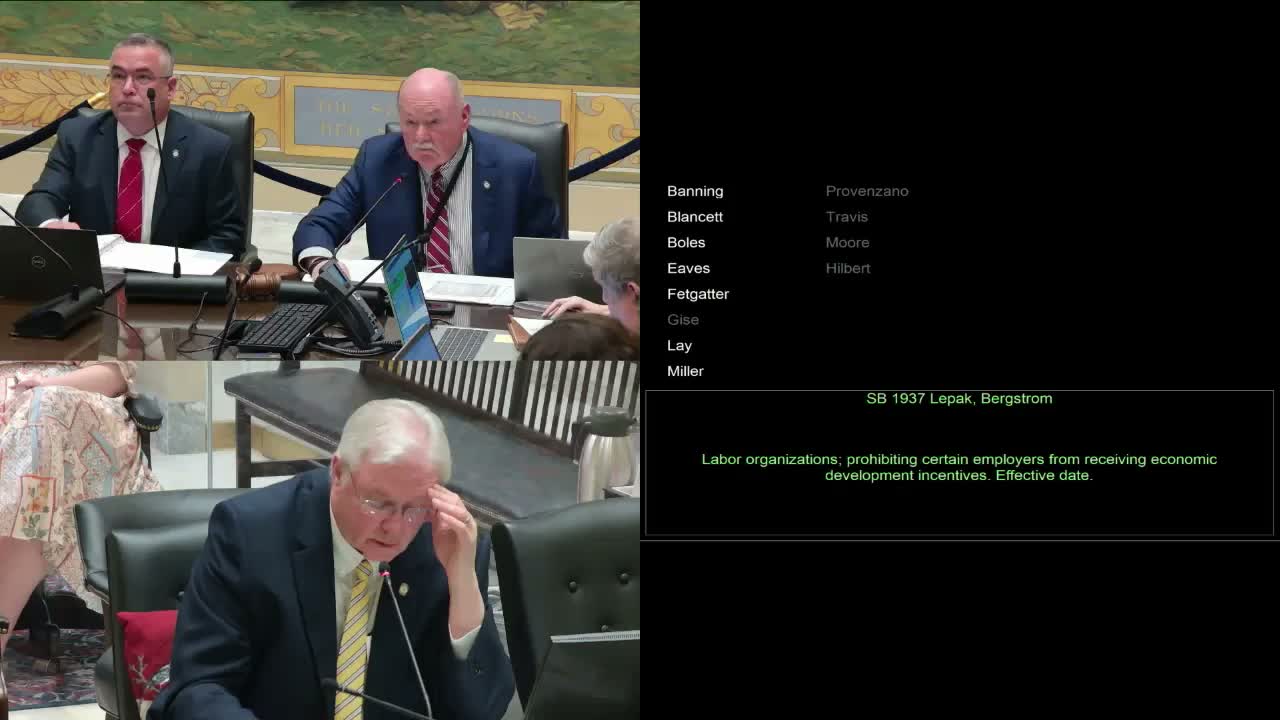
Representative Lappack presented Senate Bill 19 37, the "Taxpayer Dollars Protect Workers Act," saying the measure would tie state economic-development incentives to responsible labor practices that preserve worker privacy and choice.
The bill, as described by Representative Lappack, would require protections such as secret-ballot voting in union representation decisions, limit employer disclosure of employees' personal information without consent, and prohibit neutrality agreements that could constrain worker speech. "The bill ensures that Oklahoma's use of economic development incentives promotes responsible labor practices that protect worker privacy and choice," Representative Lappack stated when introducing the measure.
The committee exchange focused on whether those limits could harm Oklahoma's burgeoning film, music and entertainment industries. Representative Bransett, citing feedback from the industry and quoting Jeanette Stanton, director of the Oklahoma Film and Music Office, said, "this will kill film." Bransett said groups representing film and entertainment warned the bill could produce a negative return on the state's efforts to recruit productions and talent.
Representative Lappack responded that the bill targets organizing and collective-bargaining activities that occur within Oklahoma and is not intended to disrupt short-term out-of-state productions; he noted similar laws have passed in Tennessee, Mississippi, Georgia and Alabama and said, "this doesn't seem to have had any negative consequences in those places." He offered to work with the senate author to clarify language to address industry concerns.
Other members raised procedural and constitutional questions. Representative Fadgetter asked about the practical effect of a provision on page 3, line 1 that would bar certain employers from eligibility for incentives, and whether the restriction would exclude companies from state benefit programs. Representative Fadgetter also asked whether the measures have faced federal constitutional challenges under the commerce clause; Representative Lappack said he was not aware of such challenges and would follow up.
After one minute of timed debate and brief remarks urging support from backers, the committee voted and the bill was recorded as passing by a 5–2 margin. The transcript did not include a public schedule for further consideration.
The committee moved on to other business after the vote; no additional action or amendments were recorded in the transcript.