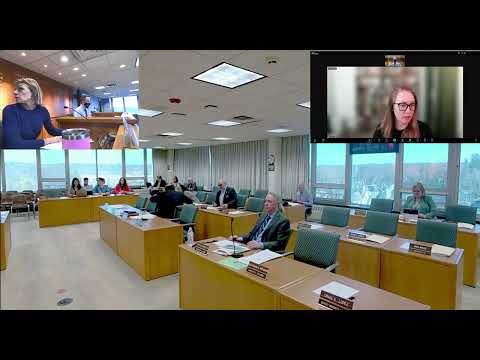
Baker Tilly recommends single 34-grade pay structure for Ulster County in salary study
Loading...
Summary
Baker Tilly presented a countywide salary study recommending a single 34-grade, nine-step pay structure for Ulster County, outlined three implementation scenarios with estimated one-time costs and urged routine maintenance; legislators pressed the consultant on peer selection, missing municipal data and geographic adjustments.
Baker Tilly told the Ulster County Audit Committee on March 18 that a single pay structure — 34 grades with nine steps — would bring consistency and transparency to county compensation and recommended the county adopt the framework and routine maintenance practices.
Jada, a consultant from Baker Tilly, told the committee the study measured positions using a nine-factor job-evaluation tool, compared those scores to market midpoints from peers and published sources, and used a regression with an R² of about 92% to assign grades. "No employee will receive reduction in pay," she said, emphasizing that the figures presented are base pay only and do not include overtime, benefits or other pay elements.
The study team reported it requested full pay ranges from 18 data sources (14 public peers and four private/ subscription sources including the Economic Research Institute and Pay Factors) and used Bureau of Labor Statistics data where applicable. Consultant figures show roughly 424 benchmark positions were requested; about 98 positions lacked sufficient market matches, producing market midpoints for about 76% of surveyed titles. For the 1,426 employees included in the calculations, the consultant reported about 202 would fall below new minimums, 974 would fall within proposed ranges and 249 would be above the proposed max and therefore would remain "red circled" (maintain current pay) under implementation rules.
Baker Tilly presented three implementation scenarios to place employees into the new structure: (1) move each employee to the closest step without a pay reduction (one‑time cost presented at approximately $2.3 million); (2) move employees based on years in position (higher one‑time cost presented by the consultant; transcript figure was unclear but described as materially larger than scenario one); and (3) move employees by years in position capped at five years (presented at roughly $3.4 million). Jada said scenario selection should align with the county's compensation philosophy and fiscal capacity.
Committee members repeatedly pressed the consultant on comparator selection and adjustments. Legislator Maloney asked how consolidating pay plans would work across different bargaining units and questioned why certain corrections and jail leadership positions did not appear underpaid relative to nearby jurisdictions. "We have so many consistent vacancies, and I wonder if that was ever taken into account," Maloney said, noting many county employees live closer to Orange and Dutchess counties where pay may be higher. The consultant replied that geographic cost-of-labor adjustments were applied using ERI indices (for example, Albany was adjusted +3.7% and Poughkeepsie −9.5%) and that vacancies were not modeled into the market midpoints.
Legislator Hanson asked why several corrections benchmarks had insufficient matches. Jada explained the study requires at least three good matches with 75% duties overlap to compute a market midpoint; if fewer exist, market value is not calculated and internal equity is used instead. Legislator Nolan asked about missing data from five municipalities; Jada said late municipal nonresponses were pursued but unlikely to materially change matches for county positions.
Comptroller Gallo asked about benefits and training deliverables under the contract. Gallo said, "I was pleased to hear you say that you're going to be doing a snapshot of benefits," and asked when that review would be completed. The consultant said a benefits snapshot and training materials (including an Excel job-evaluation tool and manual) will be provided later and that additional FOIA responses were still arriving.
Committee members raised transparency concerns about access to the consultant's raw tables. Several legislators noted municipal pay data are publicly available and asked why Baker Tilly would not disclose source tables; the consultant and others observed that some firms limit disclosure of proprietary algorithms or detailed datasets, though the underlying public data can be obtained independently.
The committee approved routine meeting business (approval of February 18 minutes) and adjourned after the presentation. No formal vote on adopting grade assignments or an implementation scenario took place at this meeting; Baker Tilly recommended the county consider approving the grade assignments and select an implementation approach that balances compensation goals with fiscal sustainability.
The next procedural steps the committee discussed were receiving the consultant's benefits snapshot and training materials and using the provided job-evaluation tool to support future updates and negotiations.