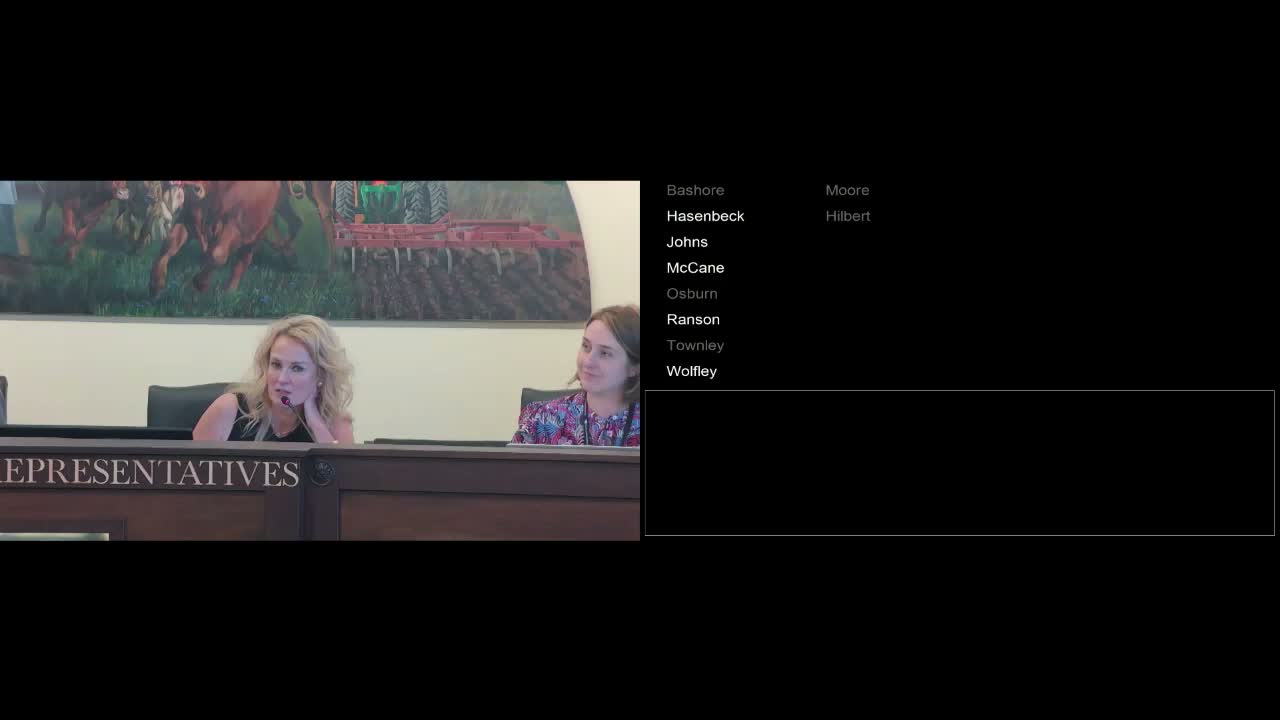
Postsecondary Education Committee clears suite of higher-education bills, including age cap for concurrent enrollment
Loading...
Summary
The committee approved multiple bills affecting higher education: an age limit for concurrent enrollment, a ban on content‑based security fees for campus expression, optional workforce assessments (WorkKeys), graduate-instructor training standards, and pilot paid apprenticeships for career-tech students.
The Oklahoma Postsecondary Education Committee approved a package of higher-education bills after a brief meeting in which members debated limited points of policy and procedure.
Representative Chad Caldwell presented House Bill 14 77, which would place an age restriction on concurrent‑enrollment programs. "Essentially, students have to be 21 years or under, to be eligible for concurrent enrollment," Caldwell said. Representative Ranson confirmed the eligibility band, noting the measure applies to students aged roughly 13 to 21 who do not yet hold a high‑school degree. The committee moved the bill and declared it passed by voice vote.
Representative Moore led several senate bills. He described Senate Bill 17 25 as clarifying how colleges may recover security costs for expressive activities on campus: it "allows an institution to charge a security fee to a student or student organization, but it prohibits such a fee from being based on the content of the expression," Moore said. Committee members probed whether the prohibition would prevent institutions from charging more when a topic predictably requires higher security; Moore said the language requires a uniform fee approach and suggested campuses could set fees based on a high point or average security need rather than content. The committee approved the bill by recorded vote.
Moore also presented Senate Bill 16 70, a State Chamber priority intended to better move university research into private‑sector jobs by modernizing startup ecosystems and encouraging university–industry collaboration. Moore pointed to a recent large investment tied to such work, saying, "There was an announcement yesterday, actually, a $100,000,000 investment in Oklahoma because of this very type of thing." The committee passed the bill unanimously.
Representative Caldwell presented Senate Bill 17 26 to establish a baseline training course for graduate student instructors. Caldwell said the aim is to "standardize that to ensure you are talking about our least experienced instructors teaching our least experienced students," so students receive more consistent instruction across the state's 25 institutions. Members asked whether onboarding already exists and whether data document current practice; Caldwell said he was not aware of a compiled dataset and described the proposal as a standardization effort. The bill passed after recorded vote.
Representative Maynard brought Senate Bill 16 33 to align state statute with federal law following a consent judgment. Members asked whether the statute’s language excluding those "not lawfully present in the United States" would cover Deferred Action for Childhood Arrivals (DACA) recipients and other immigration statuses. Maynard said "lawful presence is going to be a federal status" and described possible categories such as asylum seekers or visa holders; he also reminded members the consent judgment resulted from Department of Justice litigation and remains in effect unless overturned by later court action. The committee approved the measure.
Other measures passed included Senate Bill 17 35 (cleanups aligning career‑tech oversight under the state board) and Senate Bill 14 80, a pilot to allow paid apprenticeships for 16‑year‑old career‑tech students. Representative Hassenback explained an amendment changing a statutory duty to permissive language on workforce assessments (WorkKeys), noting high-scoring students could receive some entry‑level college credit; members clarified the amendment makes the assessment optional. Each of these bills was approved by the committee.
Votes at a glance: HB 14 77 — passed (voice); SB 15 93 — passed (recorded 6 ayes, 0 nays); SB 17 25 — passed (recorded 7 ayes, 2 nays); SB 16 70 — passed (9–0); SB 17 26 — passed (7–2); SB 16 33 — passed (6–3); SB 17 35 — passed (9–0); SB 14 80 — passed (9–0); SB 16 32 (amendment adopted) — passed (9–0).
The committee adjourned; the chair noted it was the panel’s last meeting of the session.