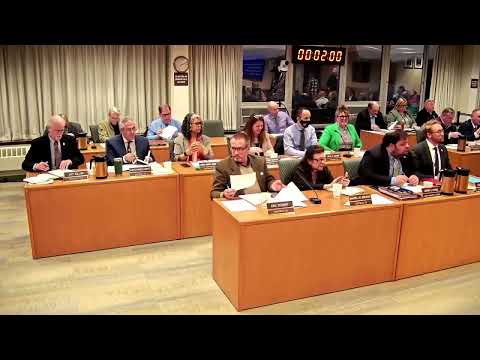
Ulster County approves $10 million bonding authority for Reuse Innovation Center amid oversight dispute
Loading...
Summary
After heated debate over oversight and transparency, the Ulster County Legislature voted 15–8 to authorize the Resource Recovery Agency to seek bonding up to $10,000,000 for a Reuse Innovation Center at a Flatbush property; a separate 60‑day extension of the agency’s service agreement passed 23–0.
The Ulster County Legislature split and adopted motions on March 18 that together address the Resource Recovery Agency’s (UCRRA) service agreement and a proposed Reuse Innovation Center (RIC). The body first separated Resolution 83 into two parts and approved Resolution 83 — a 60‑day extension of the agency’s service agreement — by a vote of 23–0. The divided item 83a, which would authorize the agency to seek bonding authority up to $10,000,000 specifically for the purchase and conversion of a Flatbush property into a Reuse Innovation Center, prompted extensive debate and passed 15–8.
Opponents, including Legislator Maloney and Minority Leader Roberts, said the bond‑authorization language would effectively remove an oversight lever from the legislature by allowing the agency to proceed with bonding on a $10,000,000 project without further legislative bonding approval. Maloney cited past problems with the agency, including a claim that the county previously absorbed $37,000,000 in unpaid net service fees, and urged the legislature to retain its bonding review to preserve leverage and insist on clearer planning, municipal coordination, and guarantees about tax‑roll status and planning‑board review.
Supporters, including Legislators Nolan, Stewart, Hewitt and Collins, argued that the authorization is narrowly tailored to a single identifiable site identified in a feasibility study and would allow the agency to secure the site before another buyer prevents the project. Proponents emphasized the project's goals — diverting construction and demolition debris from landfills, refurbishing reusable materials and creating retail or showroom space — and noted other counties' reuse centers as precedents.
Concerns raised during the debate included the project’s transparency, whether it had been vetted by town officials and planning boards, traffic and nuisance considerations for neighbors, the logistics of moving material from transfer stations, and whether leasing county‑owned land or direct county purchase (a county‑purchase compromise was proposed) would be a better use of public resources. The chair and clerk clarified that the authorization allows the agency the ability to bond; the county itself would not be the obligor unless other obligations were triggered.
The final recorded vote on Resolution 83a was 15 in favor and 8 opposed. The transcript shows clear procedural steps: the resolution was divided under Rule 10(q) before debate; Resolution 83 (service‑agreement extension) was adopted 23–0; and Resolution 83a (bonding authorization) was adopted 15–8.
Legislators and the agency will continue post‑vote coordination with town officials and planning processes as the project advances.