Lee County property appraiser: taxable values likely flat for 2026 as 'just value' slips
Loading...
Summary
Lee County Property Appraiser Matt Caldwell told the Fort Myers Beach Council the county’s 2026 tax roll shows a slight drop in market ('just') value but that taxable assessed value will be essentially flat because of homestead and non‑homestead assessment caps; he outlined the timeline for draft and official numbers and urged homeowners to consider private appraisals for major rebuild decisions.
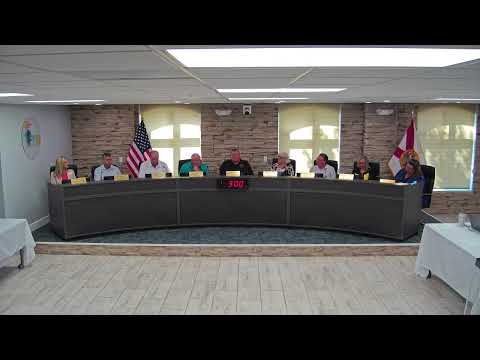
Matt Caldwell, Lee County’s property appraiser, told the Fort Myers Beach Town Council on April 6 that early runs of the 2026 tax roll show a modest decline in market or “just” value while taxable assessed value will be essentially flat.
“Right now our analysis is showing a slight decrease year over year in just value,” Caldwell said, adding that taxable value is held in check by the existing assessment caps for homestead and non‑homestead property. “So from your taxable position, essentially year over year flat with a slight decrease in just value.”
Caldwell explained the difference arises from statutory caps that limit assessed-value increases — a 3% cap for homesteads and a 10% cap for many non‑homestead properties — and a $50,000 homestead deduction. He said the office will publish draft top-line numbers on June 1 and the official roll on July 1, the date cities and counties use to shape budget decisions.
On post‑disaster rebuilding, Caldwell said the roll is counting a large volume of returned construction, but most of it is reclassified under the existing caps rather than flowing through as newly taxable value. “We had roughly $6,065,000,000 in new construction on the roll,” he said, and explained that roughly $400 million of that appears in the just‑value new‑construction category while a much smaller share (Caldwell cited about $66 million) will accrue as new taxable value for the town because of caps and exemptions.
Caldwell also described how his office determines habitability for properties still recovering from Hurricane Ian — looking at permit pulls, mailing and voter registration, third‑party data services, and physical drive‑bys — and said the office is applying stricter scrutiny now that the immediate post‑disaster window has passed.
When asked what homeowners should do if a private appraisal suggests a much higher value than the tax roll, Caldwell recommended a privately commissioned appraisal for major rebuild decisions rather than relying on the mass valuation the tax roll represents. “Our tax roll is a mass valuation model,” he said. “If you’ve got a whole‑house rebuild, get a private appraisal that determines the specifics of your situation.”
Caldwell framed the longer outlook as uncertain and driven by inflation and investor behavior: persistent inflation and where institutional money lands would have the largest influence on market direction. He also described policy options under discussion, including a move from a fixed homestead exemption toward a percentage‑based homestead credit to address inflationary erosion of the $50,000 exemption.
Councilors thanked Caldwell for the briefing; he encouraged residents with questions about individual parcels to contact his office for guidance on how the statutory formulas are applied.