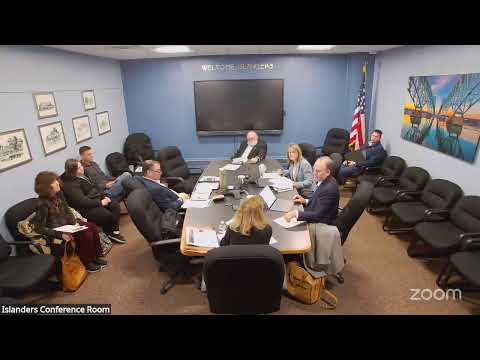
Developers pitch three town-hosted battery sites for lease revenue; board raises wetlands and interconnection questions
Loading...
Summary
Developers proposed the town lease three 5‑megawatt battery sites to a third‑party operator (Luminess/Brookfield Renewables), estimating $80,000 annual rent per site and about $4.8 million over 20 years; the board asked for engineering, interconnection and wetlands studies before pursuing an RFP.
A team of energy vendors told the Grand Island Town Board they could bring battery storage projects to town property and generate lease revenue without cost or liability to the town.
"What we're proposing is you guys being a landlord to host a couple of battery storage projects on town property," said Andy Chamber, with Community Solar Authority, during the board's workshop. He said developers would own and operate the assets and the town would be paid rent by investment‑grade tenants such as "Luminess," which Chamber identified as a Brookfield Renewables‑owned operator in the presentation materials.
Chamber proposed three candidate sites — listed in the presentation as 16 Whitehaven Road, 24 Bedell Road and 1820 Whitehaven Road — each taking about 10,000 square feet. The developer assumed 5 megawatts per site and proposed an annual lease payment of $80,000 per site (about $240,000 per year for three sites), which Chamber said amounts to roughly $4,800,000 in gross revenue over a 20‑year term under the assumptions in their packet.
Kevin, who identified himself as head of the municipal energy management program at Wave Energy/NextEra Energy, urged caution on energy‑market volatility and said municipalities often favor fixed‑rate procurement as a budget‑stability strategy. Board members pressed both presenters on how interconnection, queue positions and environmental constraints would affect final project size and timing.
The town raised practical siting questions. Chamber said the Whitehaven Road substation showed 6.3 megawatts of posting capacity in the team's analysis and displayed a 10,000‑square‑foot proposed fenced layout. Board members asked about wetlands and local permit requirements; one board member said, "So, again, let's not put a battery stored on a swamp," underscoring sensitivity to environmental constraints.
Chamber acknowledged many technical unknowns remain: final battery size will be set after interconnection and engineering studies, utilities must approve the interconnection and state agencies such as the DEC and Corps could be involved for wetland areas. He offered to pursue LOIs and interconnection studies quickly to secure queue position and incentives.
No formal agreement or RFP was approved at the workshop. Board members asked staff to run their own parcel viability analysis before authorizing any formal solicitation. The presenters said they would return with more detailed engineering, interconnection and environmental information if the town elects to proceed to an RFP or a lease negotiation.
Next steps: staff and board members agreed to assess town parcels and to request interconnection and wetlands analyses before advancing any lease or RFP process.