ACPE outlines scholarship growth, loan options and pressure on Alaska’s higher-education fund
Loading...
Summary
ACPE staff told a lunch-and-learn that expanded APS eligibility after HB 148 has quickly increased scholarship demand, that HEIF allocations (7% rule) provide APS and AEG funding, and that ACPE’s loan products and safeguards aim to expand affordable borrowing while refinance rates have increased market share; staff warned demand could outpace HEIF projections.
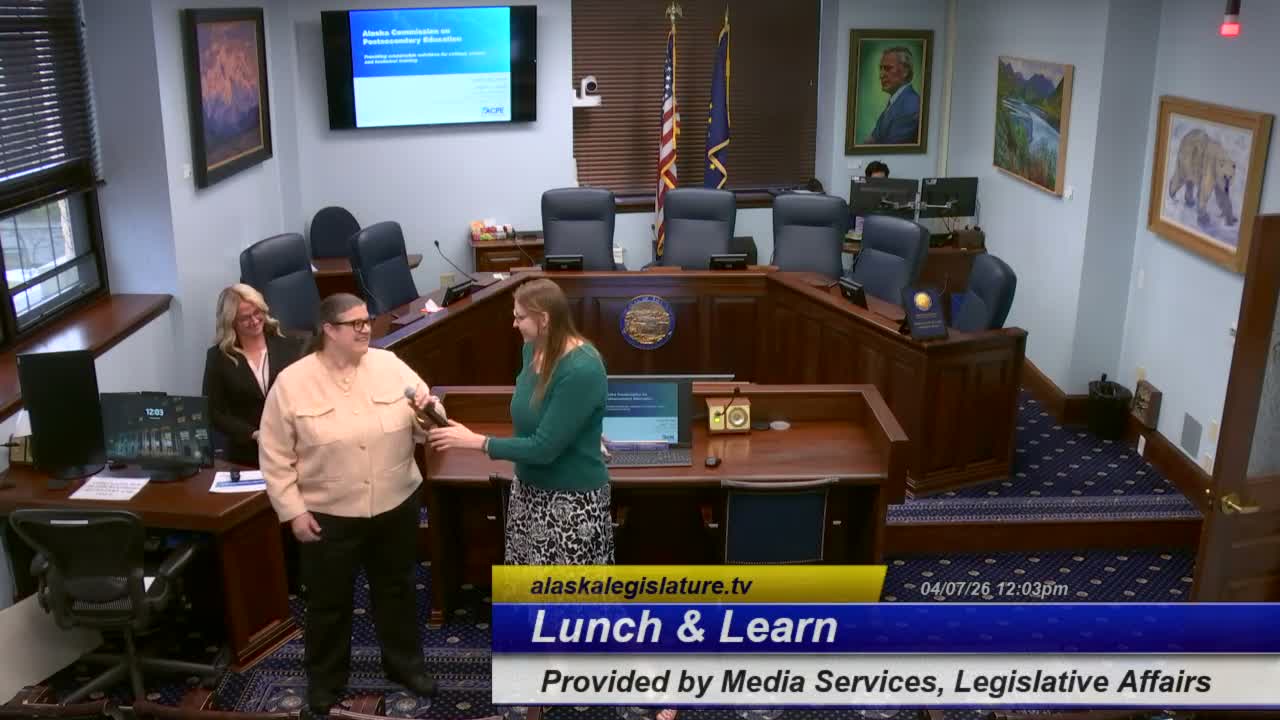
Kerri Thomas, executive director of the Alaska Commission on Postsecondary Education, told attendees at a lunch-and-learn that the agency oversees state scholarship, grant and loan programs and is funded through the Alaska Student Loan Corporation rather than the state’s general fund. "We are the state's higher education agency," Thomas said, describing ACPE’s role in administering the Alaska Performance Scholarship (APS), the Alaska Education Grant (AEG) and specialty programs.
Kate Hillenbrand, director of communications and outreach for ACPE, said ACPE’s outreach tools—AKCIS 360 for planning, the Alaska College and Career Advising Consortium (ACAC) for training local counselors, and a Success Center for FAFSA and financial-aid assistance—aim to increase students’ access to federal and state aid. "Submitting the FAFSA is an absolutely critical step," Hillenbrand said, noting Alaska historically has had very low FAFSA completion rates and that ACPE’s FAFSA Completion Initiative has produced measurable gains.
On funding mechanics, ACPE staff explained that the Higher Education Investment Fund (HEIF) is the statutorily established source for APS and AEG allocations: 7% of the HEIF balance as of June 30 is available each year for those awards, with two-thirds of that amount directed to APS and one-third to AEG. Hillenbrand said ACPE’s FY 2027 budget request sought the full 7% allocation. She warned that the rapid increase in APS eligibility and use following the passage of HB 148 (2024) has produced projections through FY2029 where demand may exceed the HEIF-based allocation.
On scholarship details, Hillenbrand said an eligible student can earn up to $28,000 through APS to be used across the equivalent of eight full-time semesters within eight years of high-school graduation; AEG is a need-based grant from $500 to $4,000 per academic year, awarded by FAFSA-determined need and date of FAFSA completion.
Hillenbrand also reviewed ACPE loan programs. ACPE offers in-school loans (supplemental and family education loans) and a refinance loan for borrowers who have finished or left school. Eligibility generally requires Alaska residency or an Alaska educational nexus, minimum credit standards (or a cosigner), and at least half-time enrollment for in-school loans. ACPE staff said safeguards limit overborrowing and that borrowing through ACPE can save students substantial interest compared with many private lenders. Hillenbrand cited a per-year loan cap of $24,000 and a lifetime cap of $96,000, and said refinance loans require at least $7,500 in qualifying education loans and may be capped at $250,000; refinance cases above $125,000 (or the cosigner) require a debt-to-income ratio of 45% or less.
Specialty programs include WinBrindle for fisheries-related students (with loan-forgiveness features), WWAMI support that funds up to 30 Alaska students in the University of Washington medical pathway and includes loan-forgiveness terms, and the WICHE Professional Student Exchange Program (PSEP) for health degrees not offered in-state.
ACPE reported recent performance improvements: the agency said it has exceeded its refinance loan-volume goal for the fiscal year and met its FY26 market-share target for student lending. Hillenbrand said ACPE has also exceeded its FAFSA-completion goal for FY25 and is on track for FY26. She noted that after HB 148’s passage, eligibility and usage of APS rose steeply—Hillenbrand said about 53% of public high-school graduates in the class of 2025 qualified for APS and roughly 1,100 students used the award.
During a question-and-answer period, ACPE confirmed that its loans can be used for graduate and doctoral professional degrees when eligibility and program rules permit, and that APS funds can be used for advanced degrees if the student has not exhausted the award and remains within the time limits. On historical loan forgiveness, Thomas said a 50%-forgiveness incentive existed in the 1970s–80s but was discontinued because it proved fiscally unsustainable and many recipients did not return to the state to earn the benefit. On refinance pricing, Hillenbrand said rates are set annually in May and currently start as low as 4.85% for fixed-rate refi loans and that printed rate sheets were available in the handout packet. When asked whether awards would be affected if the HEIF balance is not replenished, Thomas said rising demand makes projections vulnerable and that failure to replenish HEIF would compound pressure on scholarship and grant funding.
ACPE staff encouraged attendees to share program information with constituents and to refer students to ACPE resources. The session closed with thanks to Representative Kerrick and event organizers.