Sen. Lukey Tobin outlines bill to keep data‑center costs off Alaska ratepayers and require community benefit agreements
Loading...
Summary
Sen. Lukey Tobin introduced Senate Bill 250 to require data centers to bear direct infrastructure and lifecycle costs (transmission, backup generation, broadband, e‑waste removal), to use a contract‑first regulatory review with cost assignment and a rate firewall, and to include community benefit agreements; the draft omits explicit water‑usage rules and the committee set the bill aside for future public testimony.
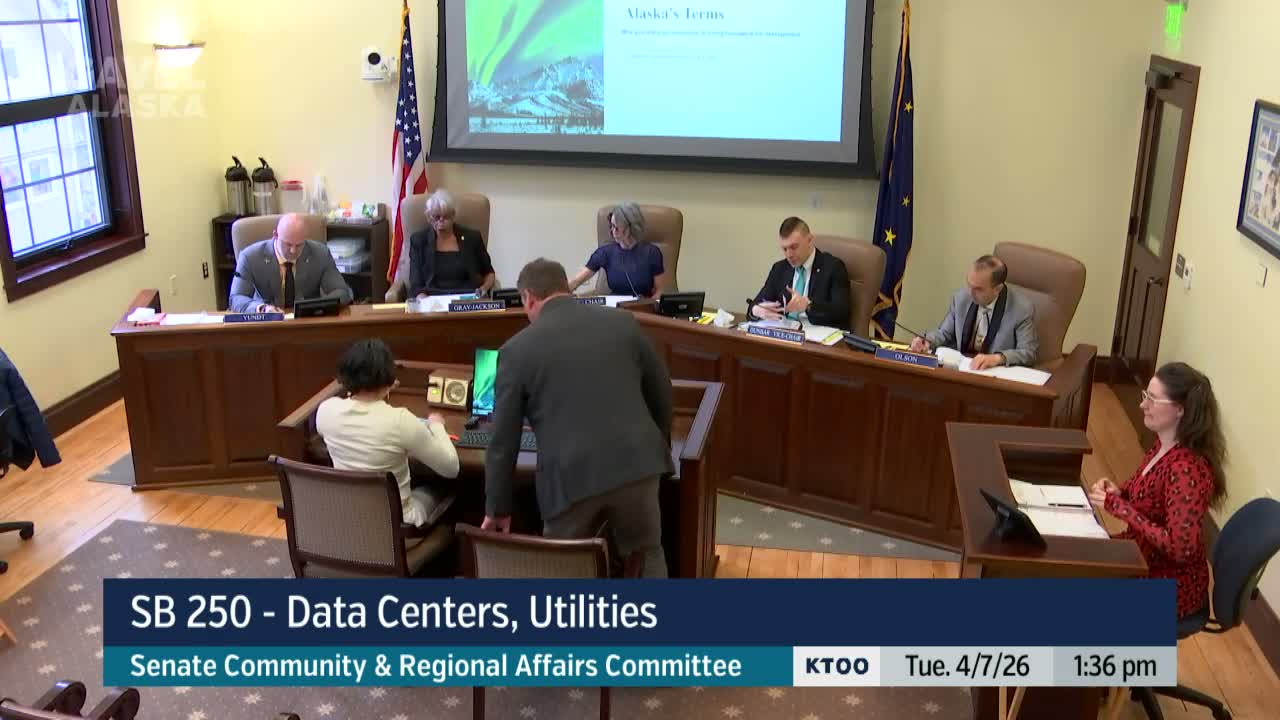
Sen. Lukey Gale Tobin introduced Senate Bill 250 to the Community and Regional Affairs Committee on April 7, 2026, framing it as a consumer‑protection and pro‑development measure aimed at ensuring data centers do not shift infrastructure or lifecycle costs to Alaska ratepayers.
Tobin told the committee the bill requires data centers to assume responsibility for transmission lines, utility connections and backup generation and to arrange broadband interconnection; he emphasized that the intent is to attract businesses while protecting consumers. “We want these enterprises to come to Alaska. However, we want to ensure that Alaskans aren't going to have to pay for that particular development,” Tobin said.
Louis Flora, staff to Sen. Tobin, presented a brief PowerPoint and said the bill would: require a commission‑reviewed contract before projects proceed; assign direct infrastructure and variable power costs to the data center (a "but‑for" cost rule); explicitly bar service to a data center from increasing rates for other consumers (a rate firewall); and require lifecycle responsibilities such as removal of e‑waste. Flora provided peak‑load context for Alaska’s rail belt (stated in the presentation as about 750 megawatts) and said a single hyperscale facility can demand roughly 100 megawatts. He described the bill as "pro‑development" while establishing clear parameters for cost assignment, community benefit agreements (CBAs), and lifecycle responsibilities.
Sen. Dunbar asked whether a CBA is mandatory and what happens if a locality and a data‑center developer cannot reach an agreement — whether that would default to the data center’s position or prevent development. Louis Flora said the bill’s language does not explicitly specify a default; the matter would typically be worked out contractually and is not spelled out in the legislation. Sen. Tobin said the issue engages local‑control and home‑rule dynamics; he pointed the committee to bill text (page 3, lines 20–24) and said municipalities may have legal recourse, including seeking injunctions, if development proceeds without agreement.
Tobin and staff also noted the current draft omits detailed water‑usage restrictions for cooling and wastewater; Tobin asked committee members to help draft a committee substitute if the committee wants to add water‑usage constraints given potential cooling and wastewater impacts.
The committee asked no further questions; Chair Merrick thanked the sponsor and staff and said SB 250 would be set aside for further consideration when the committee can receive invited and public testimony.
Next steps: No vote was taken. The bill will return for a hearing with invited and public testimony and potential amendments to address water‑usage and other community concerns.