Bear Valley resident, sponsor and DOT debate scope and costs of House Bill 317 WUI maintenance plan
Loading...
Summary
House Bill 317 would direct DOT to adopt a prioritization framework for single‑access routes to communities at wildfire risk. Testimony from a Bear Valley resident and public commenters supported the planning approach; DOT warned implementation costs could be multi‑millions and jurisdictional issues may require broader stakeholder work.
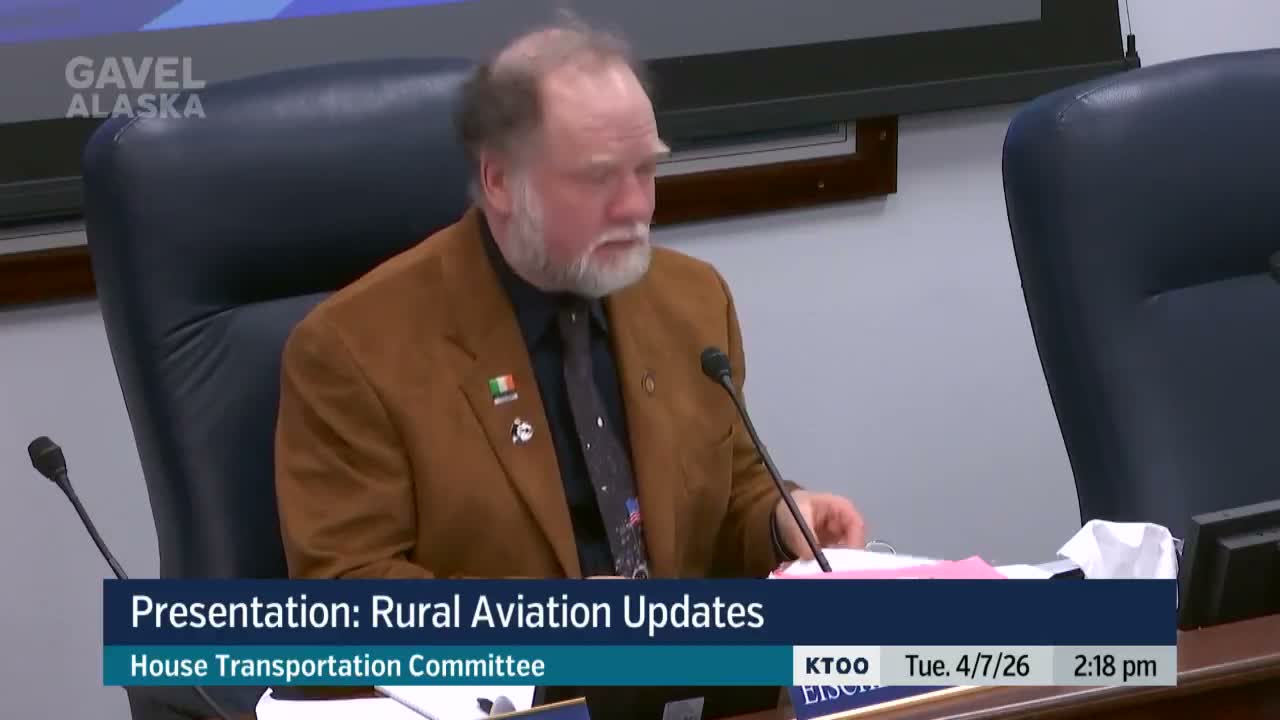
The House Transportation Committee on April 7 considered House Bill 317, a proposal that would direct the Alaska Department of Transportation and Public Facilities to adopt a prioritization framework for maintenance of routes that are the only access into residential communities in wildland‑urban interface (WUI) areas.
Aidan Nicholl, staff to Representative Kai Holland (the bill sponsor), told the committee HB 317 would require DOT to evaluate routes that access single‑ingress communities and to adopt systems for maintenance of those routes and adjacent rights‑of‑way to increase safety during wildfire events. Nicholl said staff are considering clarifying bill language to reference areas designated as “critical” or “full” under the state wildland fire management prioritization map because jurisdictions do not use a single statewide WUI definition.
Dr. Paul Flint of Bear Valley testified as an invited witness. Flint described Bear Valley as a Hillside neighborhood that relies on one access, Clarks Road, and said a relatively minor icy crash recently blocked both lanes and delayed emergency response for about 45 minutes. He testified that the valley lacks hydrants and that beetle‑killed spruce and brush close to the road create a serious wildfire and egress risk.
"If there is any sort of fire up here ... Clarks Road would ... be blocked off and closed. I'd be trapped," Dr. Flint said, arguing the community needs a planning process and clearer rules for who can perform removal work along right‑of‑way.
Public testimony from Troy Weiss, president of a WUI community action team in Anchorage, supported the bill’s approach to identifying which roads have single ingress/egress and clarifying who has responsibility for maintenance where municipal, DOT and park lands intermix.
Committee members asked several technical and fiscal questions. Andy Mills, DOT’s legislative liaison, said the department interprets HB 317 as directing a planning effort: DOT would identify priority areas and develop a framework, but actual vegetation removal, jurisdictional easement work and large‑scale clearing would require separate capital requests. Mills warned that implementation could cost “multi‑millions” to tens of millions in some corridors, giving an example figure of roughly $1 million for a portion of the Old Glenn Highway in prior work.
Members debated the appropriate vehicle for this work. Some lawmakers suggested a multi‑stakeholder task force that would include municipalities, DNR, boroughs and local community organizations to address easements, liability and cross‑jurisdictional issues. Sponsor Representative Kai Holland said pilot studies and earlier task‑force work (available in the bill packet) inform the current proposal and that the measure is meant to set policy and begin planning, not immediately fund large‑scale clearing.
The committee took no vote; staff and DOT agreed to provide fiscal documentation and the committee will consider next steps after review of those materials.