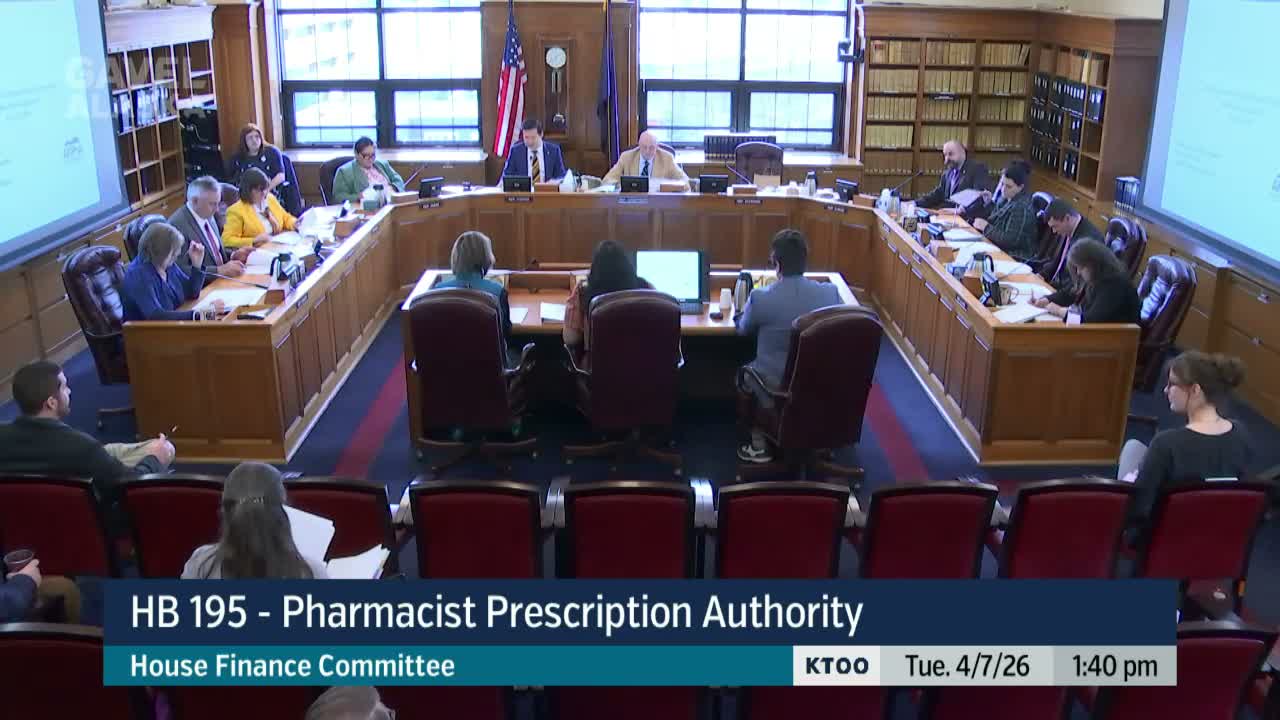
House committee hears bill to clarify pharmacists’ limited prescriptive authority amid disputes over abortion coverage
Loading...
Summary
In a lengthy April 7 hearing, supporters including Rep. Genevieve Mina and Brandy Sign Martin (Alaska Pharmacy Association) said HB 195 clarifies existing law to let pharmacists provide limited, low‑acuity care; several legislators raised concerns the bill or collaborative practice agreements could be used to enable pharmacists to prescribe abortion medication, a point the attorney general’s memo disputes.
Rep. Genevieve Mina (R‑House District 19) introduced House Bill 195 to the House Finance Committee on April 7, saying the measure clarifies 2022 changes to Alaska’s pharmacy law to allow pharmacists to provide limited, independent prescriptive authority for low‑acuity care and to operationalize those powers in a way that expands access, particularly in rural communities.
The bill’s sponsor said HB 195 was developed with the Alaska Board of Pharmacy and the Alaska Pharmacy Association and is tied to the state’s rural health transformation program, a $272,000,000 award that requires certain policies in place by Dec. 31, 2027. “This created a path to allow pharmacists to practice at the top of their education, training, and experience,” Rep. Mina said in opening remarks.
Brandy Sign Martin, executive director of the Alaska Pharmacy Association, told the committee the measure adds guardrails including a prohibition on “new diagnoses” and limits on certain controlled substances, while creating workable collaborative practice agreements and requiring registration with the prescription drug monitoring program. “These services are limited in nature, focused on routine, low‑acuity conditions, and importantly, pharmacists are already providing care within these guardrails,” Sign Martin said.
The presentation laid out examples proponents said illustrate benefits: addressing medication gaps during evacuations in rural Yukon Kuskokwim communities and resolving missing device prescriptions at community pharmacies so parents can get children home with needed care. Sign Martin also cited Idaho’s experience (policy passed starting in 2018) and studies that, she said, show cost savings and no detected patient‑safety incidents tied to pharmacist prescribing in those models.
Several committee members pressed for specifics on how the bill would operate. Rep. Josephson asked how collaborative practice agreements would scale in Anchorage versus small towns; Sign Martin said agreements typically exist at the pharmacy or clinic level and that pharmacists embedded in primary‑care clinics would use team‑based care models. On recordkeeping, Sign Martin said pharmacies increasingly use electronic records and efforts are underway to connect pharmacies to health‑information exchanges so primary‑care providers can receive visit information.
Abortion medication was a central point of contention. Multiple legislators cited an opposition letter from the Alaska State Medical Board and a legal memo circulated to the committee that argued HB 195 could allow pharmacists, under certain collaborative protocols, to prescribe abortion drugs. Representative Allard contended a written protocol could enable a physician to authorize a pharmacist to dispense such medication under a CPA.
Sign Martin and staff said the Department of Law’s senior assistant attorney general, Parker Patterson, provided a written opinion included in the packet that the bill does not change Alaska’s abortion statutes and would not authorize pharmacists to prescribe medication abortion. “House Bill 195 does not authorize pharmacists to prescribe or dispense abortion medications,” Sign Martin said, citing the assistant AG’s memo on the record. Several members said they remained unconvinced and asked that the medical board’s letter and other legal memos be included in the committee packet for review.
Other substantive points included a pathway for pharmacists to participate in medication‑assisted treatment for opioid use disorder through CPAs, education requirements (pain management and opioid‑use disorder training for new licensees), and protections that require pharmacists to recognize the limits of their training and refer patients when appropriate. Sign Martin said the bill also eliminates a fee requirement for entering a CPA and aligns continuing education timing with professional norms.
The hearing was a first reading and question period; no fiscal notes or public testimony were taken that day, and committee members set the measure aside for later consideration. Several members asked for more documentation from the State Medical Board and legal opinions distributed during the hearing.
The committee’s discussion will continue in later hearings; HB 195 has not been amended or voted on by the committee after this April 7 session.