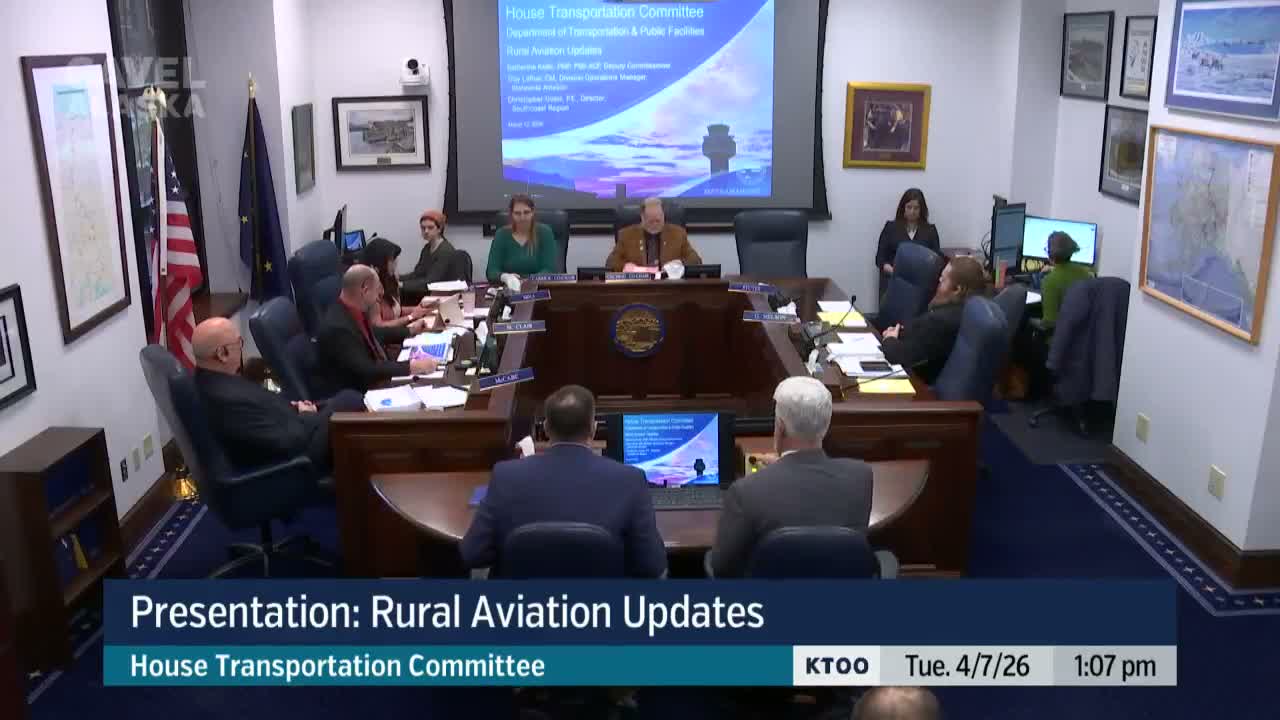
Alaska DOT outlines rural aviation funding boost, FAA safety push and expensive TSA requirements for small airports
Loading...
Summary
DOT told the House Transportation Committee it manages hundreds of rural landing areas, is seeing higher AIP/BIL funding and is implementing FAA safety measures, but said TSA security and law‑enforcement response requirements are forcing costly stopgap measures in Kodiak and Gustavus.
The Alaska Department of Transportation and Public Facilities on April 7 told the House Transportation Committee that a combination of Airport Improvement Program and Bipartisan Infrastructure Law funds have increased resources for rural airports, while operational requirements and staffing shortfalls remain a major challenge.
Christopher Goins, South Coast region director for DOT, said the state maintains “about 250 plus” state‑owned rural airports and inspects roughly 400 landing areas. He told the committee AIP and BIL together have brought an average of about $256 million a year into Alaska’s aviation system recently; in 2026 DOT said the rural system saw roughly $197 million in AIP funds and $26 million from BIL, with a 5% match requirement for many projects.
“Because we had additional money flow into the system, we have one project here that’s going to be a whole year early,” Goins said, citing Haines resurfacing, drainage, lighting and a snow‑removal equipment building as an example of projects moving sooner because of the funding changes.
DOT also emphasized workforce and equipment strains. Troy LaRue, Statewide Aviation operations manager, said equipment and maintenance costs are rising and estimated the aviation component needs roughly $24,600,000 annually from the capital improvement/AIP program to prevent a backlog of runway maintenance work. LaRue described recruitment and training hurdles for equipment operators, mechanics and electricians, saying “it takes us about a year to train up somebody at a certified airport.”
On safety, LaRue outlined the Don Young Alaska Aviation Safety Initiative, adopted during FAA reauthorization, and said the initiative’s goal is to reduce fatal accidents by 90% by 2033. LaRue identified gaps in weather‑reporting infrastructure and ADS‑B ground support, and reported the FAA will deploy additional weather systems to Alaska: DOT noted plans for 44 AWOS installations and 50 VWOS (visual weather observation systems) over two years, with VWOS offered as a lower‑cost option (about $150,000 each versus roughly $2 million for a full AWOS/ASOS deployment).
Committee members raised airport lighting and vandalism. LaRue said 28 lighting systems have significant, difficult‑to‑fix problems and that vandalism and animal interference have been reduced by community outreach and emergency lighting kits but still impose costs and operational risk.
TSA security requirements emerged as one of the hearing’s most consequential operational issues. DOT described 18 airports that now require badges for secure‑area access and said the lack of a multi‑airport badge means staff must obtain multiple credentials. LaRue said small communities often can’t meet TSA’s law‑enforcement response requirements (for example, a 15‑minute response time and arrest authority at Part 139 airports). That gap forced DOT to rotate qualified officers from other locations as a temporary solution.
Christopher Goins said the state paid roughly $900,000 a year to fly and overtime‑staff officers into Kodiak to meet TSA requirements and avoid the risk of losing a Part 139 certificate or civil penalties. DOT estimated Gustavus costs at about $70,000 a year for a 90‑day arrangement that keeps subsidized air service in place. “Right now, we are carrying that cost on our overhead budget and have had to make significant cuts within the region to make this all work,” Goins said.
The presentation also covered emergency response capabilities. Goins described drone‑enabled damage assessments after Typhoon Heilong: DOT said 40 DOT and partner staff completed assessments in 34 communities over three days, reporting roughly 13,000,000 pounds of materials moved, installation of 4,500 helical piles, 6,500 boardwalks, 70+ homes moved back into place and about 200 homes substantially repaired with another 150 under repair.
Committee members praised the rapid response but pressed DOT on unresolved funding and jurisdictional questions. Andy Mills, DOT legislative liaison, told lawmakers the bill discussion before them (House Bill 317) is primarily a planning effort and that implementation — clearing, construction and long‑term maintenance — would require separate appropriations and could reach multi‑million or tens‑of‑millions of dollars in large areas.
The committee did not take a vote on any item during the presentation. DOT staff promised follow‑up information on specific local procurement questions and the FAA/VAWOS rollout timeline.
The department said it will continue to seek federal and congressional partners to address systemwide gaps and will return with budget and technical details as requested by the committee.