Get Full Government Meeting Transcripts, Videos, & Alerts Forever!
Get email alerts on the Consumer Protection topic
No spam. Unsubscribe anytime.
Sen. Brad Hudson presents bill to curb abusive website-access suits; business groups back changes, lawyers flag —good faith— concerns
Summary
Sen. Brad Hudson urged passage of legislation aimed at stopping targeted "sue-and-settle" website-access lawsuits. Business groups and chambers supported a narrower standard and broader entity coverage; attorneys told the committee that a —good faith— standard is fact-driven and likely evaluated by trial courts.
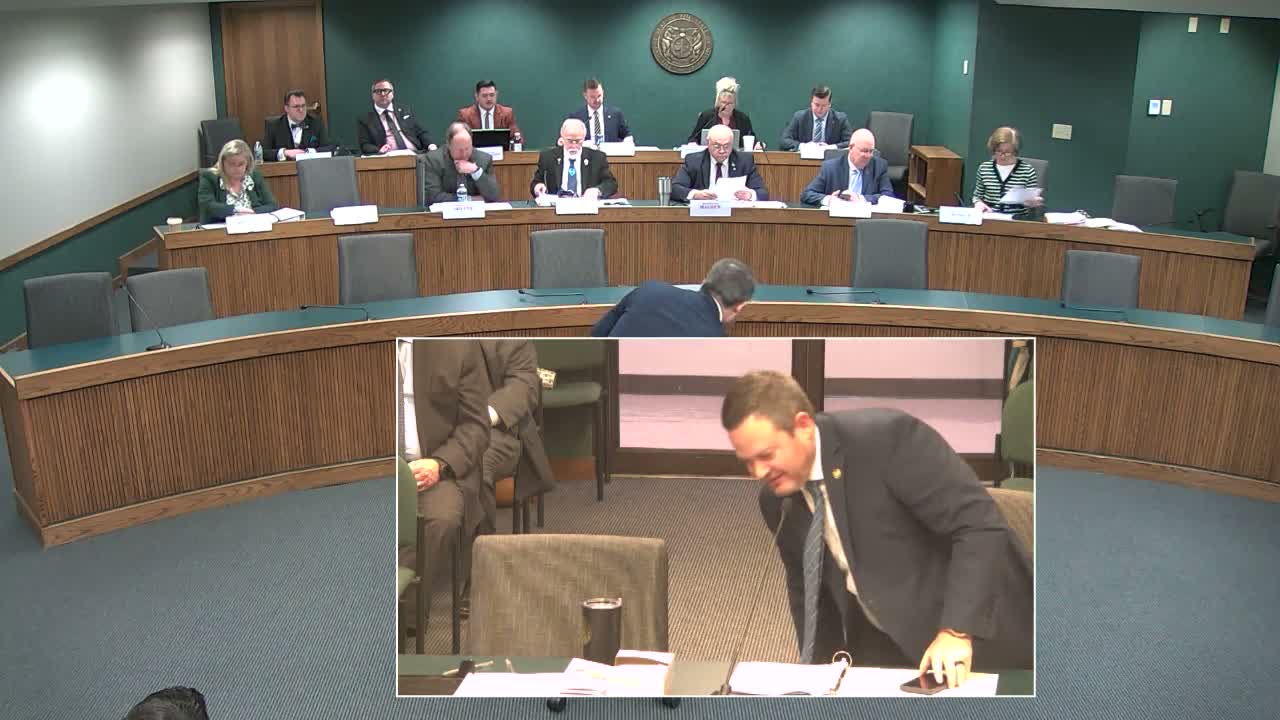
Sen. Brad Hudson told the House Commerce Committee that Senate Bill 907 seeks to curb abusive website-access litigation in which a single plaintiff allegedly targets business and public-entity websites, threatens suit, and settles for nominal amounts. "It's a shakedown," Hudson told the committee, arguing the measure would protect businesses, political subdivisions and — with additional drafting — churches and nonprofits.
Multiple business and industry witnesses went on record in support. Jared Hankinson, vice president of government affairs for the Missouri Chamber of Commerce and Industry, recommended two drafting changes: drop a restrictive cross-reference to chapter 351 so the bill covers entities that do not file under that chapter, and return the language from the original draft to avoid imposing a higher "good faith" standard that could make relief harder to obtain. "We are going to simply strip that under chapter 351 language," Hankinson said, asking the committee to restore language focused on whether a claim was filed for the primary purpose of obtaining payment.
Brad Jones of the National Federation of Independent Business described repeated suits hitting small businesses and nonprofits, saying settlement pressure and legal costs can escalate. Jones recounted local cases and told the committee that settlement figures in some matters start at about $12,000 $15,000 and can rise to $50,000 $80,000 once outside counsel is retained.
Attorney David Klarich, called to explain the legal standard, told members that a "good faith" determination is fact-driven and often resolved by trial courts under a preponderance-of-the-evidence standard; he cautioned that trial courts have broad factual discretion and suggested that some solutions (including loser-pays provisions) could have unintended consequences that limit access to courts.
Committee members probed whether the bill would overreach, whether insurance coverage typically responds in these cases, and whether professional-discipline or Rule 11 sanctions have been used against serial plaintiffs. Witnesses and counsel said some enforcement tools exist but that this legislation is a targeted, legislative response to a pattern of suits many witnesses called abusive.
The committee did not take a final vote on Senate Bill 907 at this hearing. Members asked staff to work with the senator's office on drafting changes to ensure coverage for the intended entities and to clarify the standard for courts.
The hearing record in the transcript shows broad support from business groups and industry associations and shows that the central legal issue the committee will likely resolve in future drafting is whether and how to define a court standard such as "good faith."