Get Full Government Meeting Transcripts, Videos, & Alerts Forever!
Get email alerts on the Landscaping topic
No spam. Unsubscribe anytime.
Port Richey council reviews US 19 median landscaping plan, agrees to foxtail palms pending DOT approvals
Summary
Consultants presented a US 19 median design to the Port Richey City Council on April 7; the council discussed Florida visibility-triangle limits on planting heights, weighed palm species, flagged maintenance needs and asked staff to update plans for DOT review and bidding.
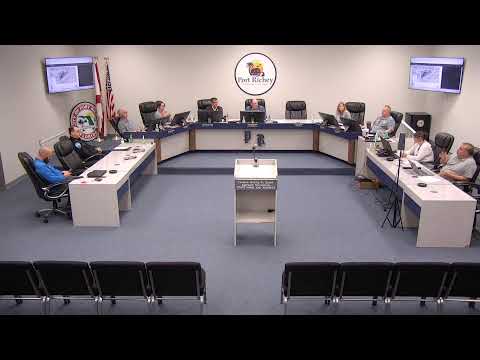
Port Richey City Council members on April 7 reviewed a landscape design for the US 19 medians and directed staff to revise plans with foxtail palms for most locations while pursuing Department of Transportation permitting and grant-funded construction. David Flanagan, a landscape architect with Kimley Horn, presented the plan and answered council questions about planting height limits, species choices and maintenance requirements.
The proposal is tied to a grant and would beautify roughly a mile of medians along US 19. Flanagan told the council that DOT as-builts show small stretches where the road’s design speed is 45 mph, allowing taller plantings at the bridge and near Ridge Road, but Florida law and industry practice limit plantings inside billboard visibility triangles to the driver’s eye line at 3.5 feet. “The billboard companies...they’re not gonna allow anything above 3 and a half feet,” Flanagan said, describing how plans are reviewed and why taller shrubs are restricted in many sections.
Those constraints shaped the council’s discussion about which palms and shrubs to use. Flanagan reviewed options—date palms, sable/cabbage palms, ribbon palms and foxtail palms—outlining trade-offs for aesthetics, cold tolerance and maintenance. He estimated an 18–20 foot clear trunk date palm could cost roughly $3,000–$4,000 depending on market fluctuations, and noted plantings on contract typically carry a one-year warranty. He also recommended dense massing of lower shrubs to achieve immediate visual impact from a moving vehicle while placing taller specimens only where the statutory/engineering clearance permits.
Council members repeatedly raised maintenance and safety questions. Flanagan said establishment watering would generally be handled once a week with a water truck and stressed that median maintenance requires lane closures and appropriate traffic control. “If you spend this money…get a maintenance contract underway,” he advised, noting that a defined contract clarifies frequency and cost. Council members said they wanted low‑maintenance selections and asked staff to evaluate contract options so the city would not be left with disproportionate upkeep costs.
Staff and the consultant also discussed schedule and permitting. Council staff said FDOT permitting remains outstanding; if the council obtains the $250,000 appropriation tied to the grant, the earliest construction start would be July 1 after the bid process. Flanagan said the team could update the plans quickly and deliver revised sheets for staff review so the city could submit permit applications and prepare bid documents.
By the end of the workshop the council signaled support for foxtail palms in many locations because of their cleaner appearance and lower fruit‑drop maintenance compared with some date palms, with taller accent palms reserved only for the limited sites where engineering and statute allow. Staff was directed to get updated plans to staff reviewer Licari and continue coordination with sign, median and Grand Boulevard projects to avoid rework.
The meeting concluded with a motion to adjourn that passed by voice vote.