Get Full Government Meeting Transcripts, Videos, & Alerts Forever!
Get email alerts on the School Budget topic
No spam. Unsubscribe anytime.
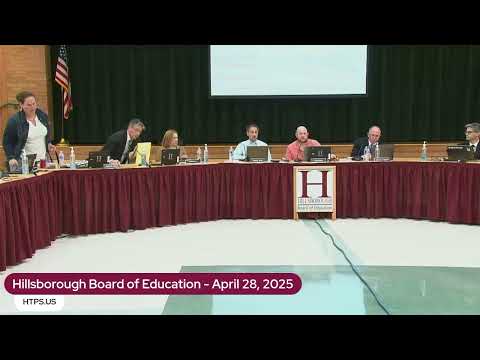
Hillsborough board approves $21.9 million tax-levy increase after 5–4 vote
Summary
After public comment and hours of debate, the Hillsborough Township Board of Education approved a budget that increases the local tax levy by roughly $21.9 million (including a $1 million state match) to restore staff and fund one-time projects; the measure passed 5–4 and remains contingent on state approval of specific line items and the governor's appropriation act.
HILLSBOROUGH, N.J. — The Hillsborough Township Board of Education voted 5–4 on April 28 to adopt a revised 2025–26 budget that uses a state tax-levy incentive to add roughly $21,931,626 in local levy capacity plus a $1,000,000 state match, a package administration said would restore about 24 positions and fund one-time capital projects.
The motion to approve Option 1 passed after an amendment to scale back the levy to $8,750,000 failed earlier in the meeting. Board members who voted in favor said the larger package was necessary to avoid staff reductions, preserve student services and stabilize the district; opponents cited fiscal responsibility and concerns about imposing a major tax increase on residents without a referendum.
Superintendent Mike Volpe told the board the district faces a structural deficit driven mainly by state-aid cuts, estimating a baseline decline of roughly $7.5 million since 2019 and cumulative losses exceeding $26 million. Volpe said Option 1 would restore services cut under the tentative budget — including reinstating courtesy busing, middle school sports and pay-to-play suspensions — and return about 24 positions to the payroll. He also said administration planned about $15 million in nonrecurring capital and facility projects in the first year, from replacing trailers at Triangle School to bus-garage work and building repairs.
"This is just math," Volpe said in his presentation, explaining that state aid reductions, rising health-benefit costs and fixed contractual salary obligations leave the district with limited revenue options. He repeatedly cautioned that the package still depends on two external approvals: the governor's appropriation act and the state Department of Education's review of the district's line items.
Business administrator Jerry Ecker reviewed the two budget options on the table. He listed Option 1's general-fund total near $172.7 million (about $176.9 million including grants/entitlements), and Option 2 (the tentative budget) at about $149.8 million (roughly $153.9 million total). Ecker said the difference between the two options is the roughly $22.9 million in additional levy capacity the state indicated the district could request.
Public comment that preceded the vote included more than a dozen speakers: students, parents, teachers and union representatives urged the board to adopt Option 1. A high-school student representative warned that large class sizes and staff losses would harm college recommendations and the student experience; teachers and a union leader described interventionists and counselors as essential to struggling students. State Assemblyman Roy Grama, speaking as a resident, encouraged supporting the schools and summarized state tax-relief programs for seniors.
Opposing board members, including Mr. Davis and Mr. Hill, said they could not support the full levy without broader voter input and questioned whether the state's incentive structure shifted an unfair burden to local taxpayers. "There's a difference between not wanting to pay more taxes and not being able to pay more taxes," Mr. Hill said during the debate.
An earlier motion to amend Option 1 to an $8,750,000 levy (described during discussion as producing a flat tax rate) failed on a roll call that produced two yes votes and seven no votes. Later, the final adoption of Option 1 passed 5–4; board members Craig, Lanningbeater, Lee, Nurse and Rooney voted yes; Davis, Jackson, Stets and Hill voted no.
Administration and the board stressed that the adopted budget is contingent on the state approving the district's list of nonrecurring and recurring items and that the governor's appropriation act must become law for the incentive to apply as presented. Ecker said the district must submit the approved budget by the May 14 deadline; if the state later removes significant items from the district's list, the board could be required to reconvene and revise the submission.
Votes at a glance
- Motion to amend Option 1 to a $8,750,000 levy: failed (2 yes, 7 no). - Motion to adopt Option 1 (full tax-levy incentive; ~ $21.9M levy increase plus $1M state match): passed 5–4. Yes: Craig, Lanningbeater, Lee, Nurse, Rooney. No: Davis, Jackson, Stets, Hill. - Action-agenda package (health-benefits waiver, capital reserve withdrawals, Sodexo renewal, ADA ramp submission, professional services, travel reimbursements and corrective action plan): approved by roll call.
What the budget would change and what remains uncertain
Administration said the Option 1 package would restore roughly 24 positions that the tentative budget would have eliminated or left unfilled (interventionists, some elementary teachers, a central-office purchasing secretary and other roles) and reinstate some suspended services. About two-thirds of the extra funding was described as nonrecurring capital projects meant to reduce recurring obligations in future years; the board emphasized that a material portion of the package would be one-time spending to avoid repeating this exact scenario next year.
But the district does not yet know which line items — if any — the state might deny when it reviews the submission, and Volpe warned that if large recurring costs are rejected by the Department of Education the board could have to hold an emergency meeting to re-evaluate the submission.
Next steps
Administration will submit the approved budget to the state by the May 14 deadline and await the state Department of Education's review and the governor's appropriation act. The superintendent and business administrator said they will notify the public if the state removes items and will recommend an emergency meeting if changes would materially alter the district's recurring obligations or staffing restorations.
The board also approved routine agenda items (health-benefits waiver, capital withdrawals, contracts and other operational motions) during the same meeting.
(Reporting: quotes and attributions are taken from speakers' remarks during the April 28, 2025 Hillsborough Township Board of Education meeting.)