Get Full Government Meeting Transcripts, Videos, & Alerts Forever!
Get email alerts on the School Solar topic
No spam. Unsubscribe anytime.
Waterbury approves bond authorization for rooftop solar at five public schools
Summary
After a public hearing with residents and technical Q&A, the Board of Aldermen approved a capital appropriation and bond authorization to install rooftop solar arrays at five Waterbury public schools. The projects will be owned by the city and funded primarily through the state DAS program with federal reimbursement.
The Waterbury Board of Aldermen on Sept. 23 approved a capital appropriation and bond authorization to install rooftop solar photovoltaic arrays at five Waterbury public schools after a public hearing and committee review.
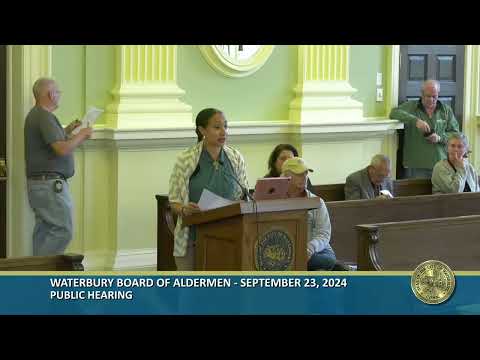
The committee vote followed public comments from local residents who urged the board to back the projects for long‑term savings. ‘‘Having solar panels on the roofs will be a big savings for the city considering our electric rates are through the roof,’’ said Martin Spring, a Waterbury resident who spoke during the hearing. Marissa Alvarez, a Waterbury homeowner with seven years of residential solar experience, told the board her household’s August bill once read $8.66 and offered production data she said demonstrates savings.
City finance director Michael LeBlanc introduced the project and the city’s clean‑energy consultants, who answered members’ technical questions. Consultant Robert Klee said the projects will be funded through the state Department of Administrative Services (DAS) school construction program with roughly 79% state reimbursement and the balance from federal sources, and that the arrays must be owned by the city. ‘‘They have to be owned by the city,’’ Klee said. Consultants said there will be no battery systems on these arrays; surplus generation will be handled through the utility (Eversource) program.
Consultant Alan Sabins said the city will use a two‑step procurement approach: an RFP to hire a contractor to build the arrays and a separate RFP, required by the state, to hire a contractor to provide routine maintenance and monitoring after installation. The project will include public‑facing monitors in school lobbies and city login access to track production; the maintenance contractor will also receive alerts to respond to underperforming equipment. Sabins said the roofs selected were generally less than two years old to align asset life with a 20‑year project horizon.
On warranties and equipment life, Sabins said typical module warranties run about 20 years, inverters can be warranted up to 20 years, racking 15–20 years and workmanship warranties commonly range from 1 to 5 years. The consultants told the board routine monitoring and annual inspections would be part of the service specification in the RFP.
The Committee of the Whole moved and approved the unfinished business item to authorize the appropriation and bond authorization for the five school arrays; the motion carried. The board returned to regular order afterward and placed the item on the consent calendar for final approval.
The project’s next steps are to finalize specifications, issue the RFPs for construction and, separately, for maintenance services, and to proceed with state reimbursement and federal funding administration. The board did not set installation dates during the meeting.