Get Full Government Meeting Transcripts, Videos, & Alerts Forever!
Get email alerts on the Vulnerable Workers topic
No spam. Unsubscribe anytime.
House committee advances bill expanding protections for 'vulnerable workers' after emotional testimony
Summary
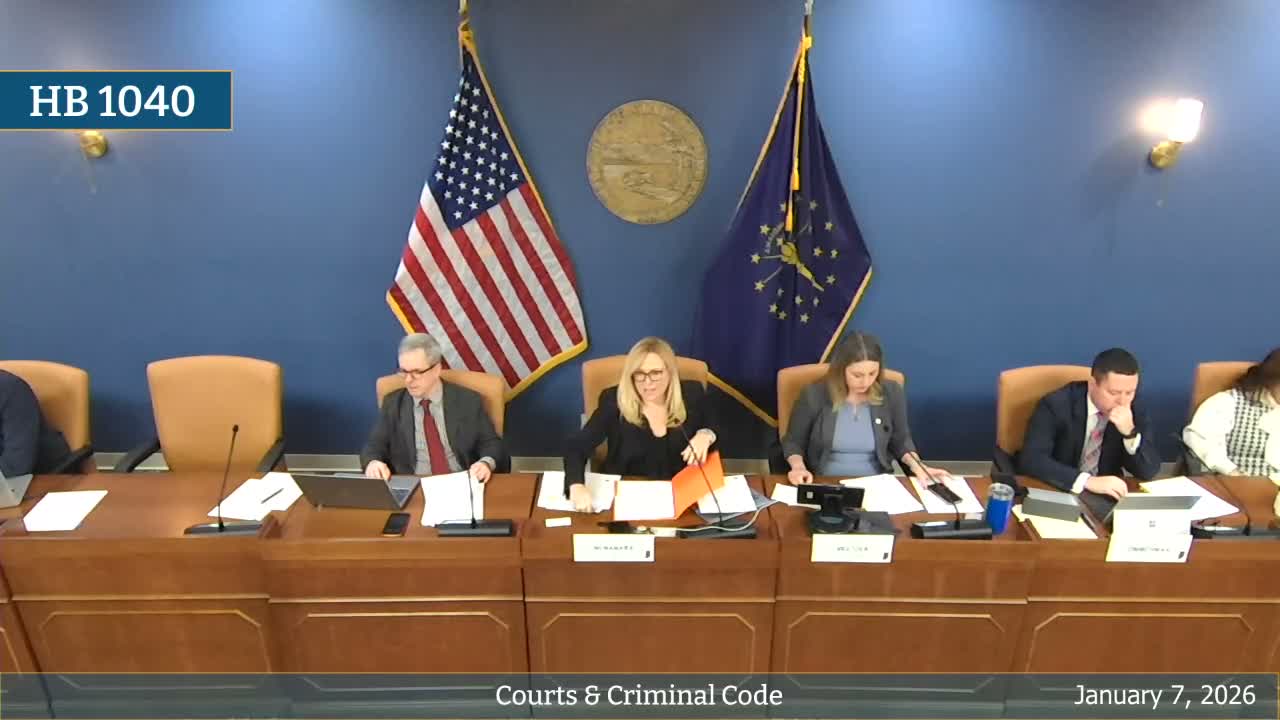
After extensive testimony from emergency clinicians, nurses and hospital leaders, the committee passed House Bill 1040, adding health care and certain school employees to a 'vulnerable workers' enhancement and adopting a reporting amendment; the measure passed 11–1.
Representative McNamara secured committee approval Thursday for House Bill 1040, a proposal to expand enhanced battery penalties to include health care and school employees and to create time-bound incident reporting to improve data on workplace violence.
Supporters said the bill closes a gap left after earlier laws that focused on emergency departments. "Workplace violence is something that almost every worker in the emergency department is personally familiar with," said Dr. Lindsey Zimmerman, a practicing emergency physician and past president of the Indiana chapter of the American College of Emergency Physicians, citing polls showing high rates of assault against emergency clinicians.
Nurses and hospital executives gave personal and system-level accounts of assaults and near-misses. "He scratched me... he hit me and he spit in my face," said Tracy Klinkhammer, a registered nurse who described a physical attack in a freestanding emergency department that resulted in her taking preventive medications and pursuing charges. Jason Gilbert, chief nurse executive for Indiana University Health, told the committee IU Health recorded 1,180 workplace-violence events in 2025 and that 21% of those included physical violence.
The bill includes a carve-out for incidents where the offender is detained or committed under Indiana mental-health statutes so that enhanced penalties do not apply to individuals solely because they are experiencing a psychiatric crisis, language the author said is intended to avoid criminalizing severe mental illness.
Lawmakers also debated data collection. An amendment adopted by consent requires facilities or designated employers to submit reports to the Department of Labor: an 8-hour immediate report in cases mirroring OSHA's death/disaster triggers and a 24-hour report for other serious incidents, though witnesses said the committee could refine timelines to fit hospital workflows. Dr. Zimmerman acknowledged hospital reporting varies and suggested syncing with existing internal reporting periods.
Not all testimony was unqualified. Zach Stock of the Indiana Public Defender Council said he respected the bill's clarity but cautioned against expanding enhanced penalties occupation-by-occupation without a limiting principle and urged lawmakers to focus on circumstances rather than titles. Representative Matt Pierce, the lone no vote, said he doubted enhanced penalties alone are an empirically proven deterrent.
The committee approved the amended bill on a roll call of 11–1. The measure will proceed to the next step in the House process.
The committee record shows multiple providers and systems asking for continued work on implementation details such as reporting windows, how commuting protections are written, and whether additional offenses should be considered in later sessions.