Get Full Government Meeting Transcripts, Videos, & Alerts Forever!
Get email alerts on the Urban Agriculture topic
No spam. Unsubscribe anytime.
House Agriculture Committee advances study of urban microfarm zones after broad stakeholder support
Summary
The House Agriculture Committee voted 9–0 to advance SB 164, which directs the Department of Agriculture to study the feasibility of establishing community and urban microfarm zones statewide; testimony from food banks, urban farmers and agricultural groups highlighted food‑security benefits and local training programs.
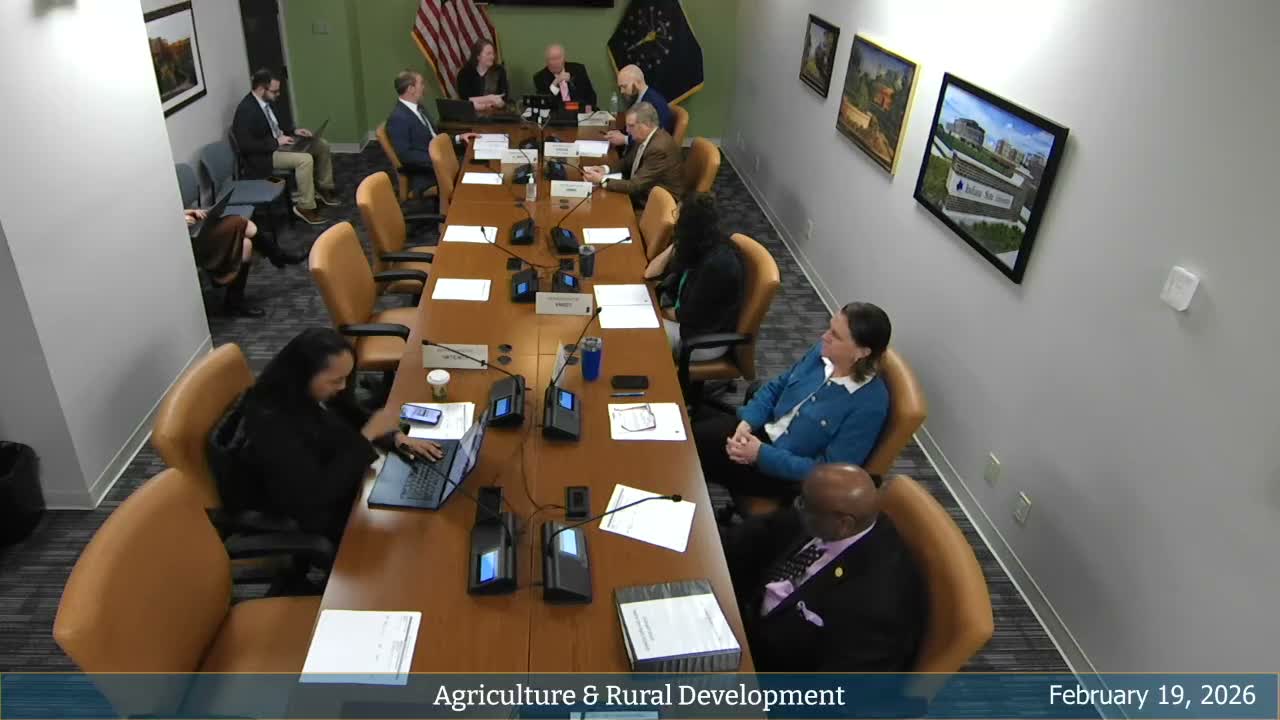
The House Agriculture Committee on Wednesday voted 9–0 to advance SB 164, a bill directing the Department of Agriculture to study the feasibility of establishing community and urban microfarm zones across the state.
Senator Spencer, who sponsored the bill, told the committee the proposal would require the department "to conduct a study regarding the feasibility of establishing community or urban microfarm zones statewide and then report on these findings to the General Assembly," and said the study should be completed without new funding.
Supporters who testified said the study could highlight ways to improve local food security and expand opportunities for small and urban growers. Mindy Dillinger of Feeding Indiana's Hungry, a statewide association of 11 food banks, said the organization supports the bill and asked the committee to consider how a study could surface partnerships between food banks and small urban producers.
Rita Graves, director of Faith Food is Medicine and an urban farmer, described converting blighted land next to a church into Faith Farms and Orchard and said, "Today, we produce over 40,000 pounds of food," most of which were donated to food banks last year. Graves told lawmakers the operation is under one acre, employs seven people, operates a prescription‑produce program tied to medical referrals, provides medically tailored meals, and runs a youth training program called Next Urban Ag Generation. She said the internship pays $15 per hour for nine hours a week over six weeks.
Reagan Hatcher, a committee member, praised the farm's work and suggested the city might repurpose adjacent closed school property to expand production. Desi Reibel of Indiana Conservation Voters and Katrina Hall of the Indiana Farm Bureau also went on record in support. Hall highlighted Purdue's Ag Innovation Center as an example of federal and university programs that help small and urban growers with growing techniques, preservation and business mentoring.
Committee members discussed a possible related summer study on food deserts and whether that work should be merged with SB 164 as an amendment. Chairman Mike Aylesworth called for a roll call; the committee recorded nine votes in favor, with two members excused.
With the committee's do‑pass recommendation, SB 164 will proceed in the legislative process; the committee did not specify further scheduling or next steps during the hearing.