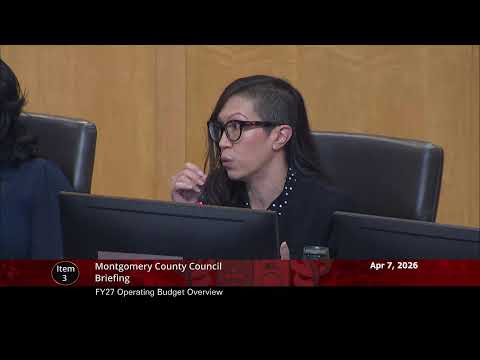
Council hears FY27 budget briefing; members spar over proposed tax increases and use of reserves
Loading...
Summary
Council staff presented the executive’s FY27 recommended operating budget, including a proposed 6.3¢ property tax increase for MCPS and income‑tax rise from 3.2% to 3.3%. Council members debated use of one‑time reserves, a projected FY28 structural gap of roughly $257.3M, and options if taxes are not approved.
County staff and the Office of Management and Budget presented the executive’s FY27 recommended operating budget to the council on April 7, outlining a tax‑supported operating plan just over $7 billion and describing key drivers and tradeoffs.
Staff framed the budget against four years of above‑average revenue growth and noted the executive’s proposal includes a 6.3¢ property‑tax increase tied to MCPS and an income‑tax rise from 3.2% to 3.3% (the income‑tax change would generate about $24 million in FY27, with full phase‑in later). Staff highlighted compensation and benefit adjustments as major cost drivers: roughly $47.4 million for county‑government pay adjustments and about $161.6 million for MCPS pay adjustments in FY27 were cited as components of the proposed increases.
The presentation included a structural‑deficit estimate for FY28 that staff characterized as a potential $257.3 million gap (equivalent to roughly a 9.85¢ tax increase) if current assumptions hold. Staff also described proposed use of one‑time reserves ($191.1 million) to meet FY27 needs and three scenarios the council may consider if it declines parts or all of the proposed tax increases.
During the council’s question‑and‑comment period, several members voiced deep concern about using one‑time reserves for ongoing costs and the prospect of increasing a structural deficit. Council members pressed staff for more granular figures (requested: the FY27 dollar difference with and without tax increases; the detailed list of the approximately $19 million in efficiencies the executive cited; precise impacts of negotiated compensation agreements). Office of Management and Budget staff defended the executive’s balancing choices—arguing the budget invests in safety‑net services, climate and infrastructure—and agreed to supply the requested line‑item clarifications to council members.
Council members disagreed on broad approach: some argued taxes now would be a necessary investment in services and equity; others warned that relying on reserves and tax increases would compound long‑term fiscal stress. Staff committed to provide follow‑up analysis, including the dollar impacts of the tax‑rate decisions and a line‑by‑line reconciliation of maintenance‑level versus new program costs, to inform committee work sessions and public hearings scheduled the same day.