Get Full Government Meeting Transcripts, Videos, & Alerts Forever!
Get email alerts on the Education topic
No spam. Unsubscribe anytime.
House committee hears sharply divided testimony on bill to create Indianapolis Public Education Corporation
Summary
House Bill 1423 would create an appointed Indianapolis Public Education Corporation to manage transportation, facilities and a unified accountability system inside IPS boundaries. Supporters said it would expand coordinated transportation and operational efficiency; opponents warned it would strip locally elected power, concentrate tax authority and leave special‑education funding and bondholder issues unresolved.
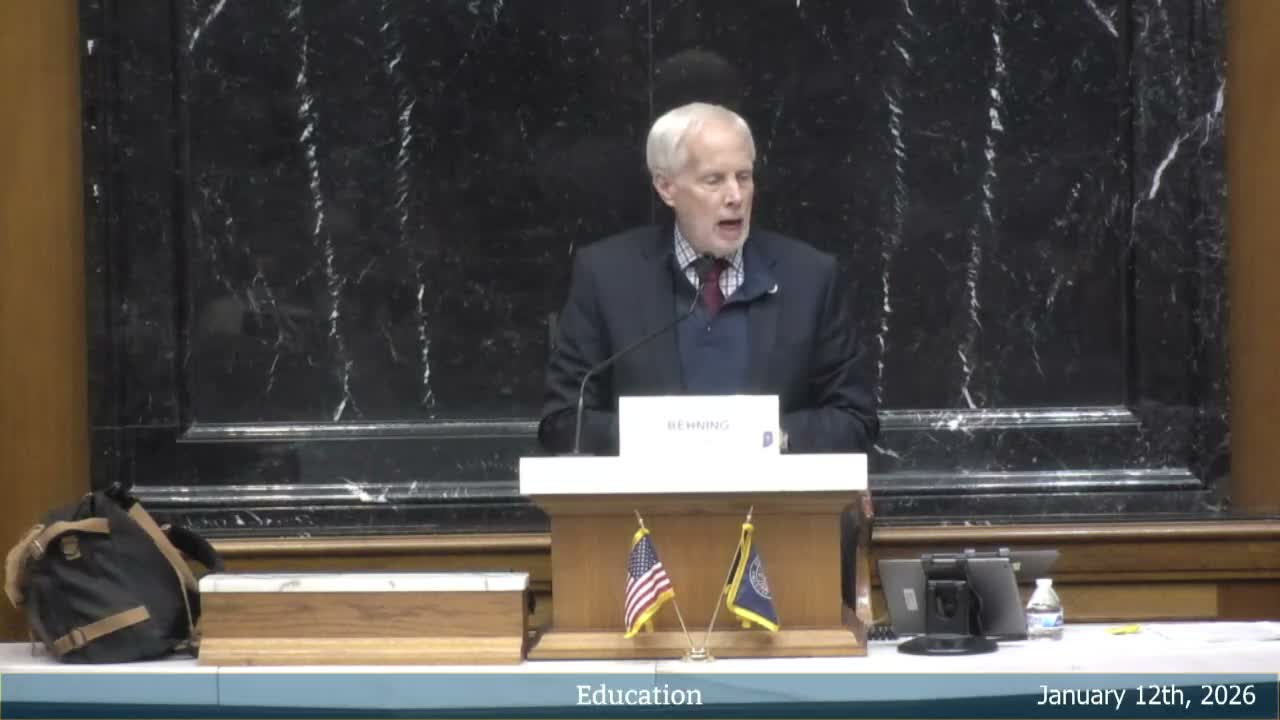
House Education Committee members on Monday heard three hours of testimony on House Bill 1423, a follow‑up to House Enrolled Act 1515 that would establish an Indianapolis Public Education Corporation to run transportation, facilities and a single performance framework for all public schools within the IPS geographic boundary. Committee members and dozens of public witnesses described the bill as an attempt to resolve fragmented services for district and charter schools, and as a risky centralization of authority.
The bill, drawn from the Indianapolis Local Education Alliance (ILEA) report, would create a nine‑member municipal corporation board appointed by the mayor that would oversee unified transportation, facilities management, a common enrollment system and a single school performance framework across district and charter schools in the IPS boundary. Michael O'Connor, who served as the ILEA project manager, told the committee the recommendations grew from 10 ILEA meetings, extensive public comment and an attempt “to develop a unified facilities and transportation plan that supports all students within the IPS district.” He said where the ILEA could be specific, the draft legislation “is a very good reflection” of the recommendations, but that fiscal issues—particularly property‑tax distribution, bondholder equity and debt associated with buildings—require further expert analysis.
Why it matters: proponents and opponents framed the bill as offering opposite remedies for the same problems. Supporters said coordinated transportation and facilities could remove operational burdens from principals and enable schools to focus on instruction, while opponents said the governance design would hand control of tax revenues and public assets to an unelected body accountable to the mayor rather than IPS voters.
Supporters’ case: charter leaders, some school operators and business and civic groups said a neutral operations authority would expand access to reliable transportation and modern facilities. Eddie Rangel, CEO of Adelante Schools, testified HB 1423 would allow school leaders to “decouple academic and operational leadership” so principals can concentrate on instruction. Taylor Hughes of the Indy Chamber said system‑level operations could address a looming IPS cash‑flow cliff and improve efficiency. Several charter leaders, including representatives of Education One at Trine University, defended their authorizing practices and warned that limiting high‑quality authorizers could reduce oversight options.
Opponents’ concerns: many current and former IPS educators, parent groups and education advocates opposed the mayoral appointment structure and the prospect of shifting fiscal authority and facility control. Kristen Fair of the IPS Parent Council said elected boards are a direct line of accountability to families and cautioned that an appointed body with fiscal and closure authority “will strip parents of their power.” Multiple witnesses warned the provision allowing closure of chronically low‑performing schools must be paired with strong community safeguards and long transition timelines. Representative Smith asked repeatedly how bondholder claims and existing building ownership by charters or nonprofits would be handled; O'Connor said those are complex fiscal issues the ILEA could not fully resolve in its report.
Special education and funding: the ILEA asked the General Assembly to provide full special‑education funding within the IPS boundary; O'Connor and several witnesses said IPS currently covers special‑education costs at an approximately $24 million annual deficit. Multiple speakers urged that any governance change preserve or strengthen commitments to fund special education and clarify whether and how costs would be shared across school types.
Authorizer limits and conflicts of interest: Section 6 of the draft would narrow which authorizers can approve new charters inside the IPS boundary. Supporters argued that reducing the number of authorizers would create coherence; opponents said it would reduce choice and could entrench conflicts if charter leaders sit on a board that controls tax levies and facility distributions. Several speakers urged explicit recusal rules and statements of economic interest for any board members with ties to school operators.
Process and timing: witnesses across positions called for more time to resolve implementation questions. Tina Algren, the only classroom educator who voted against the ILEA recommendations, urged the committee to send the bill for a summer study committee rather than rush implementation. Committee members also discussed timing inconsistencies the draft creates: certain prohibitions or authority transitions are set to begin before the mayor must make appointments, and members suggested legislative drafting fixes.
What happened next: the committee allowed roughly 50 sign‑ups for public testimony and adjourned without a vote. Chairman called for further legislative work to clarify timelines, bondholder protections and funding formulas before the bill advances. Representative Smith said the bill "will not be considered this week."
The hearing transcript indicates broad agreement that transportation and facility coordination are pressing issues in Indianapolis. The core dispute is governance and fiscal mechanics: whether to give a new municipal corporation mayor‑appointed authority over tax‑backed facilities and transportation or to pursue alternatives that preserve locally elected school board control while achieving operational coordination.
The committee did not vote. The measure’s sponsors and opponents indicated they will continue negotiations on amendments addressing accountability, timelines, bondholder and debt treatment, conflict‑of‑interest rules and protections for special‑education funding.