Get Full Government Meeting Transcripts, Videos, & Alerts Forever!
Get email alerts on the Early Voting topic
No spam. Unsubscribe anytime.
Committee advances measure to allow counties to early‑scan ballots; election officials debate retraction and chain‑of‑custody safeguards
Summary
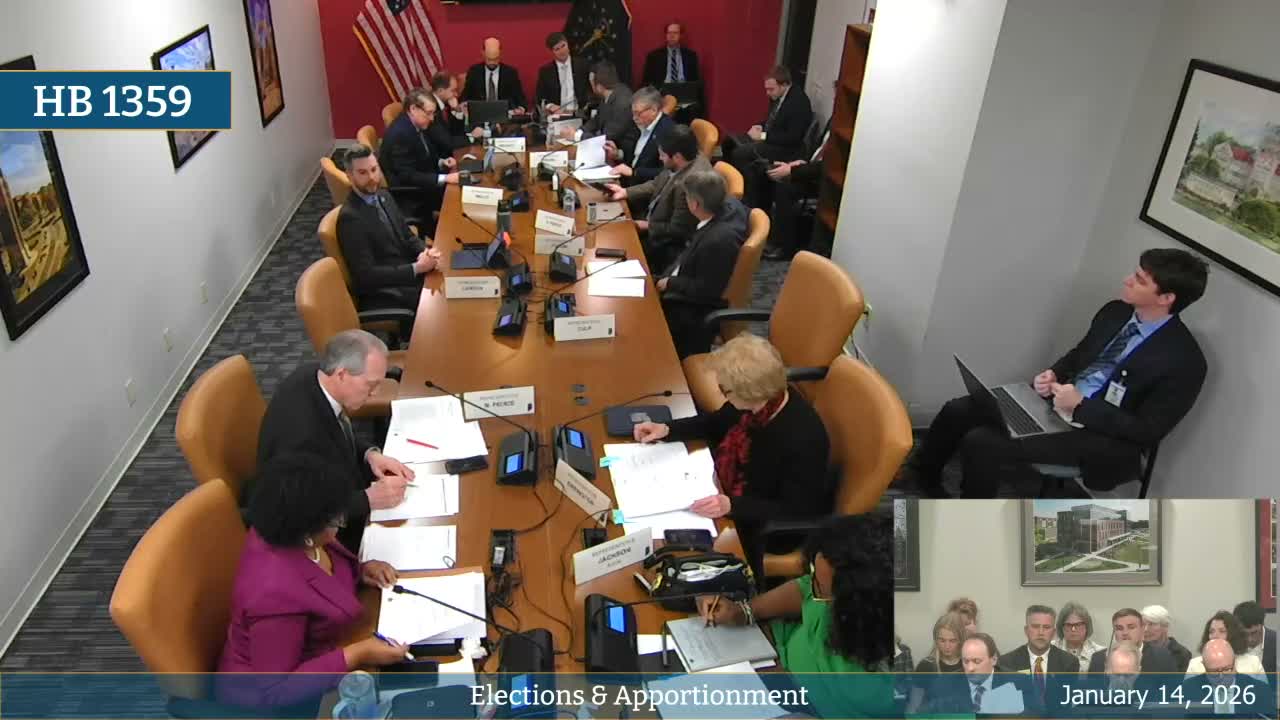
House Bill 13‑59, advanced by the committee, would allow counties with certified retraction-capable voting systems to scan in‑person early ballots and tabulate them only on election day. Clerks and vendors supported efficiency gains and voter‑last‑touch assurances; the Election Division, League of Women Voters and others warned statutory steps on retention, retraction IDs and recount procedures are missing.
Representative Westco presented House Bill 13‑59 and offered Amendment 1, which removes affidavit and same‑precinct storage requirements from earlier drafts and makes technical changes intended to align the bill with current local practices. The sponsor said the bill would let early in‑person ballots be scanned at vote centers while deferring tabulation until election day, reducing handling and making the voter the last person to touch the ballot.
Supporters included a large contingent of county clerks and the Clerks Association. Nicole Brown (Monroe County Clerk, Clerks Association legislative committee) called the bill "fiscally responsible" and said it would preserve election integrity by keeping voters as the last person to touch ballots while reducing manpower needs. Amy Rolfes (Saint Joseph County Clerk) presented flowcharts showing the county’s process and said current scans reduce ballot touches from her county’s estimate of 21 down to as few as three under the proposed procedure.
Vendors described a randomly generated retraction identifier that would allow counties to retract a scanned ballot without exposing personally identifying data. Keith McGinnis of RBM/Unison explained the identifier is unique per election and not persistent: "We pull it up, and then at that time, a bipartisan team will say reject or accept. So it never stays with them."
Opponents raised statutory gaps. Matthew Kochiver (Indiana Election Division) and the League of Women Voters warned the bill lacks explicit statutory instructions for how to (1) remove and segregate scanned ballots that are later disqualified, (2) handle retractions for deceased or ineligible voters, and (3) preserve ballot materials for recounts. Kochiver recommended codifying uniform statutory procedures and cautioned that, as of the hearing, not all optical‑scan systems have certified retraction methods; vendor certification and uniform statutory steps are needed to avoid inconsistent county practices.
The committee passed the bill out of committee after debate and amendment on a 9‑3 vote. Members and witnesses said additional statutory clarification on retraction IDs, chain‑of‑custody separation, provisional ballot handling, and recount procedures should be taken up before or during subsequent readings.
What happens next: The bill is reported out of committee but sponsors and the Election Division signaled they will continue to work on statutory language and vendor certification issues before final floor action.