Get Full Government Meeting Transcripts, Videos, & Alerts Forever!
Get email alerts on the Confined Feeding topic
No spam. Unsubscribe anytime.
Committee advances bill streamlining CFO permits after pushback over IDEM authority and testing costs
Summary
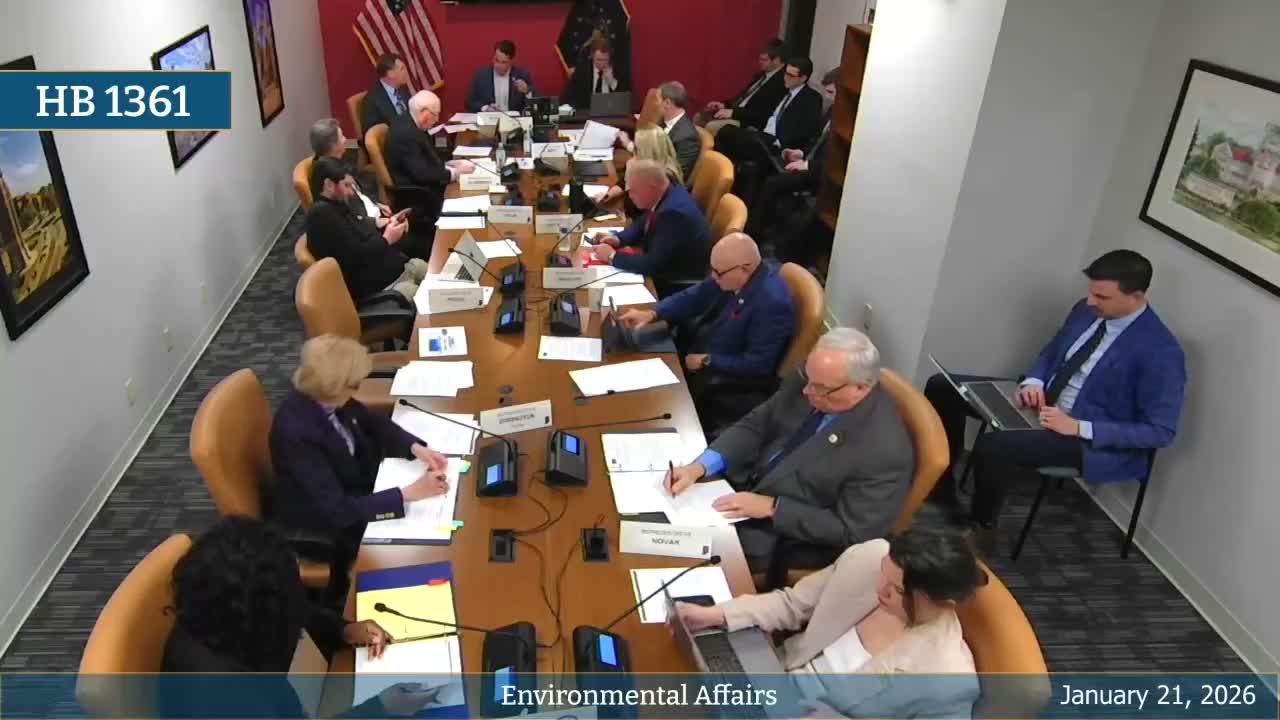
Lawmakers approved House Bill 13‑55 as amended to set predictable permitting timelines for confined feeding operations and to limit IDEM’s power to require design changes when a licensed professional engineer has certified plans; environmental groups opposed portions of the measure, and industry witnesses described what they called costly and inconsistent IDEM practices.
Representative Kendall Culp presented House Bill 13‑55 and Amendment No. 2 to revise confined feeding operation (CFO) permitting. The amendment clarifies timelines, offers a pre‑application meeting pathway to trigger a 90‑day review clock, protects certified professional engineer (PE) designs from being changed by IDEM staff if they comply with statute, adjusts manure definitions, and clarifies that an agricultural zone inside a municipality does not automatically allow siting a confined feeding operation without local review.
Alex Goodnight, Deputy Legislative Director at the Indiana Department of Environmental Management (IDEM), told the committee the bill aims to improve clarity, communication and predictability for applicants and that IDEM is willing to work with stakeholders on implementation. “These updates are intended to streamline interactions during permitting, reduce avoidable delays and promote consistent treatment of CFO projects while maintaining strong environmental protection,” Goodnight said.
The committee heard a mix of industry and environmental testimony. David Van Gilder, senior policy and legal director for the Hoosier Environmental Council, registered opposition to two provisions he called problematic: automatic deference to a private engineer’s stamp and the bill’s proposed limitation on local zoning oversight for agricultural land. “We think it is good to have a couple sets of eyes and not just defer automatically simply because somebody is a certified engineer,” Van Gilder said.
Multiple industry witnesses countered that deference to a certified PE is necessary to avoid what they described as repetitive, narrow requests from agency engineers that delay projects. Carrie Simpkins (Ag Environmental Systems), who said she represents roughly 40% of large CAFOs in the state, testified at length about examples she described as excessive agency demands — including repeated requests that applicants name a single equipment model for vehicular loading and post‑construction Shelby tube testing that she estimated added $45,000 to a $250,000 lagoon project. “Those Shelby tubes then… cost $500 a piece,” Simpkins said, “and that post construction testing added significant cost to prove something that the engineer already proved during construction.”
Representative Arrington explained his no vote on the floor would reflect concern about whether statutory changes address the agency’s underlying staffing and capacity problems; Representative Bauer also signaled opposition pending additional changes. The committee nonetheless voted to pass HB 13‑55 as amended by recorded roll call (10 yeas, 3 nays). The vote record and roll call names were entered on the record.
The bill’s provisions change administrative procedures for permitting, add pre‑application options to trigger statutory review clocks, and limit IDEM’s ability to require design changes when a licensed PE has certified compliance with the chapter. The committee’s passage sends the amended bill on to the next legislative step.