Get Full Government Meeting Transcripts, Videos, & Alerts Forever!
Get email alerts on the Environmental Code Reform Sb 277 topic
No spam. Unsubscribe anytime.
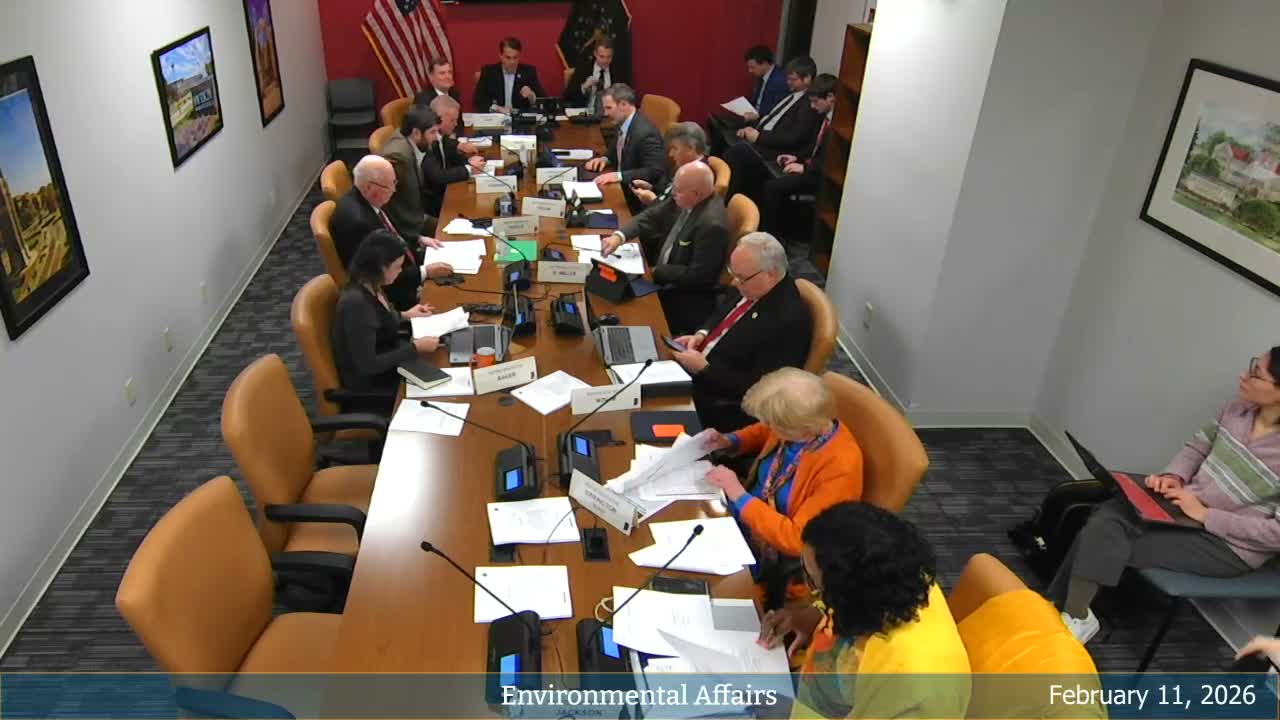
House Environmental Affairs advances Title 13 revamp after hours of testimony and a contentious PFAS debate
Summary
The House Environmental Affairs Committee voted to advance Senate Bill 277, a broad recodification of Indiana’s environmental code, after hours of testimony from industry supporters and environmental opponents; the committee approved a key amendment and sent the bill to the House floor as amended.
Senate Bill 277, a wide-ranging rewrite of Indiana’s environmental code (Title 13), moved out of the House Environmental Affairs Committee on a party-line‑leaning vote after supporters described the measure as an overdue modernization and opponents warned it would weaken enforcement and narrow protections.
Committee members and witnesses spent the session trading sharp questions about enforcement duties, changes to the Environmental Rules Board and how the bill treats non‑regulatory federal scientific values and PFAS chemicals. Senator Niemeyer, the Senate author, told the committee the legislation aims to "clean up antiquated language and align [IDEM]’s internal structure with 21st century oversight," saying "the bottom line is, senate bill 2 77 makes Indiana environmental code clear, leaner, and more accountable." Commissioner Clint Woods of the Indiana Department of Environmental Management (IDEM) said the bill "does not change those underlying state and federal environmental protections" and described the measure as one that would "reduce incentives for certain litigation" while preserving enforcement tools.
Why it matters: Supporters from manufacturing, builders, utilities and business groups said SB 277 will speed permitting, reduce paperwork and provide certainty that helps economic development. Opponents — including conservation organizations, the Sierra Club, local water and public‑interest advocates and several lawmakers — said the bill inserts discretionary language (changing many "shall" duties to "may"), allows broader executive removal authority for board members, and could limit IDEM’s ability to act quickly on imminent pollution events. Several speakers urged more time for stakeholder engagement or splitting the package into narrower bills.
Major points and exchanges
• "Very dangerous" and the "burdensome" debate: Representative Arrington, one of the amendment proponents, said she finds the bill "very dangerous" and offered amendments to remove the word "burdensome," calling that term vague and a possible trigger for costly litigation. Commissioner Woods said the bill requires IDEM to identify and explain when proposed state rules are more stringent or "burdensome" than federal requirements, and that the agency would not rely exclusively on non‑promulgated federal values.
• PFAS prioritization: A highly contested subject was PFAS language added from another Senate bill. The amendment prioritizes PFOA and PFOS — the two compounds for which EPA has promulgated maximum contaminant levels — for agency research, testing and communications. Multiple lawmakers and environmental witnesses warned that privileging a narrow PFAS definition could exclude thousands of other PFAS compounds and some gas or polymer forms. Commissioner Woods repeatedly framed the language as a prioritization, not a prohibition, saying IDEM would still engage on broader PFAS issues.
• Enforcement and board structure: Environmental groups and several committee members raised alarms about provisions that would make certain IDEM duties discretionary and that would permit broader removal authority for members of the Environmental Rules Board. Catherine Koenig of Save the Dunes warned that a provision making enforcement actions optional "relieves the commissioner of the responsibility to penalize and pursue enforcement action after receiving evidence of pollution," arguing that change would weaken protections for sensitive areas like the Indiana Dunes.
Votes at a glance
• Amendment 27 (adopted before the bill presentation): passed by roll call (7 yays, 5 nays, 1 excused). The amendment incorporated a number of conforming changes, clarifications on waste definitions, PFAS prioritization language and administrative-review clarifications cited by IDEM.
• Final committee action: The committee voted to move SB 277 to the House floor as amended (motion passed: 6 yays, 5 nays, 2 excused).
What supporters said: Ash Neller of the Indiana Manufacturers Association said the bill provides "regulatory certainty" and praised stricter permitting timelines and clearer rulemaking procedures. Utility and construction representatives told the committee that modernization would remove duplicative or outdated requirements that slow projects and add cost.
What opponents said: Conservation, legal and public‑interest witnesses said the bill goes beyond technical recodification, citing at least 40 instances where mandatory language was changed to discretionary language. They urged more time for review and expressed concern the bill could invite litigation or federal scrutiny if state duties are rendered optional.
Next steps: With the committee’s referral, SB 277 will be scheduled for debate on the House floor. Lawmakers and stakeholders signaled continued negotiation is likely on PFAS language, board composition and any clarifying amendments addressing enforcement obligations.
Ending note: The committee hearing included roughly two dozen witness statements and extended exchanges with IDEM leadership. Committee members who opposed the measure urged a slower, more modular approach; backers said the statute needs comprehensive updating after decades of incremental changes.