Get Full Government Meeting Transcripts, Videos, & Alerts Forever!
Get email alerts on the Cryptocurrency Regulation topic
No spam. Unsubscribe anytime.
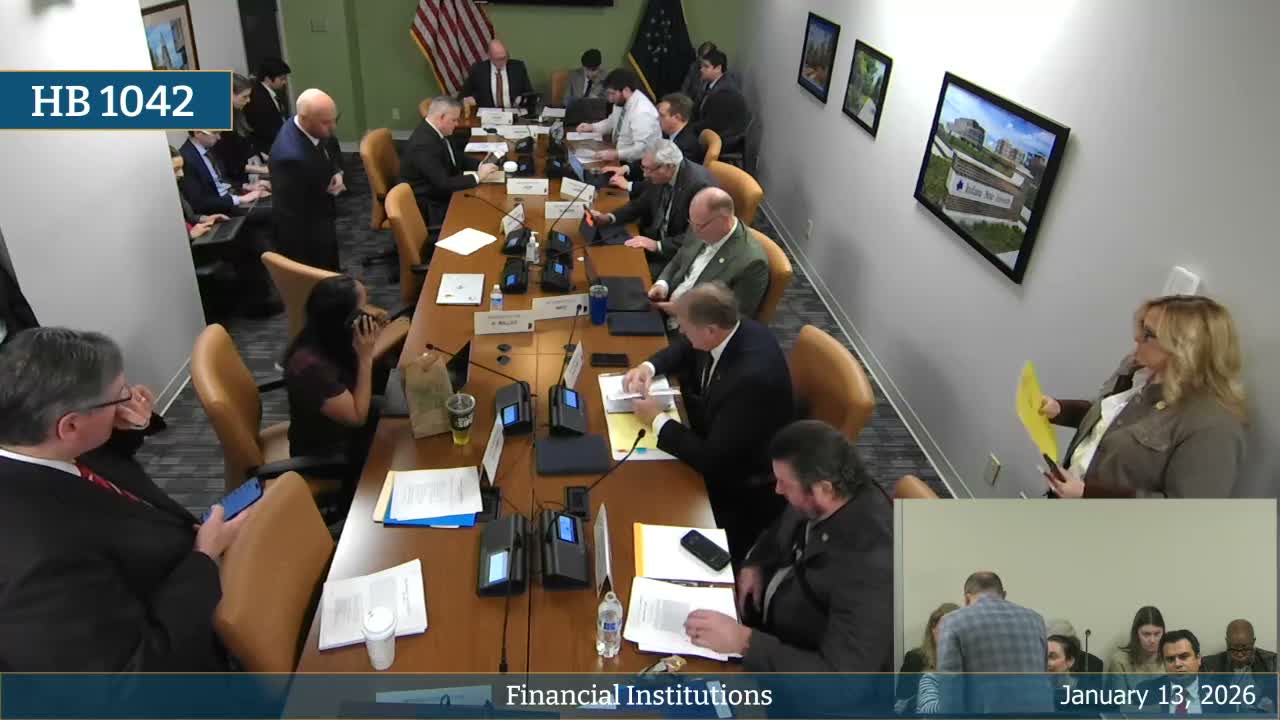
Financial Institutions Committee advances three crypto-related bills with amendments on investment access, kiosks and stablecoins
Summary
The committee passed changes to a retirement-investment bill (HB 10-42), advanced a revised crypto-kiosk bill with new limits and licensing (HB 11-16), and approved a stablecoin measure (HB 12-17). Lawmakers added consumer protections such as a 7-day wait for new kiosk users and reporting/licensing deadlines for operators.
The Financial Institutions Committee on Wednesday approved or advanced several bills aimed at regulating cryptocurrency activity in Indiana, adopting amendments that opened certain retirement accounts to self-directed crypto investments, imposed consumer safeguards on crypto kiosks and clarified state oversight of payment stablecoins.
Representative Pierce, sponsor of House Bill 10-42, described an amendment that narrows the bill—s original scope by allowing individual state retirees who control their retirement accounts to use self-directed brokerage accounts rather than expanding ETF access for public funds. Pierce said the amendment removed an earlier task force proposal, preserved local zoning authority over digital-asset mining and added a line permitting the Department of Financial Institutions (DFI) to regulate where needed so HB 10-42 does not conflict with the state—s companion stablecoin measure.
Supporters said the change preserves personal choice for retirees while removing public funds and trust funds from the bill—s investment authority. Some members expressed concern about pension exposure to crypto investment. A roll call on the amended bill recorded a 9-3 vote in favor of passing HB 10-42 out of committee.
The committee then debated House Bill 11-16, a bill to regulate crypto kiosks (sometimes called crypto ATMs). Representative McNamara offered a package of amendments that the sponsor portrayed as a compromise: it defines new versus existing users, sets per-transaction and per-period limits (for example, lower caps for new users), requires a seven-business-day activation delay for new accounts and adds operator caps on per-transaction charges. The amendment initially proposed a 15% fee cap for operator charges (replacing a prior 3% cap), drawing objections from members who said 15% is excessive and will hit consumers, particularly seniors. Supporters argued the higher percentage reflected market ranges and that the bill—s other protections (the 7-day wait and transaction limits) would help prevent scams.
Lawmakers also inserted technical edits to avoid redefining "money" to include cryptocurrencies while licensing kiosk operators as money transmitters under the Money Transmitter Modernization Act; they delayed DFI—s licensing and fee-cap enforcement until later in the year to allow the agency to stand up the licensing program. DFI testified that, given current projections (about 14 kiosks), an initial $200 per-kiosk annual fee would likely fund a small licensing team but that the department can reassess in the mandatory report to the legislature. The committee approved HB 11-16 as amended in a recorded roll call (12-0) while several members said they would continue discussions about the operator fee cap ahead of second reading.
Representative Pierce also led passage of House Bill 12-17, a measure regulating payment stablecoins and aligning state rules with ongoing federal work. The amendment clarified that stablecoin issuers may not pay yield or other economic interest to holders of payment stablecoins; the committee approved the bill by roll call, 11-0.
Votes at a glance: HB 10-42 (amended) — Passed committee, roll call 9-3. HB 11-16 (as amended) — Passed committee, roll call 12-0 (included transaction limits, 7-day wait, licensing delays and a per-kiosk fee). HB 12-17 (stablecoin) — Passed committee by roll call, 11-0.
Why it matters: The package addresses three separate risks lawmakers said merit attention—retiree access to new investments, consumer-scams and unregulated kiosk operations, and the potential instability or misuse of payment stablecoins. The committee adopted measures that seek to balance market access and investor choice with consumer safeguards and a phased regulatory ramp-up for DFI. Members signaled continuing debate, especially over operator fee caps for kiosks, and expect further changes on second reading.
What—s next: The bills move to the next steps in the legislative process with the expectation of additional amendments during the full chamber debates and continued coordination between state regulators and stakeholders.