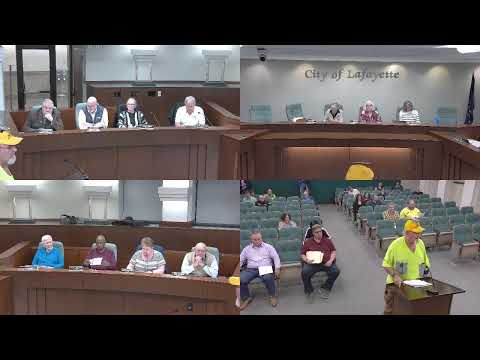
City staff presents Greater Lafayette Climate Action Plan 2025 annual report; officials cite progress on 70% of actions
Loading...
Summary
Haley Griffey of the Department of Economic Development presented the Greater Lafayette Climate Action Plan 2025 annual report, reporting progress on 50 of 71 actions (about 70%) and outlining four focus areas — energy, transportation, agriculture/forestry, and water/waste. Staff noted funding pauses at the federal level for some programs and highlighted local education and pilot initiatives.
Haley Griffey, Department of Economic Development, presented the 2025 annual report for the Greater Lafayette Climate Action Plan, telling council the plan has helped coordinate regional sustainability efforts and that, as of this year, partners have initiated progress on 50 of 71 actions — roughly 70%.
"As of the 2025, the cities of Lafayette, West Lafayette, Tippecanoe County, and dedicated partners have initiated progress on 50 of these actions, which is 70% of total actions," Griffey said, summarizing the plan’s measured progress since its adoption in January 2023.
Report highlights: Griffey outlined four focus areas. For energy in the built environment, staff pointed to outreach on energy efficiency, participation in Indiana University’s Environmental Resilience Institute cohort, and partnerships to install a free heat pump at a local residential property. On transportation, investments include trail expansions (Sagamore Parkway) and increased bicycle infrastructure and roundabouts; the city also achieved a charging-smart bronze designation in 2025. In agriculture and forestry, staff praised the Wabash River Enhancement Corporation and local land-trust partners for conservation and invasive-species removal; Tree Lafayette marked its effort to plant thousands of trees. For water and waste, staff highlighted e-waste days, new tire-recycling events, and wastewater infrastructure upgrades tied to flood-risk management.
Funding and constraints: Griffey said some federal grant programs related to solar and energy efficiency are paused, including an Energy Efficiency and Conservation Block Grant award; staff are pursuing alternate funding paths, including state programs and low-interest loans through a state green bank. Griffey said the report adds a community-spotlight section to showcase local groups like the West Lafayette Public Library’s new rooftop solar installation and Tree Lafayette’s tree-planting work.
Council questions and follow-up: A council member asked whether reaching 70% is typical year-to-year; Griffey replied that the figure represents cumulative progress rather than completed goals and that the jurisdiction was at about 55% in 2024 — an increase in initiated actions. Griffey offered to answer further questions and stressed continued emphasis on equitable engagement and partnerships with Purdue University and other local institutions.