Get Full Government Meeting Transcripts, Videos, & Alerts Forever!
Get email alerts on the Sb189 topic
No spam. Unsubscribe anytime.
Sen. Baldwin’s bill would bar insurers’ 10% hospital penalty; insurers say policy aims to curb costly arbitration awards
Summary
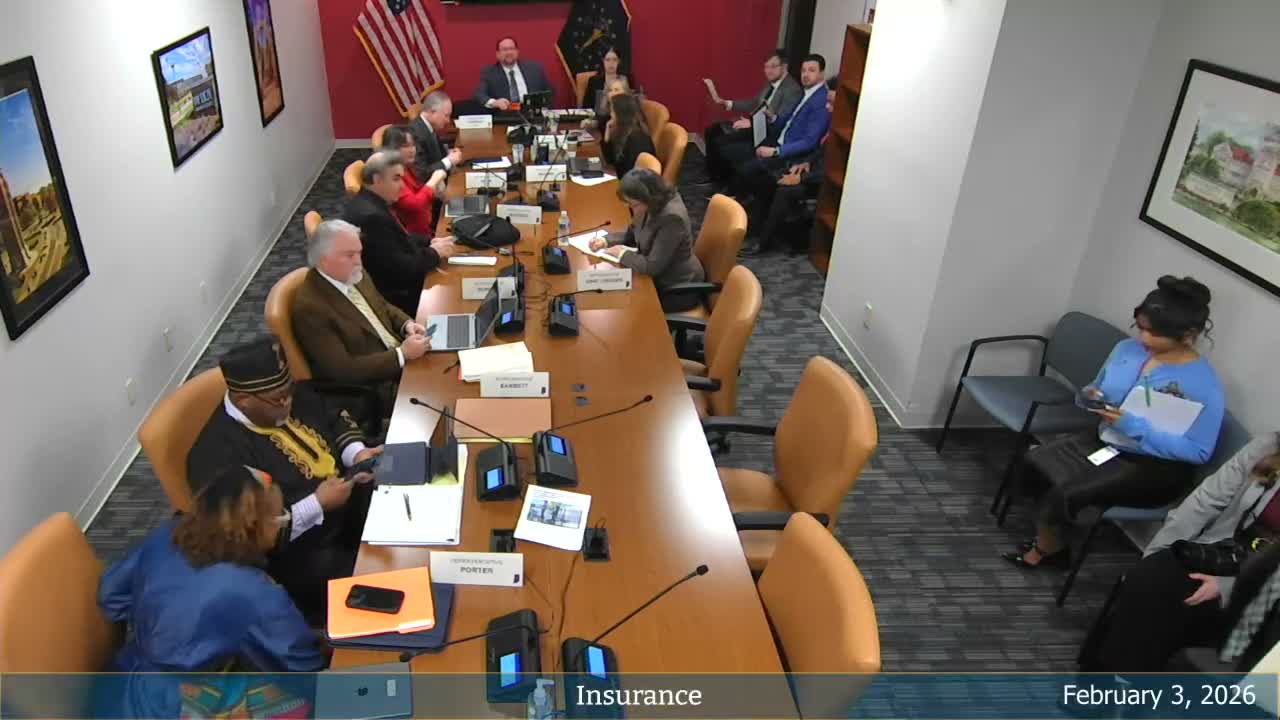
A House committee heard competing testimony on Senate Bill 189, which would ban insurers from charging hospitals a 10% administrative fee when an out‑of‑network provider treats a patient. Physicians and hospitals said the practice coerces doctors and raises patient and employer costs; Elevance Health defended its policy as a tool to reduce inflationary independent dispute resolution (IDR) awards.
Senator Baldwin urged the Indiana House committee to approve Senate Bill 189, saying the measure would prohibit a health insurer from assessing a 10% administrative fee on hospitals when an out‑of‑network provider treats a patient and would make that practice a deceptive insurance practice.
Senator Baldwin, the bill’s author, said the policy is about “profit” and warned that the 10% penalty shifts costs toward patients and strains rural hospitals. “This bill says you can’t do it. It’s not penalizing. It’s just saying you can’t do it,” he told members as he framed the legislation as protecting patients from market leverage he called unfair.
The bill drew sharply divided testimony. Brian Burdick, an attorney for the Indiana Hospital Association, described Anthem/Elevance notices to hospitals that a 10% charge would be applied if nonparticipating providers worked in a facility. Burdick said that tactic uses hospitals as leverage to force physicians into networks and that market concentration—he cited a duopoly by a small set of insurers—leaves hospitals and independent physicians with limited bargaining power. “When these letters came out…that said as part of your next year contract we’re gonna put a 10% penalty on you if you use or allow a non participating provider to provide services in your facility,” Burdick said.
Health plans’ representatives pushed back. Joey Fox (representing the Indiana Association of Health Plans) and Catherine Gaffigan (President of Health Solutions at Elevance Health) said the insurer policy was intended to keep cases out of the federal independent dispute resolution process (IDR), which they described as producing outsized, inflationary awards. Gaffigan said the industry expected roughly 18,000 IDR cases a year but is seeing millions; she gave an example in which a treatment Elevance would typically reimburse at about $900 was awarded roughly $34,000 in IDR. “There is an IDR process right now that is broken,” she told the committee, urging a multi‑pronged response that includes litigation and petitions to CMS.
Several physician witnesses and medical associations supported SB 189. Dr. Jamie Huang, an anesthesiologist representing the Indiana Society of Anesthesiologists and the Indiana State Medical Association, said the policy would coerce physicians into network contracts, reduce independent practices, and impair access to care. “This policy undermines patient protections. It threatens independent practices like mine,” he said. Witnesses for the Indiana Physicians Health Alliance and smaller independent clinicians echoed those concerns, arguing that the No Surprises Act’s framework and the IDR process should be fixed at the federal level rather than by imposing penalties that could be passed to patients.
Employer and business groups also weighed in. Testimony from the Indiana Manufacturers Association and the ERISA Industry Committee stressed that many employers are self‑insured and that higher IDR awards increase premiums and employer health costs, which can reduce wages or benefits.
Committee members asked detailed questions about which hospitals or situations might be exempt, how the fee would be shifted in practice (to hospitals, providers, or patients), and whether modest increases in initial insurer offers would reduce IDR filings. Witnesses described a variety of views: hospital groups said better up‑front offers could reduce IDR but noted incentives remain skewed; Elevance said the company has revised internal processes to respond to IDR filings and is pursuing enforcement and regulatory routes to limit abusive filings.
The committee did not vote on the bill. Chair Powell said members would hold the bill for further study and additional conversations with stakeholders before taking action.
What’s next: The committee paused consideration to allow follow‑up work among insurers, hospitals and physician groups; the chair said members expect more discussion before any vote.