Get Full Government Meeting Transcripts, Videos, & Alerts Forever!
Get email alerts on the Work Based Learning Insurance topic
No spam. Unsubscribe anytime.
Indiana committee advances bill clarifying who provides insurance for student work placements
Summary
The House Insurance Committee passed House Bill 10-98 as amended to replace a prior liability-insurance requirement for intermediaries with a workers' compensation framework and written-agreement requirements to clarify responsibilities between schools, intermediaries and employers.
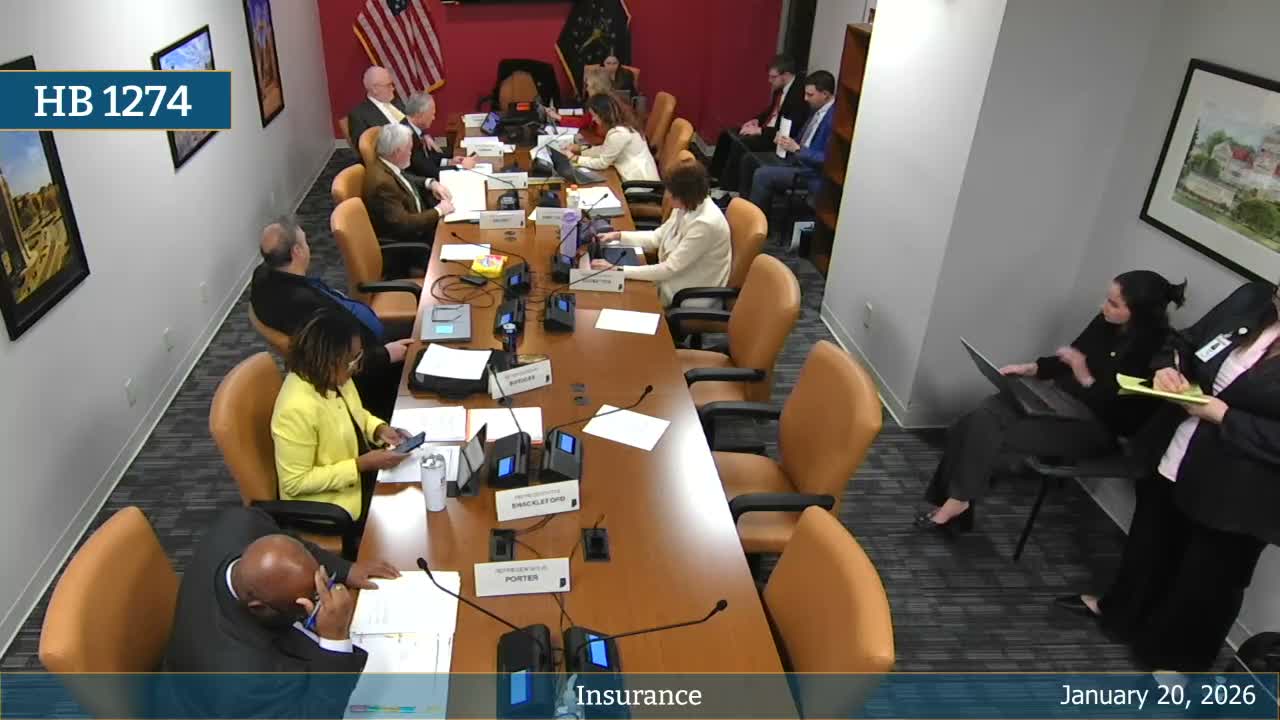
The House Insurance Committee on Thursday voted 12–0 to advance House Bill 10-98 after the committee approved an amendment that removes a prior mandate requiring intermediaries to carry general liability insurance and instead clarifies workers' compensation coverage and written-agreement responsibilities.
Representative Commons, the bill's author, told the committee the amendment "modernizes Indiana law to reflect how work-based learning actually functions today while protecting students and giving employers predictable risks." He said the change is meant to reduce employer hesitation to host unpaid student placements by making workers' compensation the "exclusive remedy" for such unpaid opportunities.
The amendment unifies definitions of work-based learning (apprenticeships, youth apprenticeships, pre-apprenticeships and work-based courses) and requires a written agreement between an intermediary and employer that details who bears responsibility for workers' compensation and liability. Commons said the bill does not mandate wages or participation, only clarity.
Greg Harrell, director of government affairs at the Institute for Quality Education, testified in support, saying Indiana's new diploma pathways increase demand for placements and that uncertainty about insurance coverage has been a barrier. "This bill helps address these issues by establishing a practical framework to guide these experiences," Harrell said.
Committee members questioned a $175,000 cap that appeared in earlier drafts for wrongful-death awards; Commons said that number mirrored prior statute and remained negotiable. Multiple business and education groups, including the Indiana Chamber and Indiana Home Builders Association, expressed support, emphasizing practical rollout and employer participation.
The committee recorded a 12-to-0 vote to advance the bill as amended. The bill will next go to the House floor for further consideration.