Get Full Government Meeting Transcripts, Videos, & Alerts Forever!
Get email alerts on the Crypto ATM Regulation topic
No spam. Unsubscribe anytime.
Panel hears bill to regulate crypto ATMs; law enforcement and consumer groups cite scams, operators warn caps could force exits
Summary
The House Financial Institutions Committee heard testimony on HB 11‑16 to regulate virtual‑currency kiosks (crypto ATMs), with law enforcement and AARP urging licensing, transaction limits, refunds and disclosures to curb scams and protect older adults; kiosk operators said some limits (daily $1,000 cap, 3% fee cap) could hamper compliance and reporting.
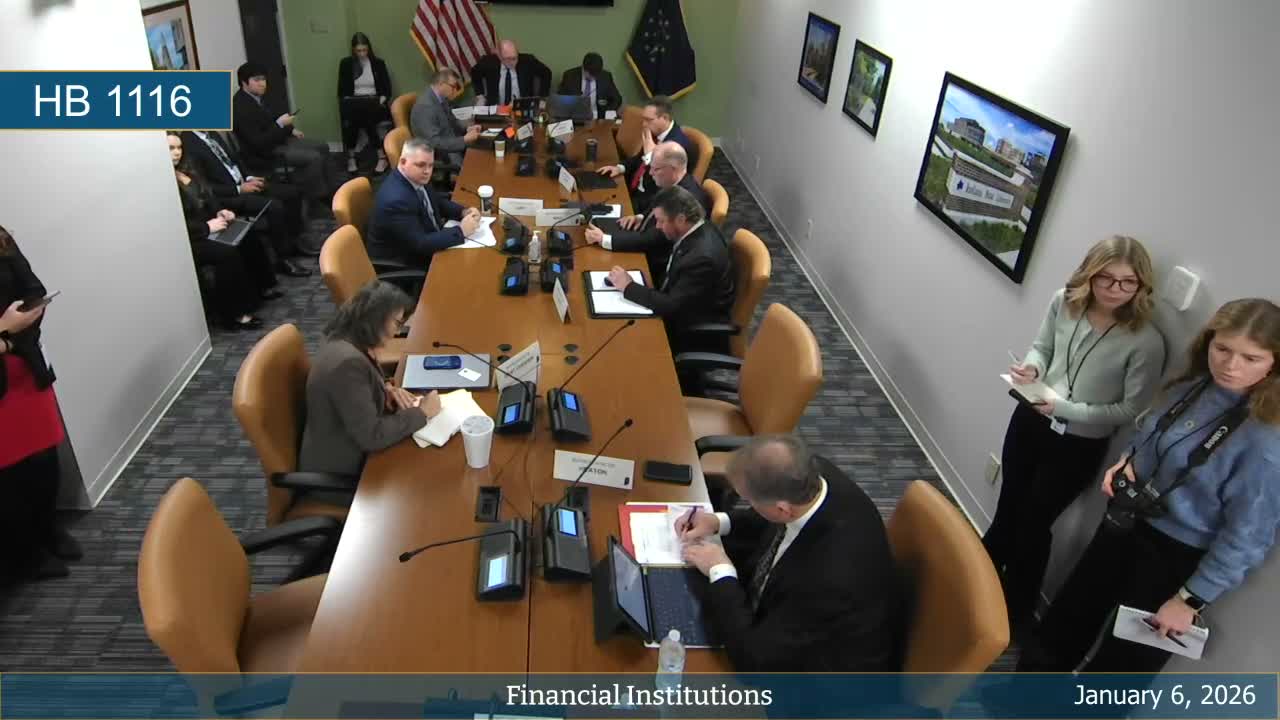
The House Financial Institutions Committee on Thursday heard wide testimony on House Bill 11‑16, a proposal to bring virtual‑currency kiosks — commonly called crypto ATMs — under state licensing and consumer‑protection rules.
Representative McNamara, the bill’s author, told the committee the measure would require kiosk operators to be licensed as money transmitters, put the machines under oversight of the Indiana Department of Financial Institutions, mandate identity verification and disclosures, impose transaction limits and fee caps, and create quarterly and annual reporting requirements.
The bill “is about strengthening consumer protection that are related to virtual currency kiosks,” McNamara said, and aims to “establish clear oversight, licensing, and enforcement standards in Indiana that don't currently exist.”
Detective Sergeant Nathan Van Cleave of the Evansville Police Department’s Financial Crimes Unit described the problem in local terms. “We are currently living in a scam demic,” Van Cleave said, recounting that his office’s Bitcoin‑ATM cases rose from four about four years ago to 35 in the most recent year and that local losses grew from roughly $75,000 in 2023 to nearly $400,000 in 2025. He described phone‑and‑wallet ruses in which victims are walked through using a kiosk and then lose funds that are difficult to recover.
“Once the transaction is complete, experts say that the money is nearly impossible to recover,” Amber Marr of AARP Indiana told the committee, urging safeguards because older adults often suffer severe financial and emotional harm from such scams. AARP also presented statewide and national loss figures and said disclosures, live customer service and transaction limits would give victims a better chance.
The bill would set identity checks, refund protections and receipts, and limit transactions to $1,000 per 24‑hour period and $10,000 per 30‑day period across an operator’s services, with a maximum fee of 3 percent per transaction, according to the author’s overview.
The attorney general’s office supported the bill as a tool to add regulatory authority and civil remedies: Davey Neal said including kiosk misconduct under the state’s Deceptive Consumer Sales Act would allow civil investigative demands and recovery of enforcement costs.
Several industry and financial‑sector witnesses voiced qualified support for consumer protections but raised specific concerns about the bill’s numeric limits. Clara Wolfson of CoinFlip said CoinFlip is federally registered with FinCEN and already files Suspicious Activity Reports (SARs) and Currency Transaction Reports (CTRs), and warned that a $1,000 daily cap could prevent operators from meeting federal thresholds that law enforcement uses to identify illicit activity.
“If the CTR threshold is $10,000 and the SAR threshold is $2,000, setting the state limit at $1,000 could counterintuitively hinder law enforcement because the data needed for federal investigations won’t be collected,” Wolfson said. Michael Geiselhart of Bitcoin Depot likewise said the proposed 3 percent fee cap and low transaction limits could make kiosk operations unprofitable, forcing compliant firms to leave the state and creating openings for unregulated operators.
Industry witnesses and advocates also disputed some published estimates about kiosk fraud rates. Wolfson cited blockchain analytics firms that show lower fraud rates for some operators; Detective Van Cleave and other law‑enforcement witnesses cited local case counts and national bureau figures showing substantial losses tied to kiosks.
Several witnesses suggested targeted fixes in committee. Industry groups proposed higher thresholds or differentiated rules for first‑time versus repeat users, additional requirements for customer verification before higher‑value transactions, and exemptions for long‑established customers so that federal reporting can continue when appropriate. Consumer groups urged strict disclosures, refund protections and live‑staff customer service to interrupt scams in progress.
The committee did not vote on the bill. Chair announced the panel would hold HB 11‑16 while lawmakers work with the author on potential amendments and return to vote next week.
What’s next: HB 11‑16 was held for further amendment and a vote at a subsequent meeting of the House Financial Institutions Committee.