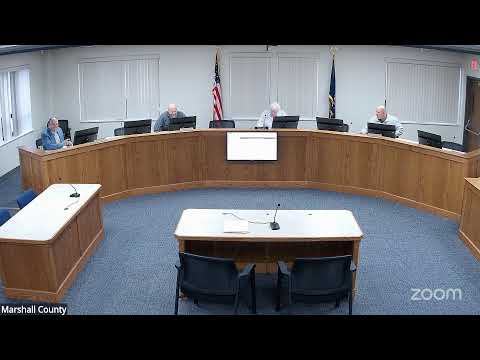
Chesco Energy pitches natural-gas peaker plant on 67-acre Marshall County site
Loading...
Summary
Reid Wills, CEO of Chesco Energy, asked county commissioners for support to develop a natural-gas “peaker” power plant near Bremen on a 67‑acre site, saying it would use existing transmission and pipeline infrastructure, create construction jobs, and run limited hours under air‑permit limits; commissioners and residents raised water, noise and ownership questions.
Reid Wills, CEO of Chesco Energy, told the Marshall County Board of Commissioners that his Philadelphia-based company is seeking the county’s support to build a natural‑gas peaker power plant on a roughly 67‑acre site between Bremen and La Paz.
“We would like to gain support and permission to build a power plant here in Marshall County,” Wills said in his presentation, describing a facility with a roughly 20‑acre plant footprint and an additional area for substation infrastructure. He said the site sits adjacent to major 765 kV transmission lines and a nearby gas pipeline, letting the project connect without off‑site easements.
Wills framed the proposal as a response to rising electricity demand and aging generation: he told commissioners the market is strained by retiring coal units and by growing demand from electric vehicles and data centers. He described the project as a peaker plant designed to operate under capacity limits—“we’d expect, you know, probably more, but certainly 200 construction jobs…and more than 10 permanent jobs,” he said—and added that the company expects the simple‑cycle gas units would operate on the order of less than about 2,000 hours per year and be subject to strict air‑permit hourly limits.
The company said infrastructure and interconnection costs would be borne by the project, not by the public. Wills described community engagement and local partnerships as part of the company’s approach: “we’re gonna engage, and people gotta know our name and how to get ahold of us and answer questions,” he said, and pledged to work with the county and potential partners on tax and workforce issues.
Commissioners asked technical and operational questions. In response to why the plant is a peaker unit, Wills explained that the simple‑cycle gas turbines are intended to run during system stress—heat waves, cold snaps or shoulder months when other plants are offline—and that the company will accept permit limits on hours of operation. When a commissioner asked when the units would typically run, staff said the utility industry considers daylight and early evening hours as “peak” and that the plant’s operations would align with those windows.
Members of the public raised environmental and resource questions. Bill Woodward asked about a company‑provided water‑use figure (he cited “200 gallons per minute”) and requested clarification on whether the system would use a closed loop and how discharges might affect ditches and the aquifer. Woodward also asked about air emissions from a gas‑fired unit and whether ownership might change over time; Wills and company staff said they would address those topics in further engineering and permitting discussions.
Commissioners signaled interest in negotiating terms and involving the county council: one commissioner said he was “looking forward to having an opportunity to negotiate… and to bring in our partners on the county council as well to make sure that they’ve got a full seat at the table.” No formal county action or vote was taken during the presentation; staff noted permitting, interconnection and any road‑use agreements (for construction access) will require further review and follow‑up.
The company provided slide materials and offered to deliver a draft road‑use agreement for staff review to address potential construction‑traffic impacts. Commissioners invited further public comment and said staff would continue evaluation of engineering, permit and fiscal impacts before any formal approvals or agreements.
The presentation concluded and the board moved on to other agenda items; there was no formal vote on the proposal at this meeting.