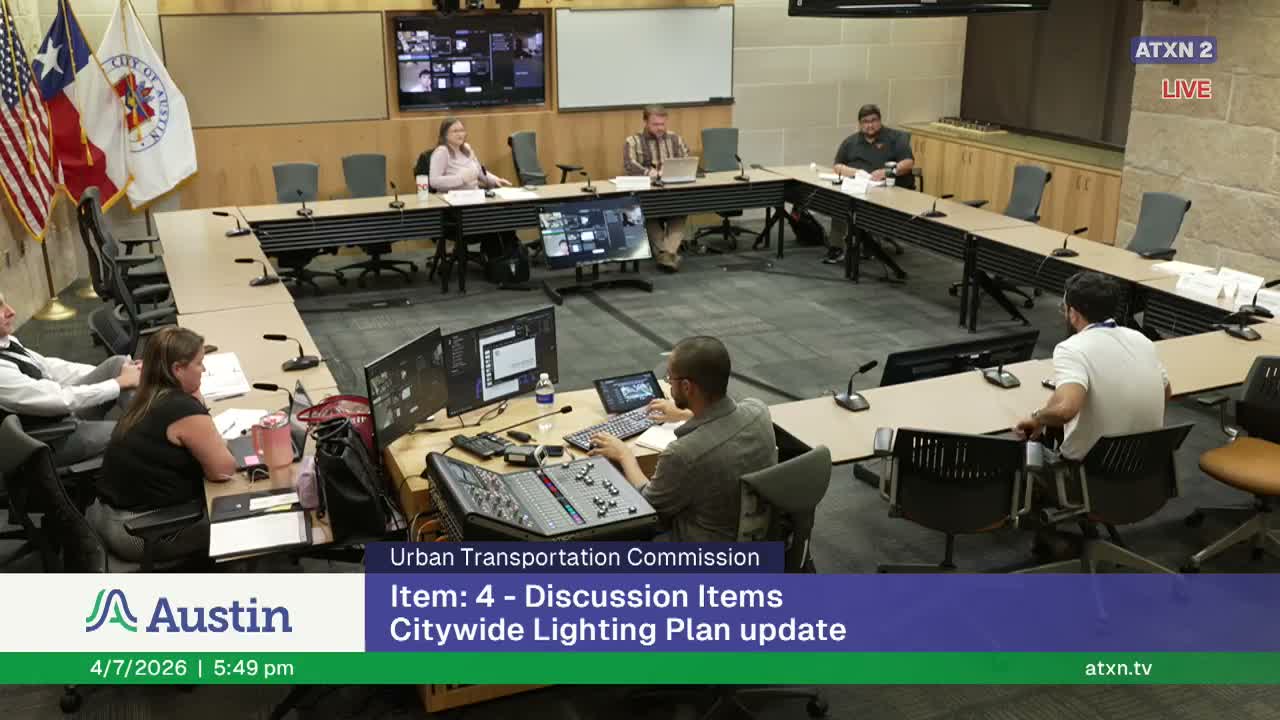
City staff outline citywide lighting plan, stress context-sensitive fixtures and dark-sky protections
Loading...
Summary
Transportation & Public Works and Austin Energy summarized a citywide lighting plan funded by a federal Safe Streets grant: a unified inventory, pedestrian-scale design guidance, and a prioritization framework; public survey (362 responses) showed preferences for warm light and reduced light pollution.
Joel Meyer, transportation safety officer for the city's Vision Zero program, told the Urban Transportation Commission that a citywide lighting plan will unify street, trail and park lighting policy, create new pedestrian/trail design guidance and identify funding and implementation steps.
"Lighting is really one of the most effective countermeasures that we can deploy to reduce the risk of roadway fatality and serious injury," Meyer said, describing lighting as a relatively low-cost, high-impact safety investment that also supports nighttime trail and transit use and community quality of life.
Meyer said the plan is co-sponsored by Transportation & Public Works, Austin Energy and Parks & Recreation and is funded in part by a Safe Streets and Roads for All federal grant. The city contracted a consultant, Ivari, to inventory existing assets and to model lighting at the ground level across the network. Staff reported 362 responses to a public survey showing a preference for warmer color temperatures, strong support for reducing light pollution and evidence of "latent demand" for nighttime walking and biking: 26% of respondents said they would use the trail system more if lighting improved.
The plan will produce updated lighting design guidelines, including the city's first trail and pedestrian-scale lighting guide, new lighting warrants to define where lighting is appropriate, and a prioritization framework that balances community input, safety, equity and environmental protection. Meyer said staff will examine where ownership of pedestrian and trail lighting should sit across departments as the city expands beyond traditional street lighting managed by Austin Energy.
Commissioners asked about balancing pedestrian-scale fixtures in special districts (for example, the Drag near the University of Texas) against arterial lighting needs and about preserving historic Moonlight Towers. Meyer said the plan will consider context-sensitive design, pole heights, spacing and color temperature, and that while Moonlight Towers are treated as historic resources, they are not the backbone strategy for new streetscape lighting.
Staff said a draft plan will be available in the fall with Council consideration possible late in 2026, followed by implementation tied to identified funding sources.