Austin Transit Partnership says FTA gave 'median high' rating as NEPA clears way for light rail construction
Loading...
Summary
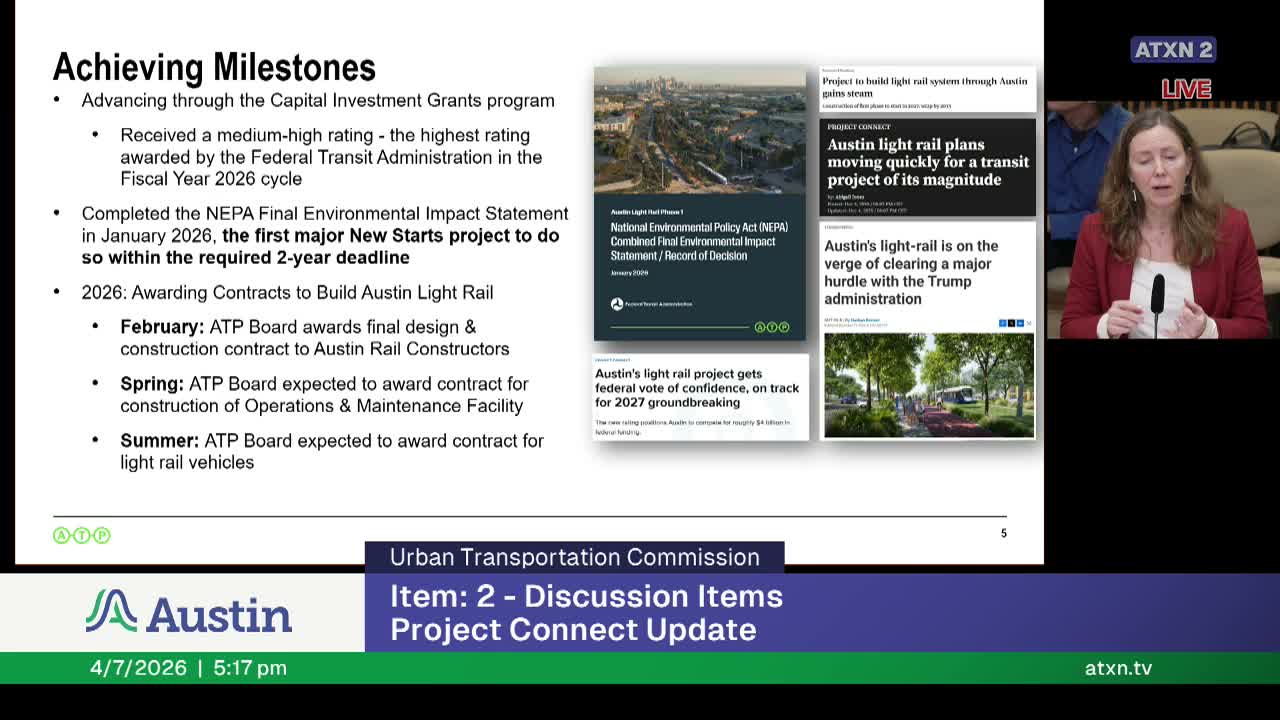
Austin Transit Partnership reported a "median high" FTA rating and completion of NEPA in two years for Austin Light Rail phase 1, awarded the first design-build contract and said construction prework begins in 2026 with major construction expected in 2027.
Austin Transit Partnership officials told the Urban Transportation Commission on April 7 that the Austin Light Rail Phase 1 project recently cleared key federal milestones and is shifting from environmental review to detailed engineering and preconstruction planning.
"The Austin Light Rail project received a median high rating," Jennifer Pine of Austin Transit Partnership said, describing an FTA evaluation that signals strong competitiveness for federal grant funding. Pine said the project also completed NEPA documentation in about two years and has received a Record of Decision, allowing the agency to advance to contract awards and early construction activities.
Lindsay Wood, also with ATP, said the partnership awarded a progressive design-build contract in February to Austin Rail Constructors to deliver streetscape reconstruction, rail guideway, stations and utilities, and that ATP expects to award the operations and maintenance facility contract at its board meeting on April 15. She added that vehicle procurement is under evaluation with an award expected this summer.
ATP showed corridor visualizations, including a central-running Greenway concept on East Riverside and a new bridge over Lady Bird Lake. Pine said the design concept retains rail in the street for much of the alignment while improving pedestrian and bikeway continuity and multimodal transfers.
Officials described the progressive design-build approach as a way to bring contractors into early design work so teams can refine cost, phasing and scheduling. Wood said ATP began early field investigations such as surveys and soil borings and expects construction sequencing and more detailed neighborhood schedules to be available this summer so the agency and other regional partners can coordinate major infrastructure work.
Commissioners asked where remaining street-design decisions will be set and whether right-of-way acquisition could start earlier. ATP said most street configurations were defined in the preliminary design and recorded in the environmental impact statement, though some areas like South Congress continue to be refined through focused stakeholder engagement. For some facilities—such as the operations and maintenance facility and traction power substations—footprints are known earlier and acquisition activity can begin during the preconstruction phase.
On fare-collection policy, ATP said the system will operate as an open urban system without fare gates, prioritizing access and integration into the surrounding street fabric.
The commission did not take an action on the presentation but asked ATP to return with additional details about phasing, neighborhood impacts and construction schedules as design advances.