Commission approves DB‑90 rezoning for South Capital of Texas Highway site despite neighborhood safety and traffic objections
Loading...
Summary
The Zoning and Planning Commission voted to approve a DB‑90 overlay allowing up to a roughly 70‑foot, mixed‑use redevelopment at 1120–1122 South Capital of Texas Highway after heated debate; neighbors pressed for traffic, evacuation and watershed analyses and conditional protections that commissioners discussed but did not make prerequisites to approval.
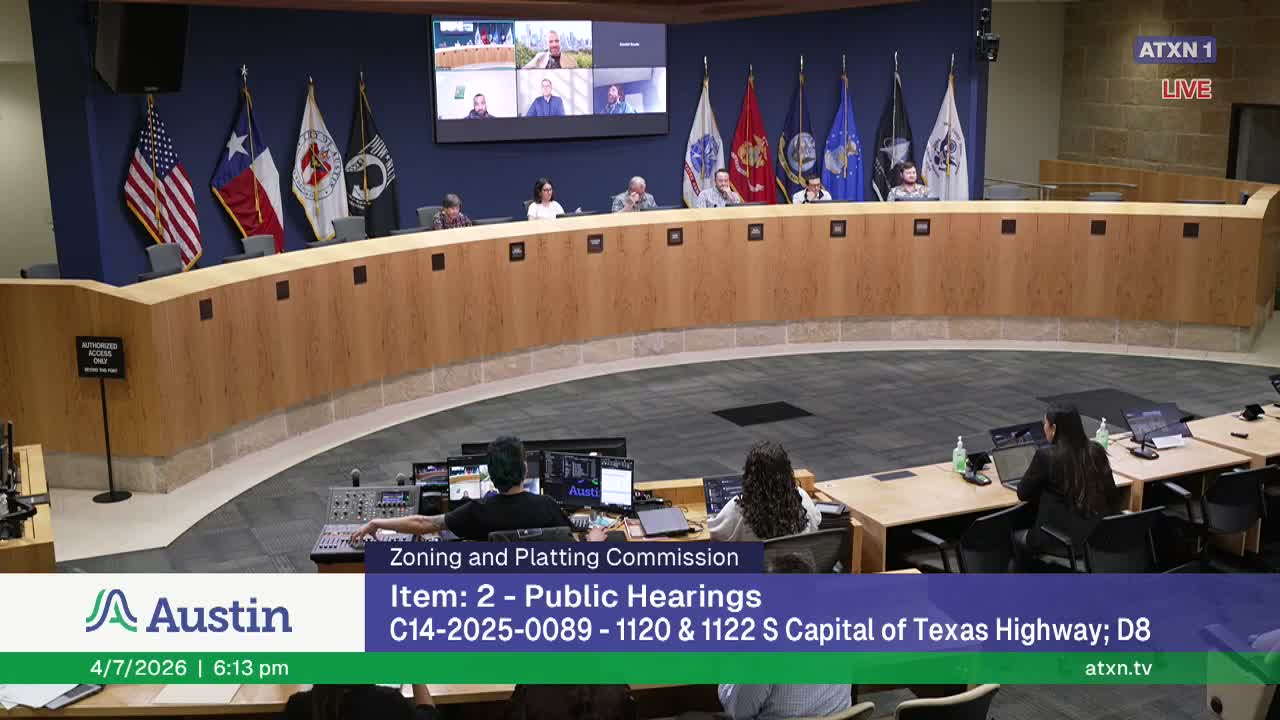
The Zoning and Planning Commission on April 7 approved a request to rezone roughly 15.5 acres at 1120 and 1122 South Capital of Texas Highway to a limited office vertical mixed‑use density bonus (LOB DB 90) combining district, a move that permits higher maximum height (70 feet under the district despite the DB name) and enables a mixed‑use redevelopment the applicant said could yield approximately 475 residential units with first‑floor retail and 10–12% affordability under the density bonus.
Beverly Veil of Austin Planning framed the staff recommendation by saying the DB 90 overlay “aligns with council‑adopted goals by providing an avenue for more residential density and increased affordability in a part of town where both are currently scarce.” Applicant Leah Bojo (Jenner Group) told commissioners the site is an underutilized office park and that redevelopment would reduce current impervious cover, add retail, and provide a shared‑use path connection when long‑range corridor improvements are built.
Neighbors and neighborhood representatives pressed for conditions or delays. Scott Smith, speaking for the Lost Creek Neighborhood Association, said the commission lacked critical information — no final unit count, no confirmed ingress/egress, and “no cumulative traffic modeling,” and he urged a conditional overlay requiring an accurate traffic impact analysis, verified TxDOT coordination, and a wildfire evacuation analysis. Several residents cited Lost Creek’s limited emergency access, the site’s location in a high wildfire‑risk WUI area, and concerns about dark‑sky protections and impervious‑cover calculations.
Transportation staff said they use the site’s entitled use (office) to calculate trip generation and that the worksheet was being recalculated to reflect the proposed mid‑rise rather than a high‑rise assumption. Juan Valletta, supervising engineer, confirmed the city assigns trip generation based on the property’s entitled use and noted that the worksheet was re‑run with corrected inputs during the hearing period.
Commission debate turned on tradeoffs: whether adding multifamily housing in a high‑opportunity school district and converting an underused office park justified the rezoning now, or whether the site’s limited transit, constrained evacuation options and currently unresolved TxDOT access coordination required postponement. Commissioner Lonnie Stern moved to deny, citing the lack of transit, safety and infrastructure; that motion failed in the first vote. A later motion to approve staff‑recommended DB 90 carried after discussion, with the roll call recording more votes in favor than opposed.
The applicant reiterated that any redevelopment would still have to comply with LDC requirements — watershed, dark‑sky and other environmental studies are required at site plan — and vendors must meet deed restrictions; the rezoning is the entitlement step commissioners said is typical before a site plan is available. The commission closed the public hearing before voting. The approval gives the property a zoning framework that will remain in place and will guide any future site plan and required environmental/traffic reviews.
The commission recorded the approval and moved on to other items on a lengthy agenda; staff and neighbors signaled they expect to follow up on traffic, TxDOT coordination and wildfire evacuation analyses during the site‑plan and permitting stages.