Interim committee praises dual-credit gains, debates whether students should pay subsidized tuition
Loading...
Summary
Universities, school districts and teachers told lawmakers that dual-credit programs expand access and save families time and money. State Superintendent Levi Bachmeier urged eliminating subsidized tuition for high‑school dual credit, saying the funding formula already provides institutions substantial revenue.
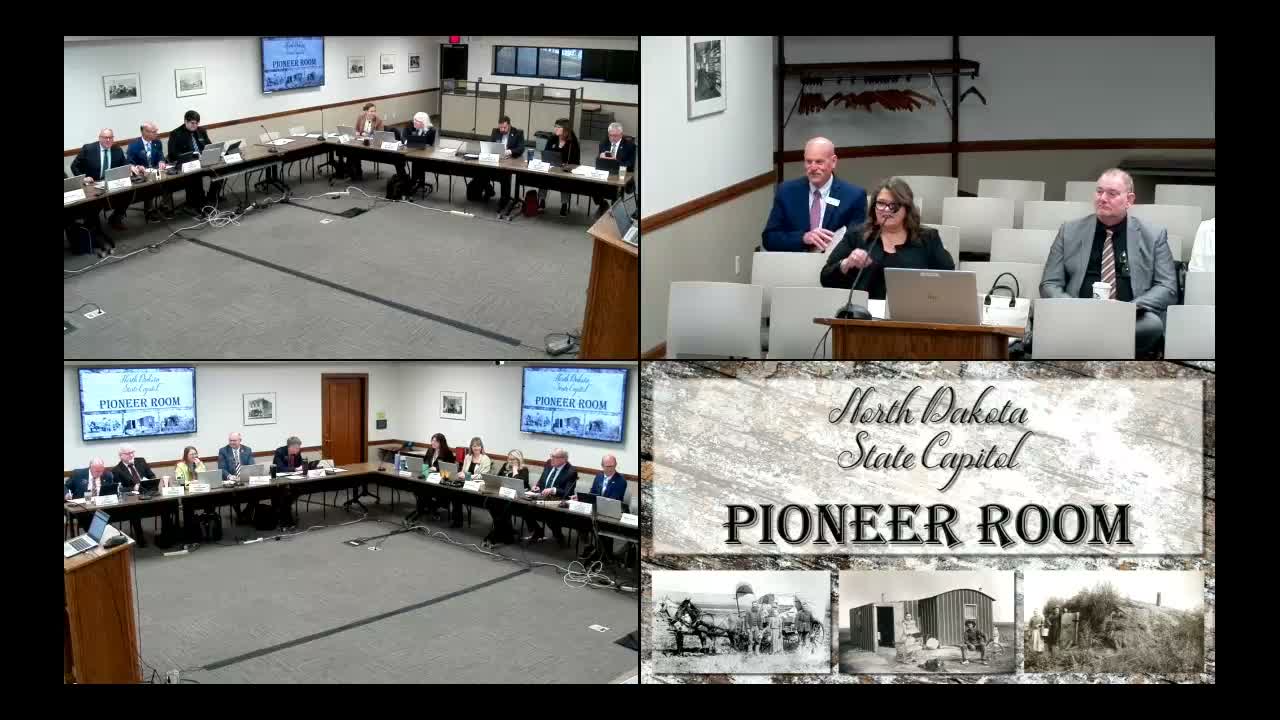
Chair Jonas convened the Interim Education Committee on Oct. 15 to review dual‑credit programs and hear testimony from university leaders, district officials, teachers and the state superintendent.
Valley City State University and Lake Region State College outlined how they train and oversee high‑school instructors who deliver college courses, emphasizing course alignment, shared syllabi and professional development. "These are truly college courses," said Jim, the VCSU dual‑credit lead, noting the institution brought 74 teachers to campus annually for alignment and evaluation and that faculty qualifications typically require a master’s plus 18 graduate credits or approved professional experience.
VCSU reported about 504 unduplicated dual‑credit students in fall and 559 in spring this year, projecting roughly 5,539 completed dual‑credit credits if students do not withdraw. Jim summarized revenue flows: the subsidized tuition rate cited in his presentation was about $92.78 per credit and the higher‑education funding formula reimburses roughly $167 per credit; after overhead VCSU estimated roughly $180,000 net revenue from last year’s dual‑credit activity. "We pay teachers a stipend — roughly $35 per credit — but the funding formula dollars are substantial," he said.
Lake Region State College President Carmen Simone described a roughly even split between online and face‑to‑face delivery at her institution and said Lake Region served about 913 dual‑credit students last fall across 44 districts. She emphasized rural access and that the college invests in building local teacher capacity by paying for graduate credits so high‑school teachers can qualify as adjuncts. "Dual credit is good for students and should not be only for the best and brightest," Simone said.
Fargo Public Schools Superintendent Dr. Corey Steiner, joining virtually, said his district now partners with several institutions to offer 50 dual‑credit courses and reported a 12.6% increase in participation year‑over‑year. He urged more aligned registration and credentialing systems across institutions because inconsistent processes require families and counselors to navigate multiple platforms and deadlines.
Teachers from West Fargo and Drake Anamos shared classroom perspectives. Mike Preston, who has taught dual‑credit anatomy and physiology with NDSCS for nearly two decades, urged careful timing for science sequences to preserve retention. Gene Bartz of Drake Anamos highlighted student testimonials: several former students said dual credit eased the transition to college and accelerated degree progress; the school projects multiple graduates who will complete associate‑level work before high‑school graduation.
Those testimonies framed the toughest policy exchange of the hearing. State Superintendent Levi Bachmeier told the committee he supports expanding dual credit but urged immediate policy fixes. "There is no reason to charge students for subsidized dual‑credit courses," Bachmeier said, arguing that funding‑formula reimbursements (which he described in round numbers as generating several hundred dollars per three‑credit course) already place institutions in a position to provide subsidized courses without assessing families. He called the current patchwork of local agreements opaque and said some state‑board policies limit geographic access for rural districts to certain institutions.
Lawmakers pressed on tradeoffs. Senators and representatives asked whether centralizing dual‑credit delivery would reduce administrative overhead without damaging local partnerships, whether varying institutional reimbursements reflect legitimate cost differences, and how to protect program quality if access expands. Bachmeier acknowledged legitimate institutional costs for administrative overhead and enrollment services but said he has not seen math justifying the current student tuition charge for subsidized offerings and recommended the state board and legislature consider options to increase affordability and transparency.
The committee approved its minutes by voice vote and recessed for a scheduled lunch. Members deferred additional decision items; staff were asked to follow up on funding spreadsheets and on data showing how many dual‑credit students matriculate to North Dakota institutions.
What’s next: the committee’s agenda moves to a separate presentation on school‑improvement coaching (BARR) after the break. The department and university presenters agreed to provide more detailed cost spreadsheets and enrollment breakdowns at future briefings.