Lifetime Citizen Portal Access — AI Briefings, Alerts & Unlimited Follows
Senior electrical engineer Paul Meyer details Ellensburg's electric system and resilience
Loading...
Summary
At an Ellensburg City Council study session, senior electrical engineer Paul Meyer reviewed the city's electric distribution system, explained common outage causes and described feeder and substation switching that staff use to limit customer impact.
Paul Meyer, senior electrical engineer, gave a technical briefing on the City of Ellensburg’s electric distribution system and how staff maintain reliability during outages.
Meyer said the system begins at the city's hydro generation and moves through transformers and substations into distribution lines. "The City of Ellensburg operates at 12,470 volts," he said, describing how power is stepped up for transmission and stepped down at substations for local distribution.
Why it matters: Meyer emphasized that system design and staff procedures — from feeder sizing to coordinated switching between substations — let crews do maintenance and repairs with minimal customer outage. "Our system is quite robust," he said, noting redundancy and the ability to parallel substations to transfer loads.
Meyer gave concrete technical details: the utility operates both 600‑amp feeder conduits and 200‑amp distribution lines, and staff showed installed‑cost examples (about $150 per foot for the 600‑amp conduit and about $75 per foot for the 200‑amp distribution conduit). He explained differences between overhead and underground conductors, pad‑mounted switches and the limits of no‑load knife switches, and how feed‑through and single‑phase transformers serve commercial and residential customers.
On outages, Meyer listed causes and frequency: vehicle strikes on pad‑mounted equipment, equipment failures (cutout or paddle failures), fallen trees, wildlife interference and occasional vandalism. He said dig‑ins by construction equipment are uncommon — "I think we probably get maybe one dig in a year" — and that robust tree‑trimming and redundant feeder routing keep outages infrequent and short.
Meyer also explained customer demarcation: meter bases are customer owned while the meters themselves are utility owned, and large customers such as CWU, Twin City Foods and WinCo use primary metering.
The briefing closed with council questions about damage prevention and how the utility measures the effectiveness of 'call before you dig' (811). Meyer said locates can be ignored or sometimes incorrect, making the overall impact hard to quantify.
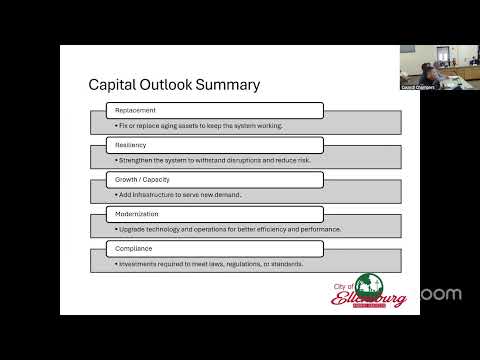
Next steps: staff will continue to present more detailed capital and rate materials later in the meeting and will factor system resilience and replacement needs into those discussions.