Get Full Government Meeting Transcripts, Videos, & Alerts Forever!
Get email alerts on the Construction topic
No spam. Unsubscribe anytime.
Larkspur staff report Rose Lane library is on track; project includes solar, EV charging and resiliency features
Summary
Public works director Julian Skinner told partners the design-build Rose Lane library is roughly halfway through construction and the project budget is about $17.5 million; staff highlighted seismic resilience, solar arrays with battery backup and eight EV chargers (wired for 16).
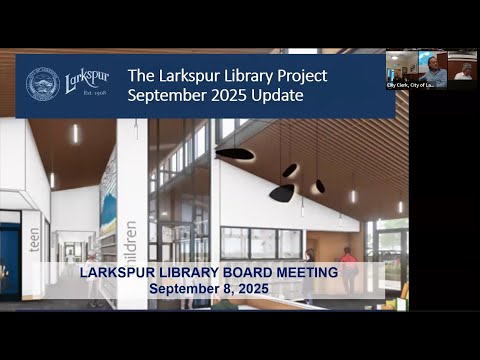
Julian Skinner, Larkspur's public works director, said the city's Rose Lane library project is about six months into construction and that the contractor's completion is projected for March 2026 with an opening targeted for April after punch-list work. "We're about 6 months into construction. There's another 6 months to go," Skinner said.
The building is a design'build project led by Alton Construction, Skinner said, and the city presented a roughly $17,500,000 budget that blends two library grants, support from the Commons Foundation, Measure G and Measure C allocations for resiliency features and general-fund reserves. "All in all, including all the architects and the Alton construction contract, on all our consultants, we're at about 17,500,000.0," he told the group.
Skinner walked the group through the floor plan and key features: a main reading room, four small breakout rooms, a team space, a children's area with a patio and movable shelving that can be reconfigured for programming. He said the library grant constrained the building to a 20,000-title capacity, and the city added a separate community space with city funds to expand programming possibilities.
The building uses a steel frame and, Skinner said, is being built to "risk category 4," which he described as the same structural requirements used for hospitals and other emergency facilities to improve seismic performance. "This is essentially being built to the same structural requirements as a hospital or a shelter so that it will stand a an earthquake," Skinner said.
Staff also described sustainability and resilience investments. The rooftop solar is sized to offset a substantial portion of the facility's electricity use, and a separate solar array will charge batteries to run critical systems (server, essential lights and staff computers) in a power outage. Skinner said the project will open with eight EV charging stations and is wired to add eight more in the future.
Skinner noted certain elements will not be integrated as structural features. On the question of historic stained-glass windows from the current library, he said architects and the builder advised against installing the old windows as working architectural windows. Instead, he said the city is considering treating them as artifacts to be displayed in designated interior wall spaces: "The windows are old. They're not compatible with all of the latest standards, and it's just not a good idea to have those windows be part of the building," Skinner said.
The next public steps are community workshops and continued outreach: Skinner said the project team will host a site walk-through for the public and scheduled additional workshops (including one next Monday and a follow-up on Oct. 7) to gather feedback on reuse of the current library building. The board set its next regular meeting for Oct. 6.
Skinner said the city has posted webcams and produces time-lapse files of construction for public viewing. He encouraged partners and donors to review the project page and said staff are available to answer further questions.