Get Full Government Meeting Transcripts, Videos, & Alerts Forever!
Get email alerts on the Land Use Policy topic
No spam. Unsubscribe anytime.
Carlsbad Planning Commission splits on lifting drive‑through ban; asks staff for more analysis and outreach
Summary
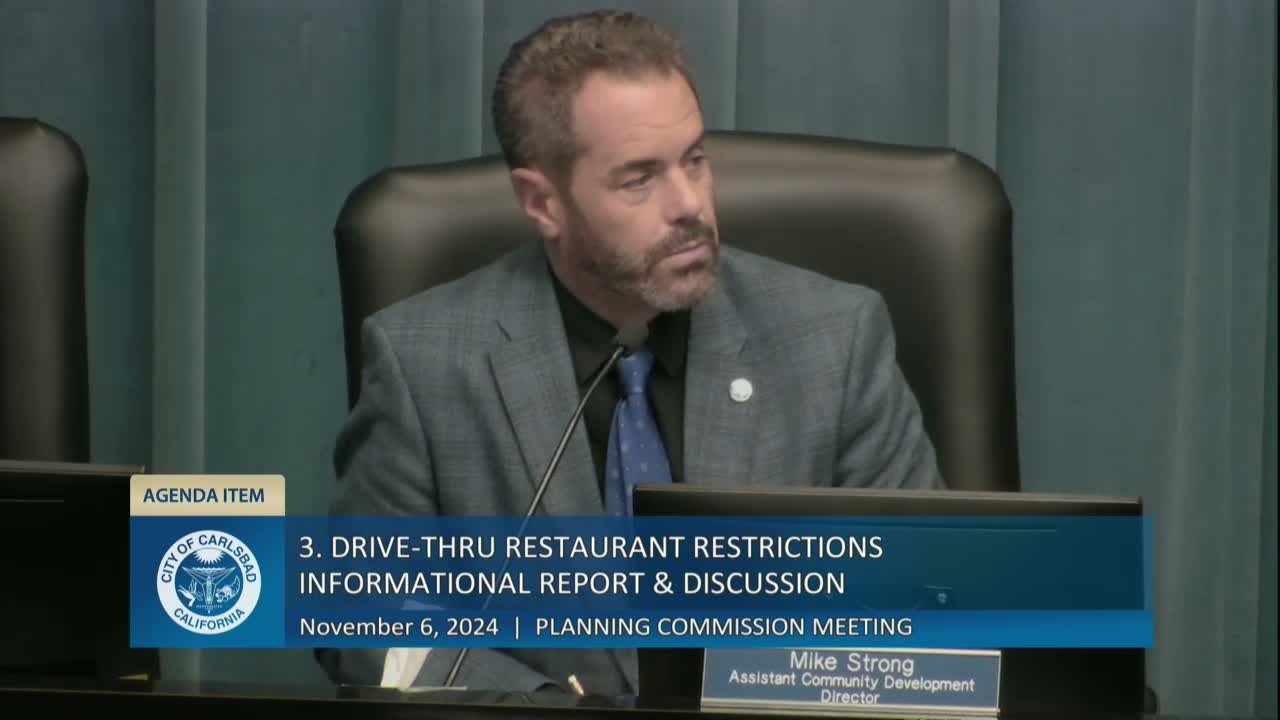
Commissioners and the public debated lifting the citywide ban on new drive‑through restaurants in a lengthy Nov. 6 discussion; the commission took no formal vote and asked staff to report options and public outreach to City Council and the Economic Development Subcommittee.
The Carlsbad Planning Commission heard an informational staff report and extensive public testimony Nov. 6 on whether to lift the city’s 1998 prohibition on new drive‑through restaurants. Staff presented background, the inventory of existing drive‑throughs and a menu of regulatory options — ranging from no additional permitting to administrative or discretionary conditional‑use permit (CUP) review — and asked for commission feedback prior to a council discussion in early 2025.
Associate planner Kyle Van Halouen summarized the ordinance history: after public concerns during the Legoland entitlement period, the city instituted a prohibition in 1998 to limit poorly designed fast‑food development and related impacts. Staff identified up to 12 existing drive‑through locations citywide (including five in the village) and described potential regulatory tools if the prohibition were lifted: standards for queueing distances and minimum separation, hours limits, landscaping and design controls, and different review thresholds (staff, planning commission, council).
Public testimony was split. Brett Schonzenbach, president and CEO of the Carlsbad Chamber of Commerce, urged lifting the ban and establishing an administrative process to allow vetted drive‑throughs to activate long‑vacant commercial pads. He said the change would spur economic activity and added that electric vehicles reduce idling‑related emissions. In contrast, speakers from Preserve Calavera, Sierra Club and Surfrider argued the prohibition has protected walkability, reduced vehicle miles traveled and avoided visual blight; Mitch Silverstein of Surfrider called the 1998 ban “visionary” and urged the commission to retain it to meet climate goals.
Commissioners expressed a range of views: several members (including Commissioners Stein and Hoevinger) favored removing a blanket prohibition and using a CUP process (preferably planning‑commission review) with specific areas off limits; others (including Commissioner Lafferty) favored keeping the prohibition to preserve pedestrian character, especially in village and historic districts. Commissioners asked staff for more detailed mapping of existing drive‑through types (restaurants, pharmacies, banks, gas stations), comparisons with neighboring cities, and expanded public outreach. Staff noted that any ordinance or project approvals would be subject to CEQA review and that policy options could include objective development standards to enable code enforcement remedies.
No motion was made; the commission closed the public hearing and directed staff to record the discussion and provide a summary and options to the City Council and the Economic Development Subcommittee for further study and potential draft code amendments in 2025.